Rotating-Anode X-ray Tube (AQA A Level Physics): Revision Note
Exam code: 7408

Rotating-anode X-ray tube
An X-ray tube is a device that converts an electrical input into X-rays
It is composed of four main components:
a heated cathode
an anode
a metal target
a high voltage power supply
The production of X-rays has many practical uses, such as in:
medical imaging (radiography)
security
industrial imaging
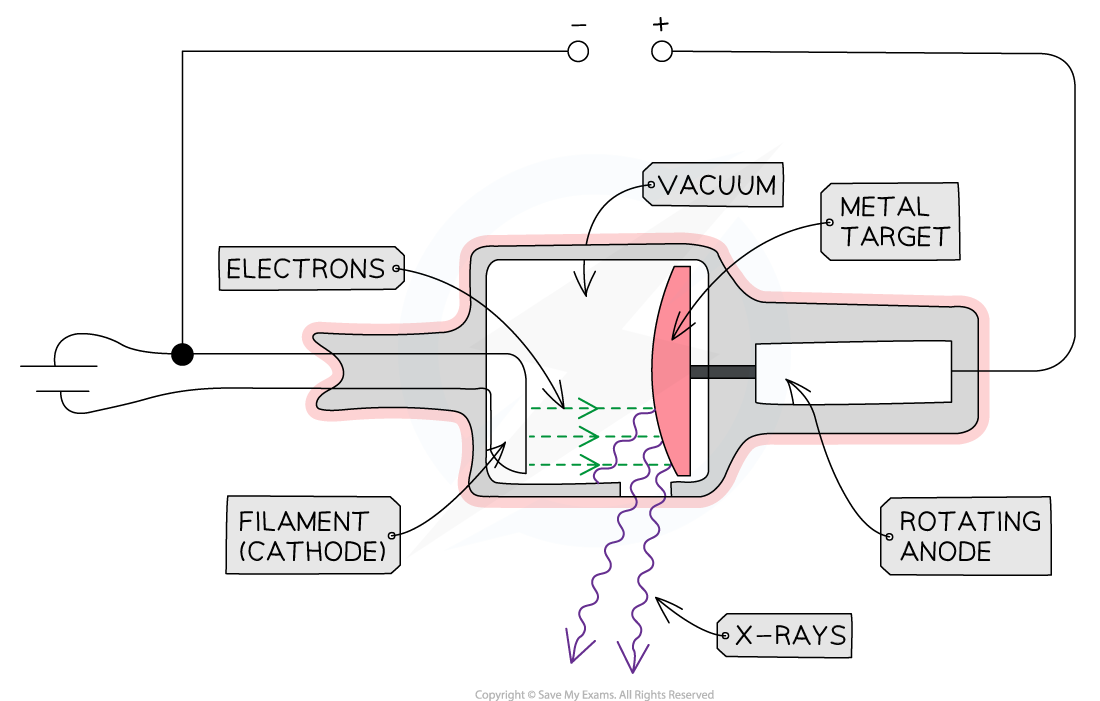
Heated cathode
At one end of the tube is the cathode (negative terminal) which is heated by an electric current
The heat causes electrons to be liberated from the cathode, gathering in a cloud near its surface
This process of thermionic emission is the source of the electrons
Anode
At the other end of the tube, an anode (positive terminal) is connected to the high-voltage supply
This allows the electrons to be accelerated up to a voltage of 200 kV
When the electrons arrive at the anode, they gain a kinetic energy of 200 keV (by the definition of an electronvolt)
Only about 1% of the kinetic energy is converted to X-rays
The rest is converted to heat energy
Therefore, to avoid overheating, the anode is spun at 3000 rpm and sometimes water-cooled
Metal target
When the electrons hit the target at high speed, they lose some of their kinetic energy
This energy is re-emitted as X-ray photons
A heat-resistant block of metal, usually tungsten, is embedded at the end of the anode, facing the cathode
This is the material that the electrons collide with and X-rays are generated in
High voltage power supply
The high voltage supply creates a large potential difference (> 50 kV) between the cathode and the target
This causes electrons in the cloud around the cathode to be accelerated to a high velocity towards the target, which they strike, creating X-rays
Other components
X-rays are produced in all directions, so the tube is surrounded by lead shielding
This is to ensure the safety of the operators and recipients of the X-rays
An adjustable window allows a concentrated beam of X-rays to escape and be controlled safely
The anode and cathode are housed inside a vacuum chamber
This is to ensure that the electrons do not collide with any particles on their way to the metal target

Unlock more, it's free!
Join the 100,000+ Students that ❤️ Save My Exams
the (exam) results speak for themselves:

Was this revision note helpful?
Build on this topic