Angular Impulse (AQA A Level Physics): Revision Note
Exam code: 7408

Angular impulse
In linear motion, the resultant force on a body can be defined as the rate of change of linear momentum:
This leads to the definition of linear impulse:
An average resultant force acting for a time produces a change in linear momentum
Similarly, the resultant torque on a body can be defined as the rate of change of angular momentum:
Where:
= resultant torque on a body (N m)
= change in angular momentum (kg m2 s−1)
= time interval (s)
This leads to the definition of angular impulse:
An average resultant torque acting for a time produces a change in angular momentum
Angular impulse is measured in kg m2 s−1, or N m s
This equation requires the use of a constant resultant torque
If the resultant torque changes, then an average of the values must be used
Angular impulse describes the effect of a torque acting over a time interval
This means a small torque acting over a long time has the same effect as a large torque acting over a short time
Angular impulse on a torque-time graph
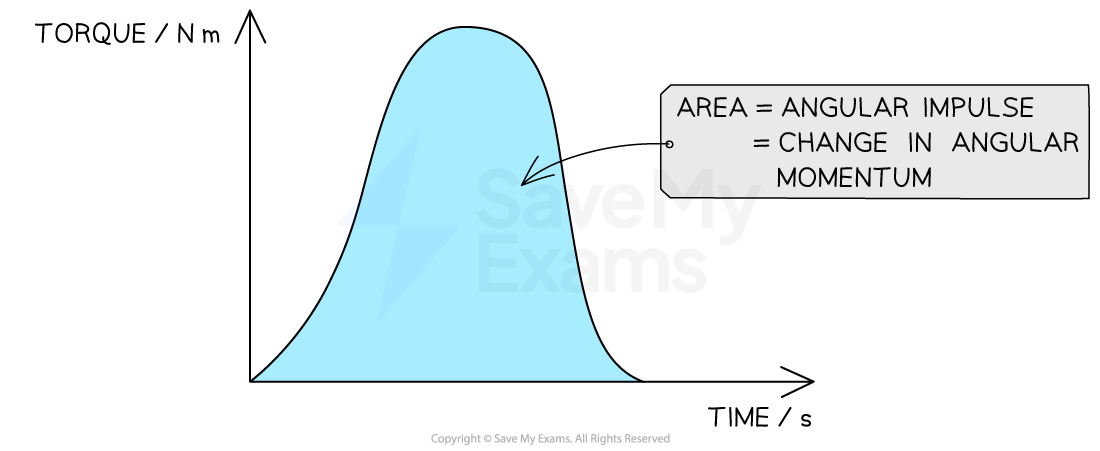
The area under a torque-time graph is equal to the angular impulse or the change in angular momentum
This is because the area, angular impulse, is a fraction of the base × height, torque × time,
The fraction of torque × time depends upon the shape of the area under the graph
Worked Example
The graph shows the variation of time with the net torque on an object which has a moment of inertia of 6.0 kg m2.
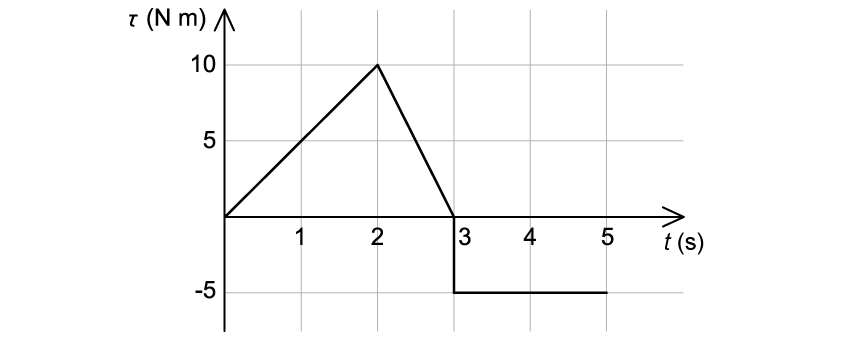
At , the object rotates with an angular velocity of 2.0 rad s−1 clockwise.
Determine the magnitude and direction of rotation of the angular velocity at .
In this question, take anticlockwise as the positive direction.
[4]
Answer:
The area under a torque-time graph is equal to angular impulse, or the change in angular momentum
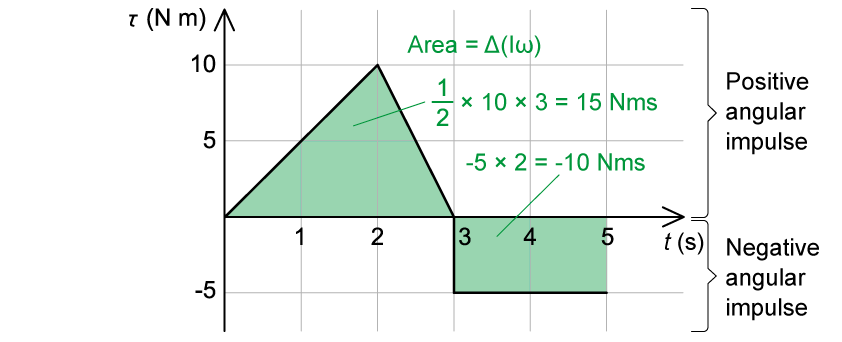
The area under the positive curve (triangle) =
The area under the negative curve (rectangle) = [1 mark]
Therefore, the overall change in angular momentum is
[1 mark]
The change in angular momentum is equal to
Where:
Moment of inertia,
Initial angular velocity, (clockwise is the negative direction)
Therefore, when , the angular velocity is
[1 mark]
Anti-clockwise is positive, so in the clockwise direction [1 mark]
Examiner Tips and Tricks
You'll find that many applications of angular impulse are related to sports. They work in the same way as the linear impulse topic.

Unlock more, it's free!
Join the 100,000+ Students that ❤️ Save My Exams
the (exam) results speak for themselves:

Was this revision note helpful?
Build on this topic