Uniform Electric Field (AQA A Level Physics): Revision Note
Exam code: 7408

Uniform Electric Field Strength
The magnitude of the electric field strength in a uniform field between two charged parallel plates is defined as:
Where:
E = electric field strength (V m−1)
V = potential difference between the plates (V)
d = separation between the plates (m)
Note: both units for electric field strength, V m−1 and N C−1, are equivalent
The equation shows:
The greater the voltage between the plates, the stronger the field
The greater the separation between the plates, the weaker the field
This equation cannot be used to find the electric field strength around a point charge
This is because the field around a point charge is radial
The electric field between two plates is directed:
From the positive plate (i.e. the one connected to the positive terminal)
To the negative plate (i.e. the one connected to the negative terminal)
Uniform Electric Field Between two Parallel Plates
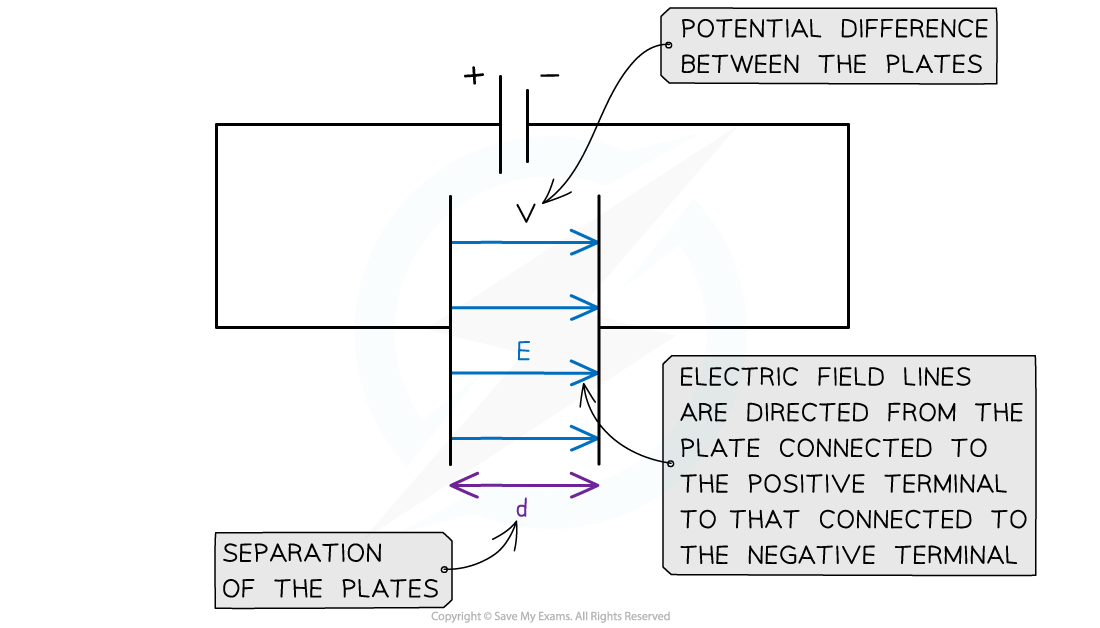
The electric field strength between two charged parallel plates is the ratio of the potential difference and separation of the plates
Worked Example
Two parallel metal plates separated by 3.5 cm have a potential difference of 7.9 kV between them.
Calculate the electric force acting on a point charge of 2.6 × 10⁻¹⁵ C when placed between the plates.
Answer:
Step 1: List the known quantities
Potential difference between plates, V = 7.9 kV = 7900 V
Distance between plates, d = 3.5 cm = 0.035 m
Charge, Q = 2.6 × 10⁻¹⁵ C
Step 2: Equate the equations for electric field strength
E field between parallel plates:
E field on a point charge:
Step 3: Rearrange the expression for electric force F
Step 4: Substitute values to calculate the force on the point charge
N (2 s.f.)
Examiner Tips and Tricks
Remember the equation for electric field strength with V and d is only valid for parallel plates, and not for point charges
However, when a point charge moves between two parallel plates, the two equations for electric field strength can be equated:
Top tip: if one of the parallel plates is earthed, it has a voltage of 0 V
Derivation of Electric Field Strength Between Plates
When two points in an electric field have a different potential, there is a potential difference between them
To move a charge across that potential difference, work needs to be done
Two parallel plates with a potential difference V across them create a uniform electric field
The electric field strength between the plates is given by the equations:
Rearranging the fractions by multiplying by Q and d on both sides, gives:
When a charge Q moves from one plate to the other, the work done on the charge by the field is
Where:
W = work done on charge (J)
F = electrostatic force (N)
d = distance between plates (m)

The work done on the charge depends on the electric force and the distance between the plates
Therefore, the work done in moving a charge Q through a potential difference V between parallel plates is also given by:
Worked Example
Calculate the electrostatic force on an electron between two parallel plates 20 cm apart and have a potential difference of 400 V applied between them.
Answer:
Step 1: List the known quantities
Potential difference, V = 400 V
Distance between plates, d = 20 cm = 0.2 m
Charge of an electron, Q = 1.60 × 10⁻¹⁹ C
Step 2: Write an expression for the electrostatic force between two parallel plates
Step 3: Substitute the values into the expression
N

Unlock more, it's free!
Join the 100,000+ Students that ❤️ Save My Exams
the (exam) results speak for themselves:

Was this revision note helpful?
Build on this topic