Newton's Law of Gravitation (AQA A Level Physics): Revision Note
Exam code: 7408

Newton's law of gravitation
The gravitational force between two bodies outside a uniform field, e.g. between the Earth and the Sun, is defined by Newton’s law of gravitation
Newton’s law of gravitation states that:
The gravitational force between two point masses is proportional to the product of the masses and inversely proportional to the square of their separation
In equation form, this can be written as:
Where:
= gravitational force between two masses (N)
= Newton’s gravitational constant
and = the two point masses (kg)
= distance between the centre of the two masses (m)
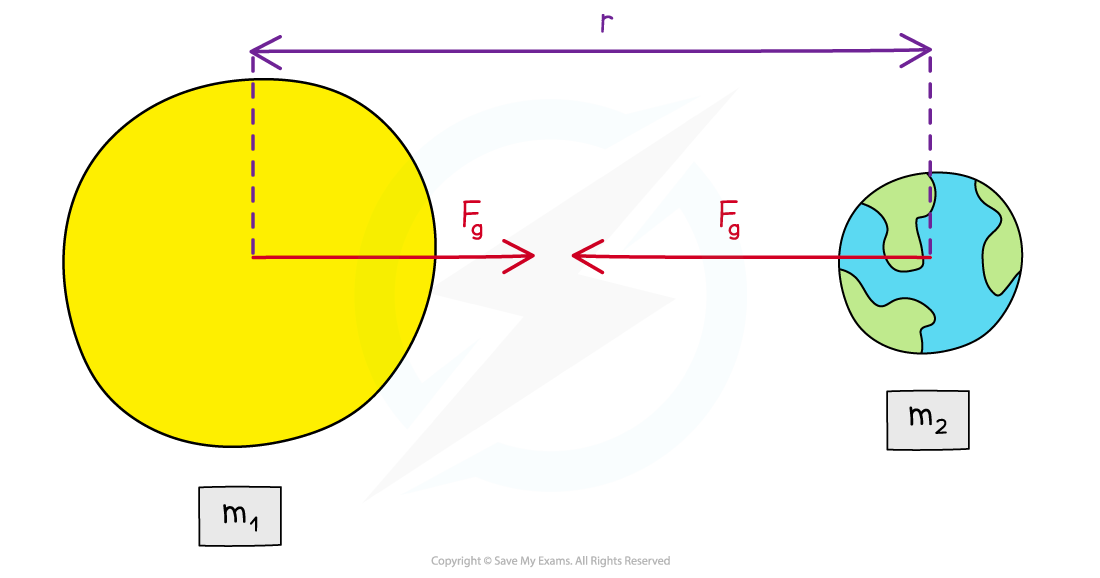
Newton’s law of gravitation applies to orbiting bodies, e.g. planets orbiting the Sun
Although stars and planets are very large, they can be considered to be point masses as:
they are approximately uniform spheres
their separation is much larger than their radii
The relation is called the inverse square law
This means that when a mass is twice as far away from another, the gravitational force reduces by a quarter, i.e.
Worked Example
A satellite of mass 6500 kg is orbiting the Earth at 2000 km above the Earth's surface. The gravitational force between them is 37 kN.
Calculate the mass of the Earth.
Radius of the Earth = 6400 km.
[3]
Answer:
Step 1: List the known quantities
Mass of satellite,
and can be either way around
Distance of satellite above Earth's surface = 2000 km
Gravitational force,
Radius of Earth = 6400 km
Step 2: State the equation for Newton's law of gravitation and rearrange for the mass of the Earth
Step 3: Calculate the distance,
is the distance between the centre of the Earth and the satellite
= distance of satellite above Earth's surface + radius of Earth

[1 mark]
Step 4: Substitute the known values into Newton's law of gravitation to calculate the mass of the Earth
[1 mark]
[1 mark]
Examiner Tips and Tricks
A common mistake is to forget to add together the distance from the surface of the planet and its radius when you work out . The distance is measured from the centre of the mass, which is from the centre of the planet.

Unlock more, it's free!
Join the 100,000+ Students that ❤️ Save My Exams
the (exam) results speak for themselves:

Was this revision note helpful?
Build on this topic