p–V Diagrams (AQA A Level Physics): Revision Note
Exam code: 7408

p–V Diagrams
When a gas expands, it does work on its surroundings by exerting pressure on the walls of the container it's in
For a gas inside a piston, the force exerted by the gas pushes the piston outwards
As a result, work is done by the gas when the piston expands the volume of the gas
Alternatively, if an external force is applied to the piston, the gas will be compressed
In this case, work is done on the gas when the piston compresses the gas
Gas pushed in a piston
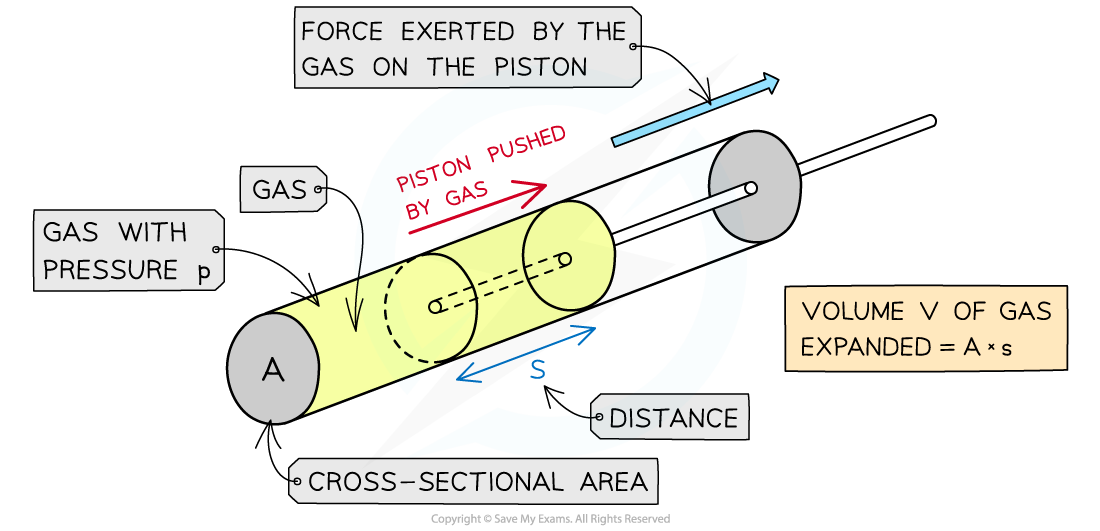
The expansion of the gas does work on the piston by exerting a force over a distance, s
The work done when the volume of a gas changes at constant pressure is:
Where:
W = work done (J)
p = pressure of the gas (Pa)
ΔV = change in the volume of the gas (m3)
This equation assumes that the surrounding pressure does not change as the gas expands
This is true if the gas is expanding against the pressure of the atmosphere, which changes very slowly
p-V diagrams
Pressure-volume (p-V) diagrams are often used to represent changes in the state of a gas in thermodynamic processes
Gas expanding and compressing in a cylinder by a piston
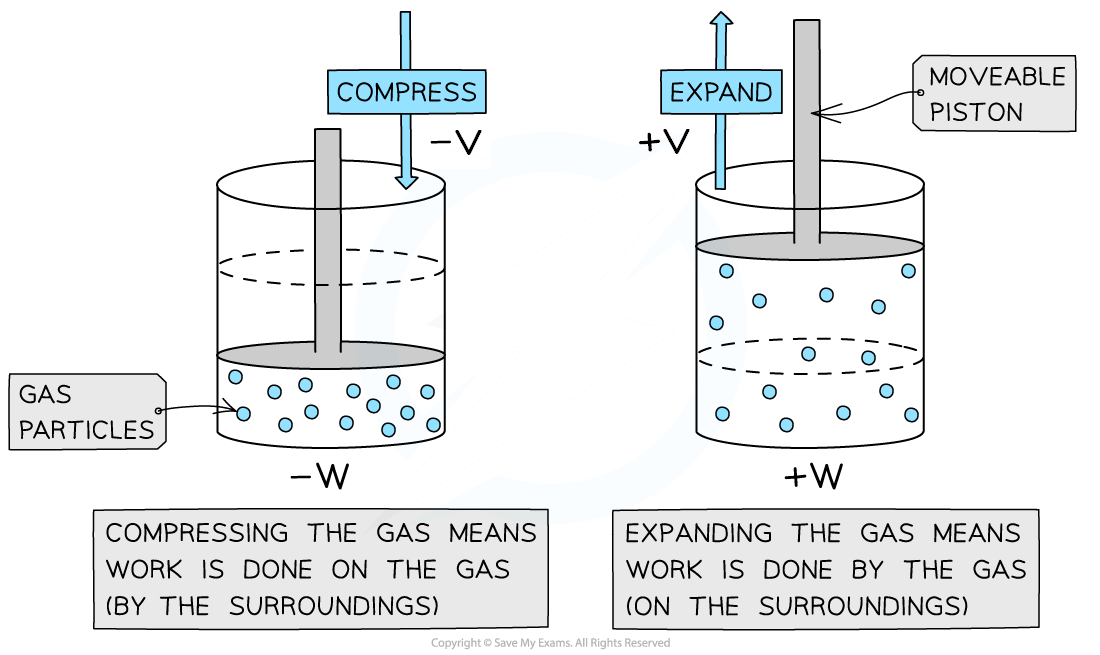
Positive or negative work done depends on whether the gas is compressed or expanded
The area under a p–V diagram tells us how much work is done
When a gas expands (at constant pressure) work done is positive
Volume increases +ΔV
Work is done by the gas +W

When a gas is compressed (at constant pressure) work done W is negative
Volume decreases −ΔV
Work is done on the gas −W

When both the volume and pressure of gas changes
The work done can be determined from the area under a p-V diagram
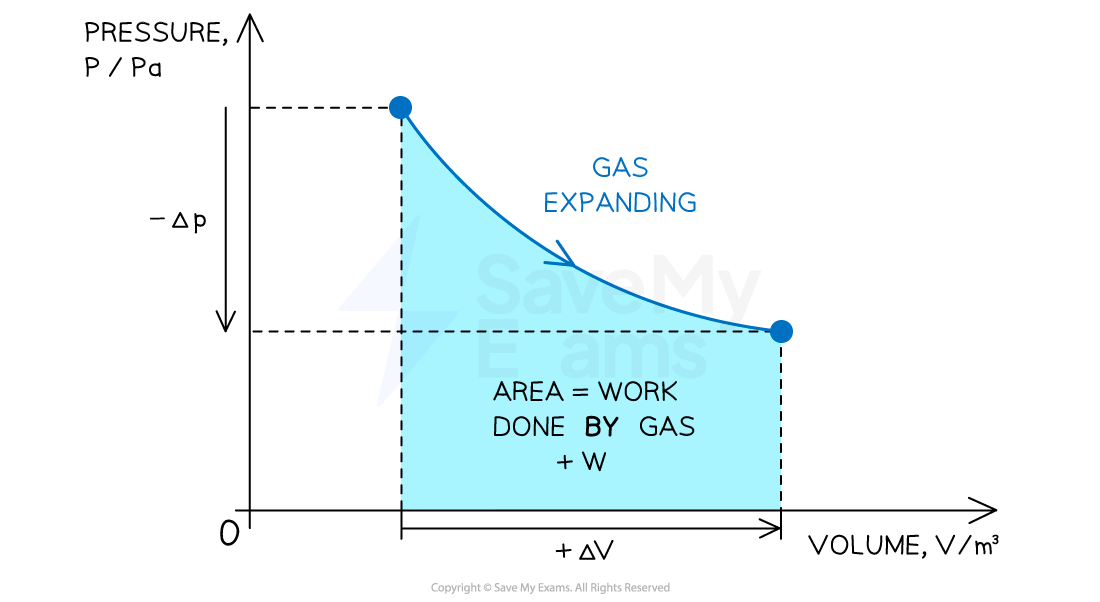
In the context of engines, these are referred to as indicator diagrams
Worked Example
When a balloon is inflated, its rubber walls push against the air around it.
Calculate the work done when the balloon is blown up from 0.015 m3 to 0.030 m3.
Atmospheric pressure = 1.0 × 10⁵ Pa.
Answer:
The work done by a gas is equal to
Where the change in volume is
ΔV = final volume − initial volume = 0.030 − 0.015 = 0.015 m3
Therefore, work done is
W = (1.0 × 105) × 0.015 = 1500 J
Worked Example
An ideal gas is compressed, as shown on the graph below.

(a) For this change, state and explain whether work is done on the gas or by the gas
(b) Determine the value of the work done and state whether it is positive or negative
Answer:
Part (a)
The volume decreases, therefore, work is done on the gas
Part (b)
The work done is equal to the area under the p-V diagram
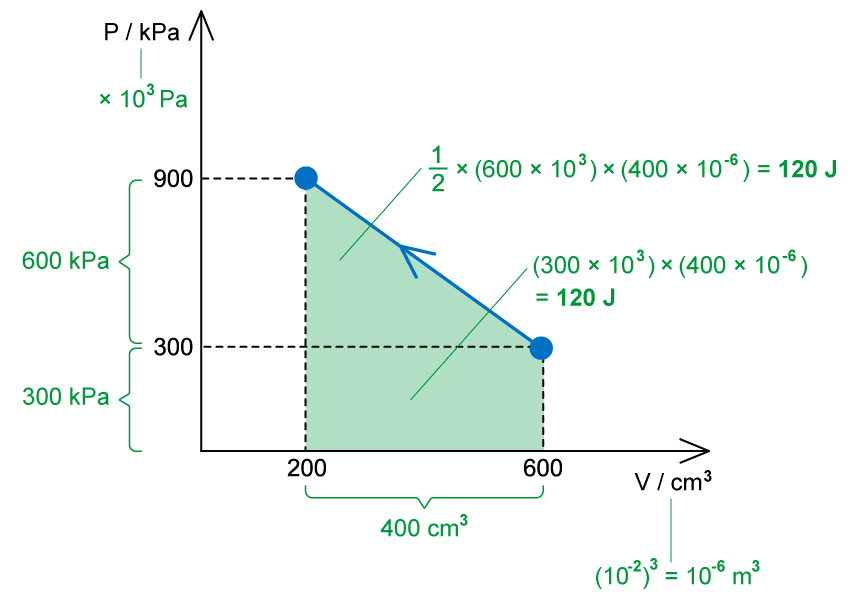
Work done on the gas, W = 240 J
Examiner Tips and Tricks
Interpreting p-V diagrams is a very important part of Thermodynamics. Questions linked to the ideal gas equation, or might also be involved.

Unlock more, it's free!
Join the 100,000+ Students that ❤️ Save My Exams
the (exam) results speak for themselves:

Was this revision note helpful?
Build on this topic