Relativistic Energy (AQA A Level Physics): Revision Note
Exam code: 7408

Relativistic Energy
Relativistic Kinetic Energy
We know that an object in motion relative to an observer has energy E = (γm0)c2 and its rest energy is E0 = m0c2
The kinetic store is the energy store associated with motion
If an object in motion has a total energy E which is greater than its rest mass E0, the additional energy must be in the kinetic store
Where:
Ek is energy in the kinetic store
m is relativistic mass
m0 is the object's rest mass
c is the speed of light
This can be rearranged for an expression for the total energy, E, of a particle:
The total energy of an object increases at a rapidly increasing rate as it's speed approaches the speed of light
Graph showing how total energy increases as an object's speed approaches the speed of light
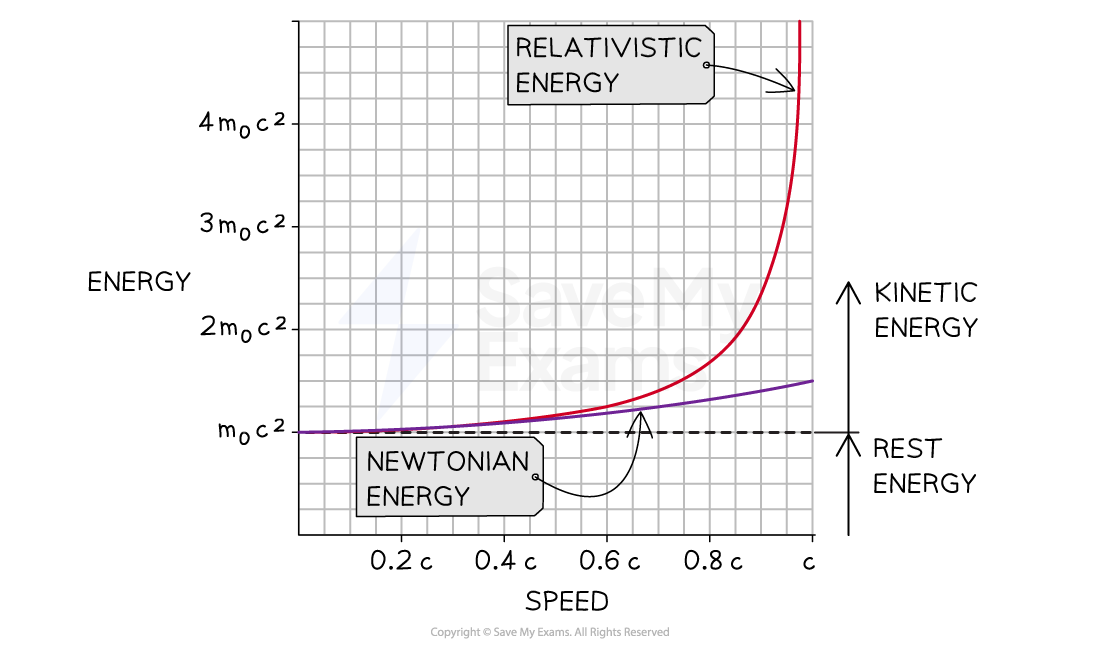
As with mass on the previous page, the asymptote on this graph shows that an infinite amount of energy is needed to make an object with mass reach the speed of light
Worked Example
A spacecraft with a proper mass of 450 kg accelerates to a speed of 0.7c. Calculate the difference in its relativistic kinetic energy and its kinetic energy calculated using Newtonian physics.
Answer:
Step 1: List the known quantities:
Rest mass, m0 = 450 kg
Speed, v = 0.7c
Speed of light, c = 3.0 × 10⁸ ms-1
Step 2: List the relevant equations:
Newtonian kinetic energy, Ekn = ½m0v2
Relativistic kinetic energy, Ekr = γm0c2 − m0c2
Step 3: Calculate the Newtonian kinetic energy:
Substitute the known quantities:
Step 4: Calculate the gamma term:
Substitute the speed into the gamma term:
Step 5: Substitute the gamma term into the relativistic kinetic energy equation:
Substitute the rest mass, speed of light and speed as well:
Step 6: Calculate the difference between the two kinetic energies:
Subtract the smaller Newtonian kinetic energy from the larger relativistic energy
As you can see, the relativistic kinetic energy is almost twice as large as the Newtonian kinetic energy!

Unlock more, it's free!
Join the 100,000+ Students that ❤️ Save My Exams
the (exam) results speak for themselves:

Was this revision note helpful?
Build on this topic
