Linear Momentum (AQA A Level Physics): Revision Note
Exam code: 7408

Linear momentum
When an object with mass is in motion and therefore has a velocity, the object also has momentum
Linear momentum is the momentum of an object that is moving in only one dimension
The linear momentum of an object remains constant unless the system is acted upon by an external resultant force
Momentum is defined as the product of mass and velocity
Where:
= momentum, measured in kg m s−1
= mass, measured in kg
= velocity, measured in m s−1
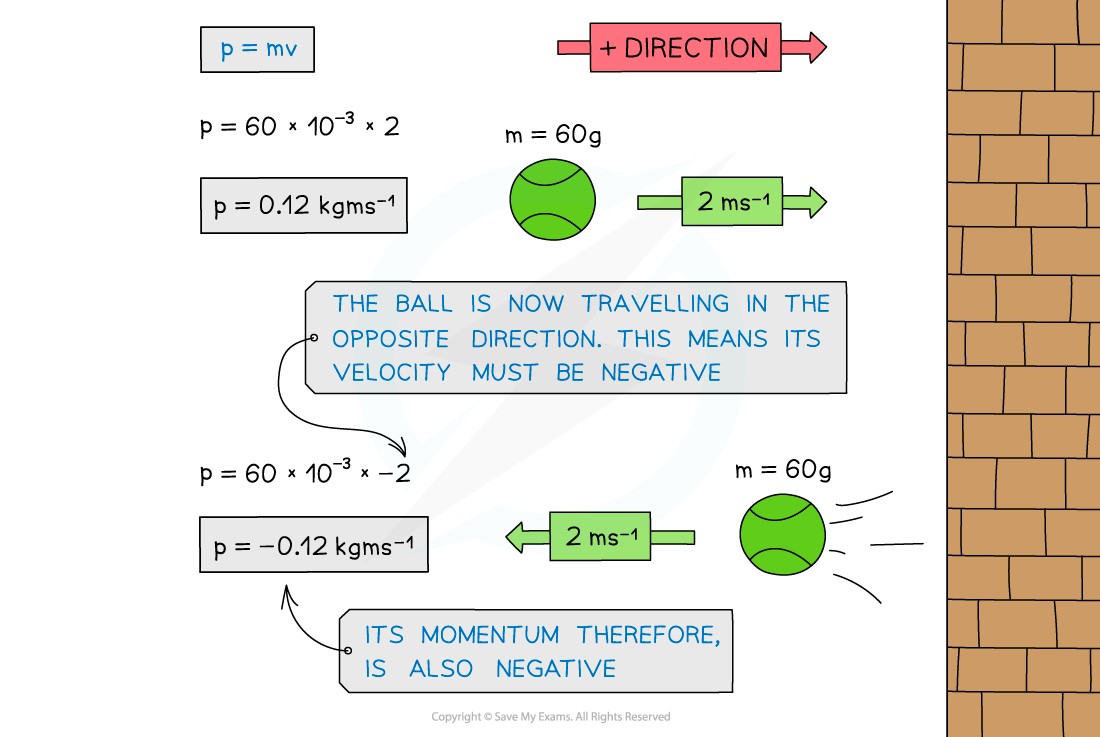
Momentum is a vector quantity with both magnitude and direction
The initial direction of motion is usually assigned the positive direction
Worked Example
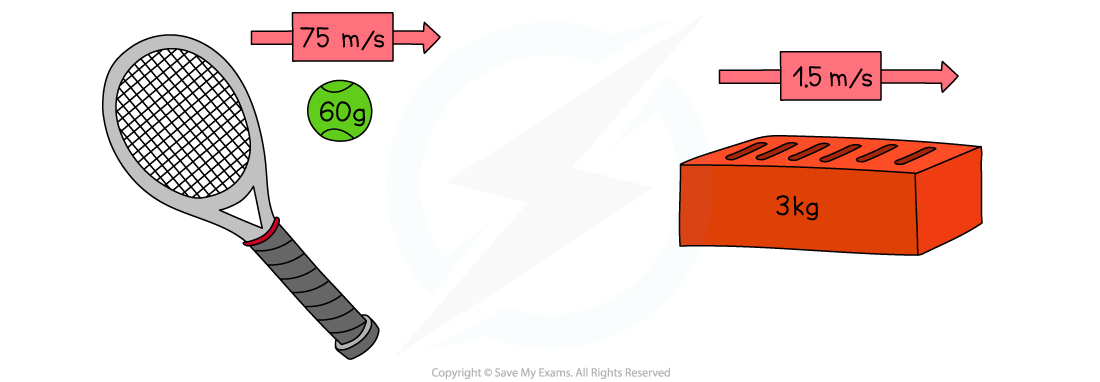
A tennis ball of mass 60 g travels to the right with a speed of 75 m s−1.
A brick of mass 3 kg is thrown to the right at a speed of 1.5 m s−1.
Determine which object has the greatest momentum.
[2]
Answer:
Step 1: Calculate the momentum of the tennis ball
Step 2: Calculate the momentum of the brick
[1 mark]
Step 3: Compare the momentum of each object
Both the tennis ball and the brick have the same momentum [1 mark]
Even though the brick is much heavier than the ball, the ball is travelling much faster than the brick
This means that on impact, they would both exert a similar force (depending on the time it takes for each to come to rest)
Examiner Tips and Tricks
Since the SI units for momentum are kg m s−1:
If the mass is given in grams, you need to convert to kg by dividing the value by 1000
If the velocity is given in km s−1, you need to convert to m s−1 by multiplying the value by 1000
The direction you consider positive is your choice, as long as the signs of the numbers (positive or negative) are consistent with this throughout the question

Unlock more, it's free!
Join the 100,000+ Students that ❤️ Save My Exams
the (exam) results speak for themselves:

Was this revision note helpful?
Build on this topic