Production of X-rays (AQA A Level Physics): Revision Note
Exam code: 7408

Production of X-rays
When the fast-moving electrons collide with the target, X-rays are produced by one of two methods:
Method 1: Bremsstrahlung
Method 2: Characteristic Radiation
Method 1: Bremsstrahlung
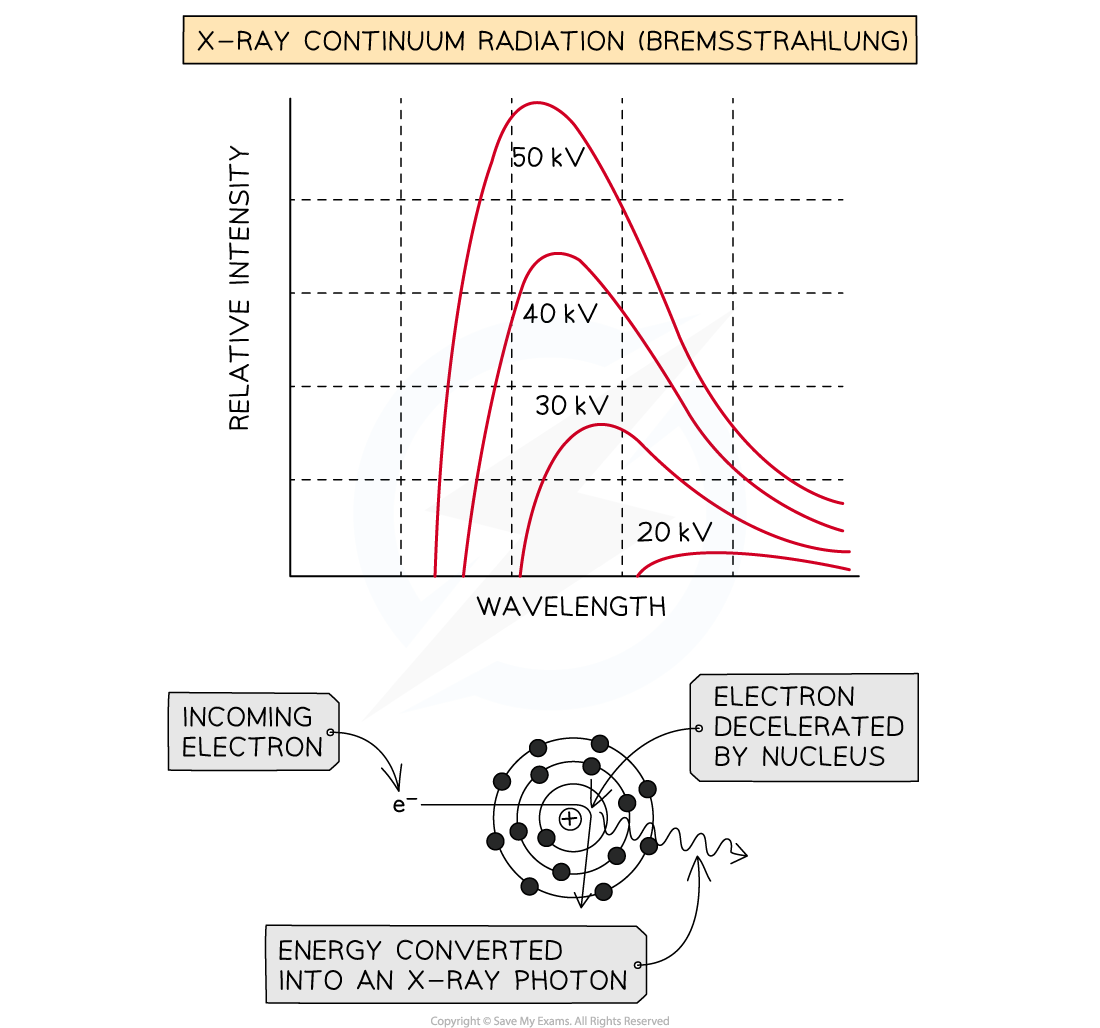
When high-speed electrons collide with a metal target (often tungsten), they undergo a steep deceleration
When a charged particle decelerates quickly, some of the energy released is converted into a photon
A small amount of the kinetic energy (~ 1%) from the incoming electrons is converted into X-rays as the electrons decelerate in the tungsten, due to conservation of energy
The rest of the energy heats up the anode, which usually requires some form of cooling
The energy of the X-ray photon can be of any value, up to the original kinetic energy of the electron, giving a range of possible X-ray energies
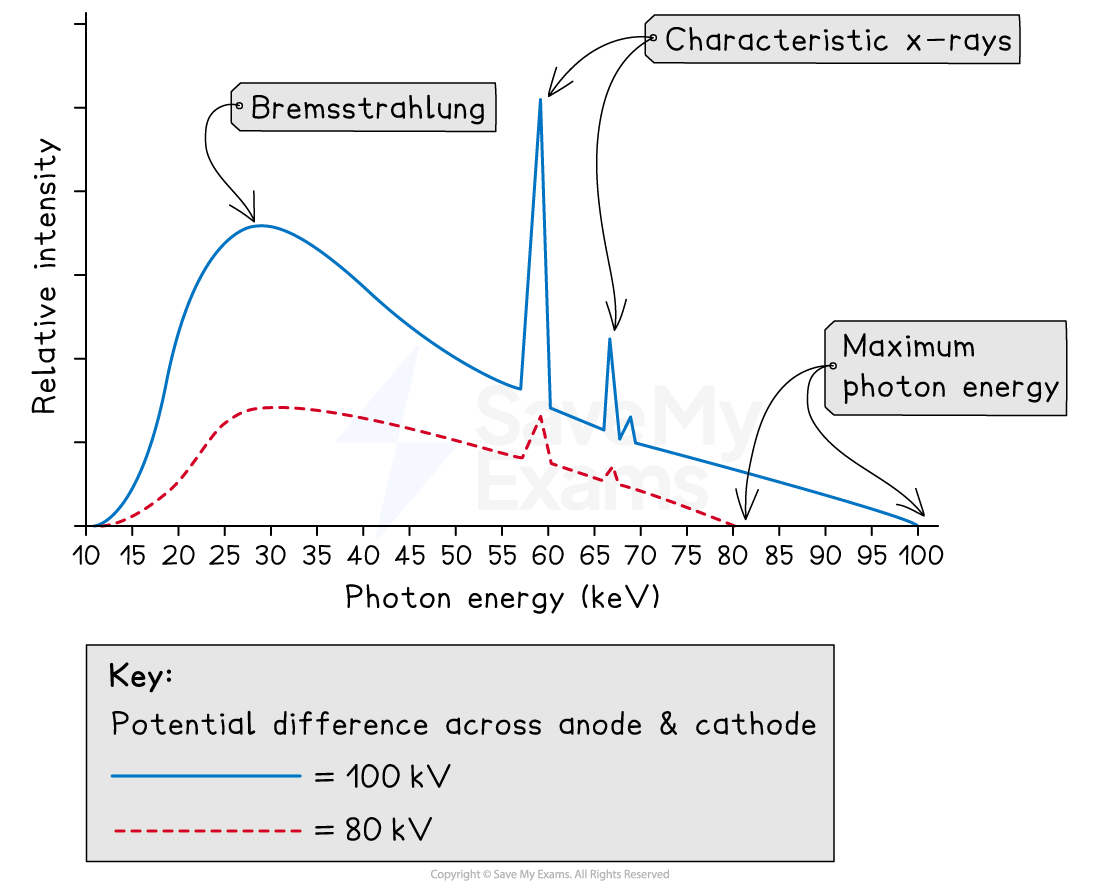
These X-rays cause the continuous or ‘smooth hump shaped’ line on an intensity wavelength graph
Ranges of wavelengths in Bremsstrahlung radiation
When an electron is accelerated, it gains energy equal to the product of its charge and the accelerating potential,
This energy can be calculated using:
This is the maximum energy that an X-ray photon can have
The smallest possible wavelength is equivalent to the highest possible frequency and therefore, the highest possible energy
This is assuming all of the electron’s kinetic energy has turned into electromagnetic energy
Therefore, the maximum X-ray frequency , or the minimum wavelength , that can be produced is calculated using the equation:
The maximum X-ray frequency, , is therefore equal to:
The minimum X-ray wavelength, , is therefore equal to:
Where:
= elementary charge (C)
= potential difference between the anode and cathode (V)
= Planck's constant (J s)
= the speed of light (m s−1)
Method 2: Characteristic radiation
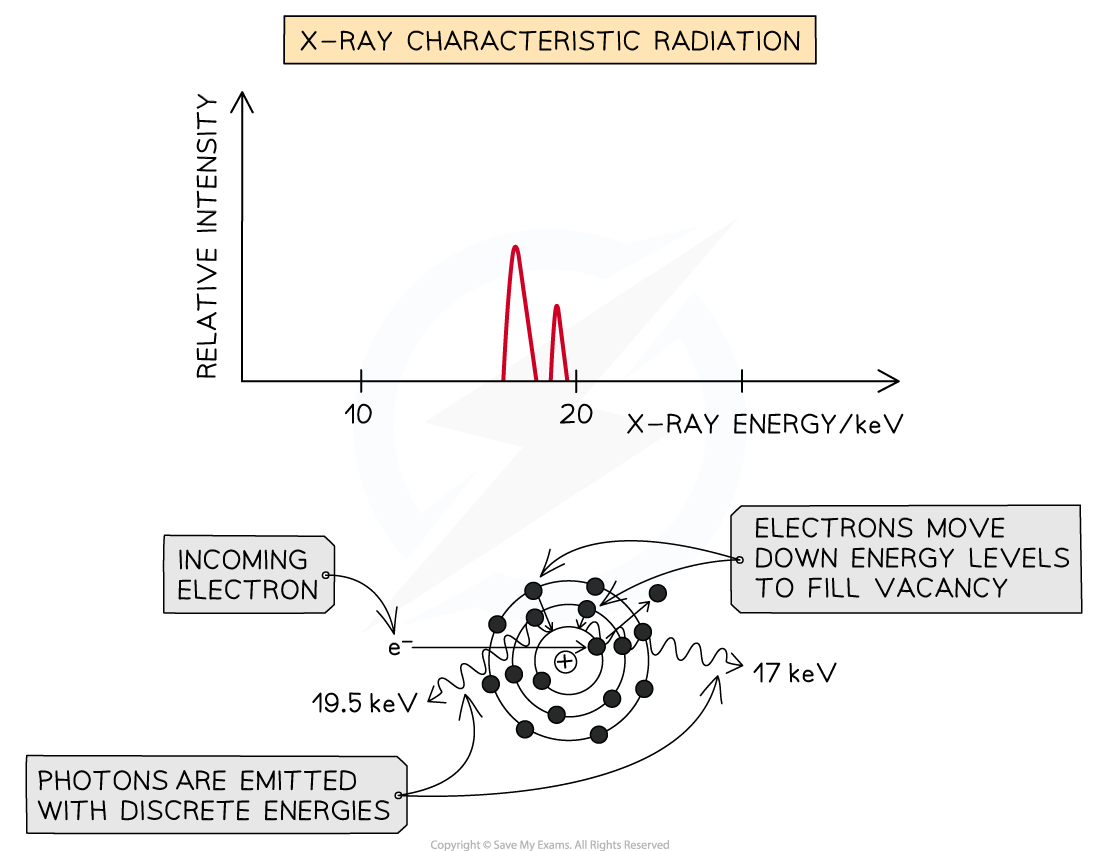
Some of the incoming fast electrons cause inner shell electrons of the tungsten to be ‘knocked out’ of the atom, leaving a vacancy
This vacancy is filled by an outer electron moving down and releasing an X-ray photon as it does (equal in energy to the difference between the two energy levels)
Because these X-rays are caused by energy level transitions, they have only specific discrete energies
They cause sharp spikes on an intensity wavelength graph
The number of spikes depends on the element used for the target - there are two sets of spikes for a tungsten target, representing two sets of possible energy transitions
Characteristic discrete X-Ray wavelengths
Combined X-Ray spectra of Bremsstrahlung and characteristic photons
Worked Example
X-rays are a type of electromagnetic wave with wavelengths in the range 10−8 to 10−13 m
If the accelerating potential difference in an X-ray tube is 60 kV, determine if the photons emitted fall within this range.
[3]
Answer:
Step 1: Write out known quantities
Charge on an electron,
Accelerating potential difference,
Planck’s constant,
Speed of light,
Step 2: Determine the maximum possible energy of a photon
The maximum possible energy of a photon corresponds to the maximum energy an electron could have:
Step 3: Determine an expression for minimum wavelength
Planck relation:
Wave equation:
When energy is a maximum:
Maximum energy corresponds to a minimum wavelength:
Rearrange for minimum wavelength, :
Step 4: Calculate the minimum wavelength
[1 mark]
[1 mark]
Step 5: Comment on whether this is within the range for the wavelength of an X-ray
X-ray wavelengths are within 10−8 to 10−13 m
The minimum wavelength for a 60 kV supply is 2.1 × 10⁻¹¹ m, which means the photons produced will be X-rays [1 mark]
Worked Example
A typical spectrum of the X-ray radiation produced by electron bombardment of a metal target is shown below.
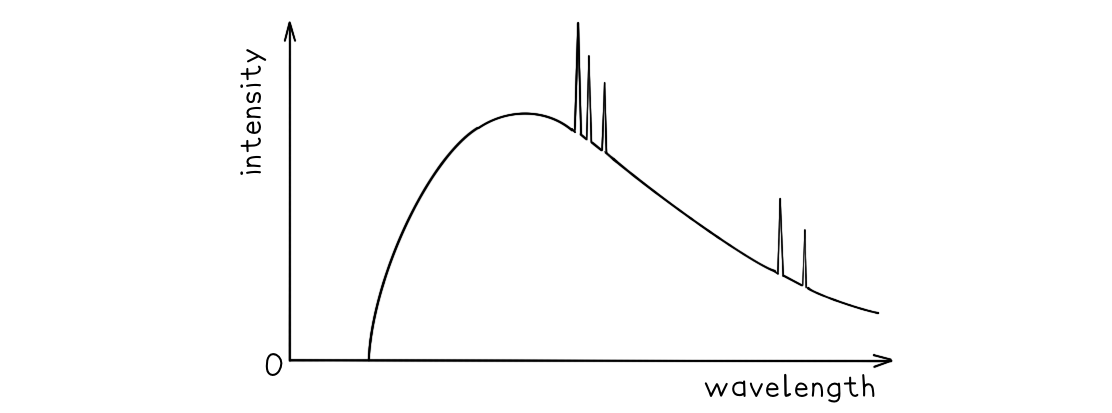
Explain why:
(a) A continuous spectrum of wavelengths is produced. [2]
(b) The gradient is steeper at shorter wavelengths. [2]
(c) The spectrum has a sharp cut-off at short wavelengths. [2]
Answer:
Part (a)
Step 1: Consider the path of the electrons from the cathode to the anode
Photons are produced whenever a charged particle undergoes a large acceleration or deceleration
X-ray tubes fire high-speed electrons at a metal target
When an electron collides with the metal target, it loses energy in the form of an X-ray photon as it decelerates [1 mark]
Step 2: Consider the relationship between the energy of the electron and the wavelength of the photon
The wavelength of a photon depends on the energy transferred by a decelerating electron
The electrons don't all undergo the same deceleration when they strike the target
This leads to a distribution of energies, hence, a range, or continuous spectrum, of wavelengths is observed [1 mark]
Part (b)
Step 1: Identify the significance of the intensity
The intensity of the graph signifies the proportion of photons produced with a specific energy, or wavelength
The higher the intensity, the more photons of a particular wavelength are produced
In other words, the total intensity is the sum of all the photons with a particular wavelength [1 mark]
Step 2: Explain the shape of the graph
When a single electron collides with the metal target, a single photon is produced
Most electrons only give up part of their energy, and hence there are more X-rays produced at wavelengths higher than the minimum (or energies lower than the maximum)
At short wavelengths, there is a steeper gradient because only a few electrons transfer all, or most of, their energy [1 mark]
Part (c)
Step 1: Identify the relationship between minimum wavelength and maximum energy
The minimum wavelength of an X-ray is equal to
The equation shows the maximum energy of the electron corresponds to the minimum wavelength, they are inversely proportional
Therefore, the higher the energy of the electron, the shorter the wavelength of the X-ray produced [1 mark]
Step 2: Explain the presence of the cut-off point
The accelerating voltage determines the kinetic energy which the electrons have before striking the target
The value of this accelerating voltage, therefore, determines the value of the maximum energy
This corresponds to the minimum, or cut-off, wavelength [1 mark]

Unlock more, it's free!
Join the 100,000+ Students that ❤️ Save My Exams
the (exam) results speak for themselves:

Was this revision note helpful?
Build on this topic