Collecting Power of Telescopes (AQA A Level Physics): Revision Note
Exam code: 7408

Collecting Power
Telescopes are designed to gather as much light as possible
The more light energy a telescope can gather, the brighter the images it will be able to produce
This can be measured by a telescope's collecting power
The collecting power of a telescope is defined as:
A measure of the amount of light energy it collects per second
This is equivalent to the power per unit area, or intensity of the incident radiation collected
Differences in Collecting Power
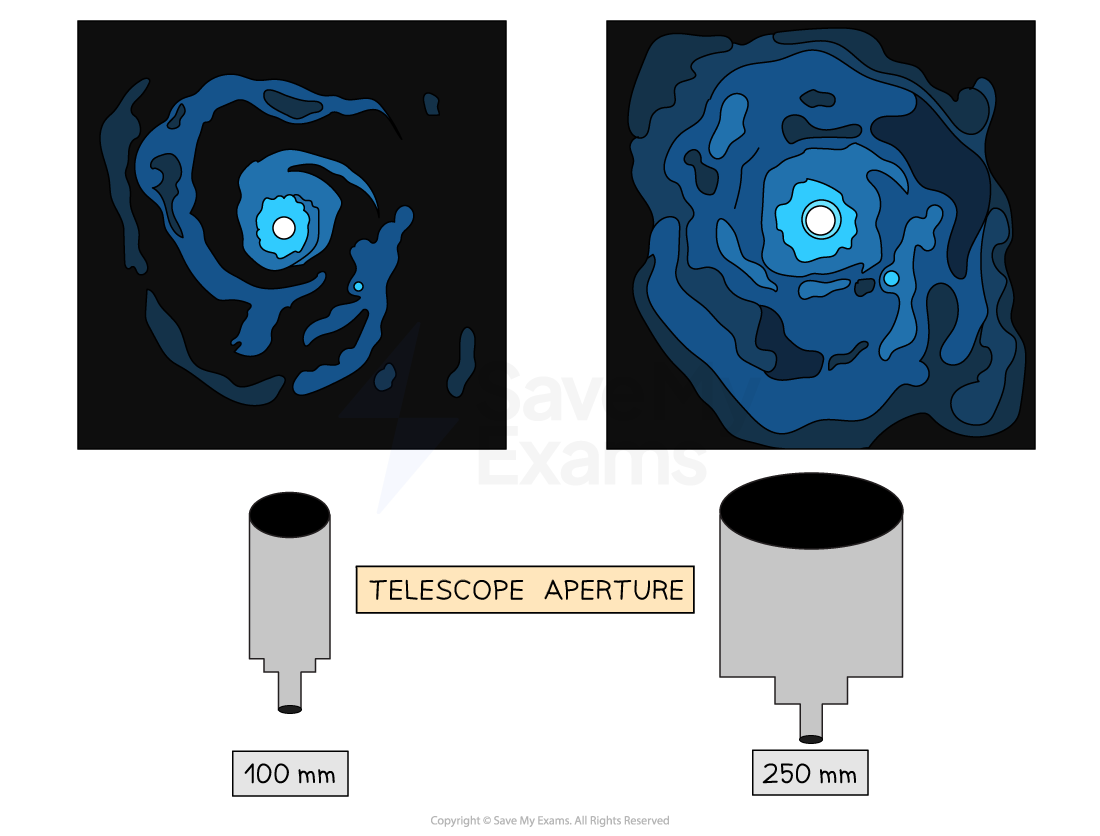
The telescope with the larger aperture is able to produce a brighter image
The collecting power of a telescope is directly proportional to the square of the diameter of its objective
This is because:
Intensity is proportional to surface area
The surface area of a circular object of diameter D is equal to
This means that objects at greater distances can also be seen
The intensity of light from a point source decreases inversely with the square of the distance according to the inverse square law
Large Diameter Telescopes
Larger aperture diameter telescopes are advantageous for two main reasons:
They have a greater collecting power, so images are brighter
They have a greater resolving power, so images are clearer
The collecting power of two telescopes can be calculated using the ratio
The resolving power of two telescopes operating at the same wavelength can be calculated using the ratio
Worked Example
The largest refracting telescope still in operation is the Yerkes refractor. The construction of this telescope later paved the way for the Otto Struve reflector to be built. Both telescopes detect optical wavelengths of light.
The table below summarises some of the properties of the two optical telescopes.
Telescope | Type | Objective diameter / cm |
Yerkes | refractor | 102 |
Otto-Struve | reflector | 208 |
Compare the two telescopes in terms of their collecting power and resolving power.
Answer:
Step 1: Compare the collecting power of the telescopes
Since collecting power, or intensity of light collected area (diameter)2
The collecting power of the Otto-Struve reflector is 4 times greater than the Yerkes refractor, meaning it will produce brighter images
Step 2: Compare the resolving power of the telescopes
Resolving power, or minimum angular resolution: (for the same wavelength)
The Yerkes refractor can resolve detail half as well as the Otto-Struve reflector
Therefore, the resolving power of the Otto-Struve reflector is twice as great as the Yerkes refractor, meaning it will produce clearer images
Examiner Tips and Tricks
Remember: the smaller the value of θ, the greater the resolving power

Unlock more, it's free!
Join the 100,000+ Students that ❤️ Save My Exams
the (exam) results speak for themselves:

Was this revision note helpful?
Build on this topic
