Calculating Maximum Speed & Acceleration (AQA A Level Physics): Revision Note
Exam code: 7408

Maximum speed
The maximum speed of an oscillator, , is given by the equation:
Where:
= maximum speed (m s-1)
= angular frequency (rad s-1)
= amplitude (m)
This comes from the SHM speed equation
Where:
is maximum at the equilibrium position
So,
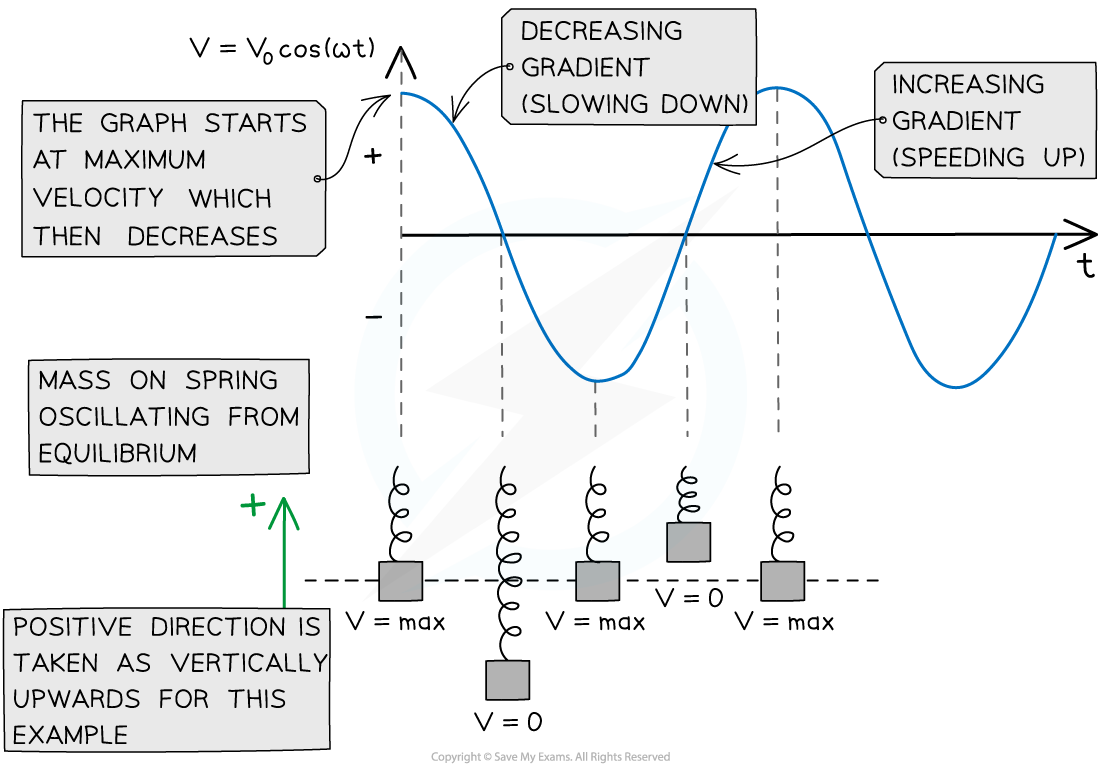
When an oscillator begins its motion at the equilibrium position then the velocity-time graph is a cosine graph
The maximum speed of an oscillator is the amplitude, v0 of the velocity-time graph
For a mass oscillating on a vertical spring:
occurs when the spring is in its equilibrium position
at the amplitude position
Worked Example
Calculate the frequency of an oscillator with a maximum speed of 12 m s-1 and amplitude of 1.4 m.
[2]
Answer:
Step 1: State the known values
Maximum speed,
Amplitude, A = 1.4 m
Step 2: Write down the equation
Step 3: Rewrite angular velocity in terms of frequency f
Step 4: Rearrange for frequency, f
Step 5: Substitute in the values
[1 mark]
[1 mark]
Maximum acceleration
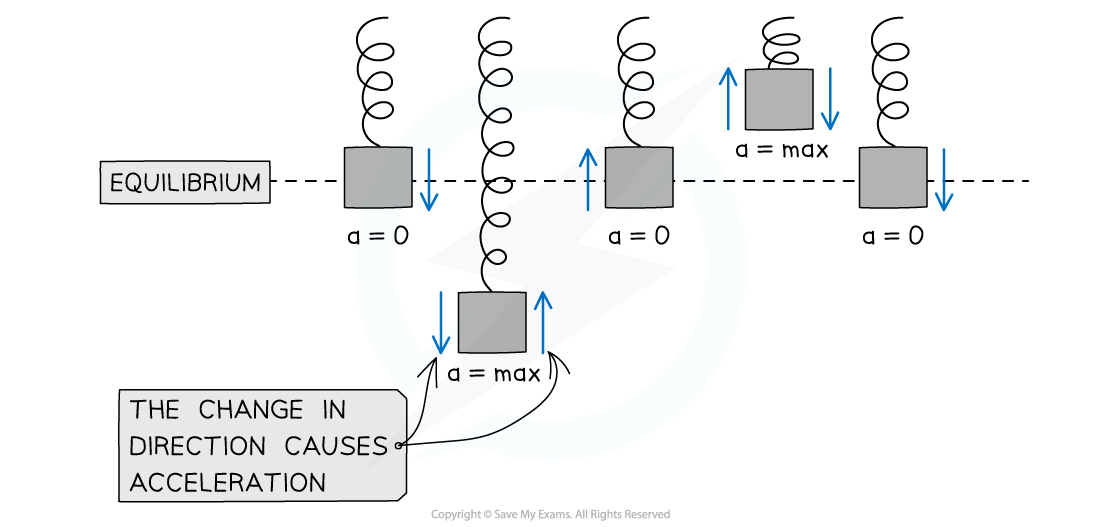
The maximum acceleration, , of an oscillator will occur when the gradient of the velocity-time graph is steepest
When at
Acceleration is zero at the equilibrium position ()
The maximum acceleration is given by the equation:
Where:
= maximum acceleration (m s-2)
= angular frequency (rad s-1)
= amplitude (maximum displacement, x) (m)
This comes from the defining equation of SHM:
Worked Example
Calculate the maximum acceleration of an oscillator with a time period of 0.4 s and amplitude of 2.8 m.
[2]
Answer:
Step 1: State the known values
Time period,
Amplitude,
Step 2: Write down the equation
Step 3: Rewrite maximum acceleration with time period T
Step 4: Substitute in the values
[1 mark]
[1 mark]
Examiner Tips and Tricks
Make sure not to get mixed up with lowercase (acceleration) and uppercase (amplitude). Make sure you feel confident moving between the equations in their various forms.

Unlock more, it's free!
Join the 100,000+ Students that ❤️ Save My Exams
the (exam) results speak for themselves:

Was this revision note helpful?
Build on this topic