Magnetic Force on a Current-Carrying Conductor (AQA A Level Physics): Revision Note
Exam code: 7408

Magnetic force on a current-carrying conductor
A current-carrying conductor produces its own magnetic field
When interacting with an external magnetic field, it will experience a force
The force on a conductor carrying current at an angle to a magnetic field with flux density is defined by the equation
Where:
= force on a current-carrying conductor in a field (N)
= magnetic flux density of applied field (T)
= current in the conductor (A)
= length of the conductor (m)
= angle between the conductor and applied field (degrees)
This equation shows that the force on the conductor can be increased by:
increasing the strength of the magnetic field
increasing the current flowing through the conductor
increasing the length of the conductor in the field
Note: The length represents the length of the conductor that is within the field
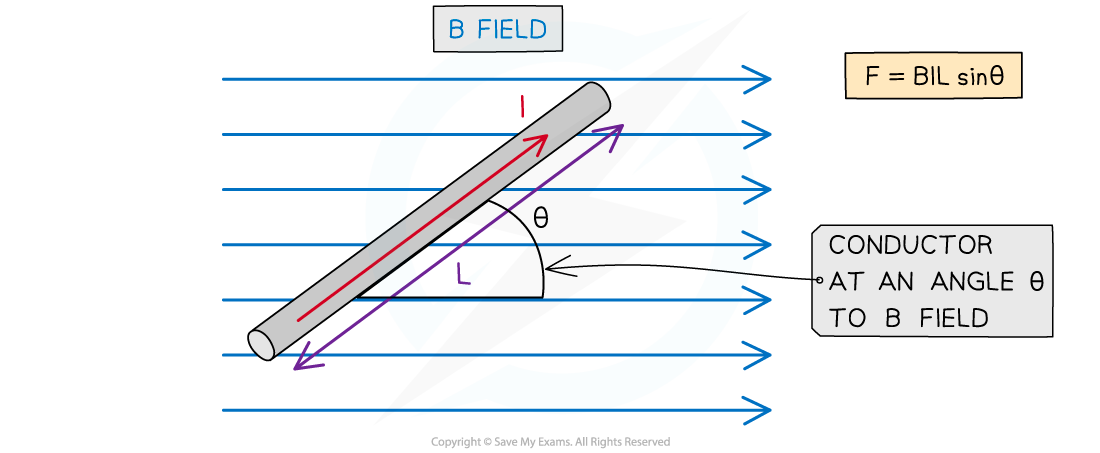
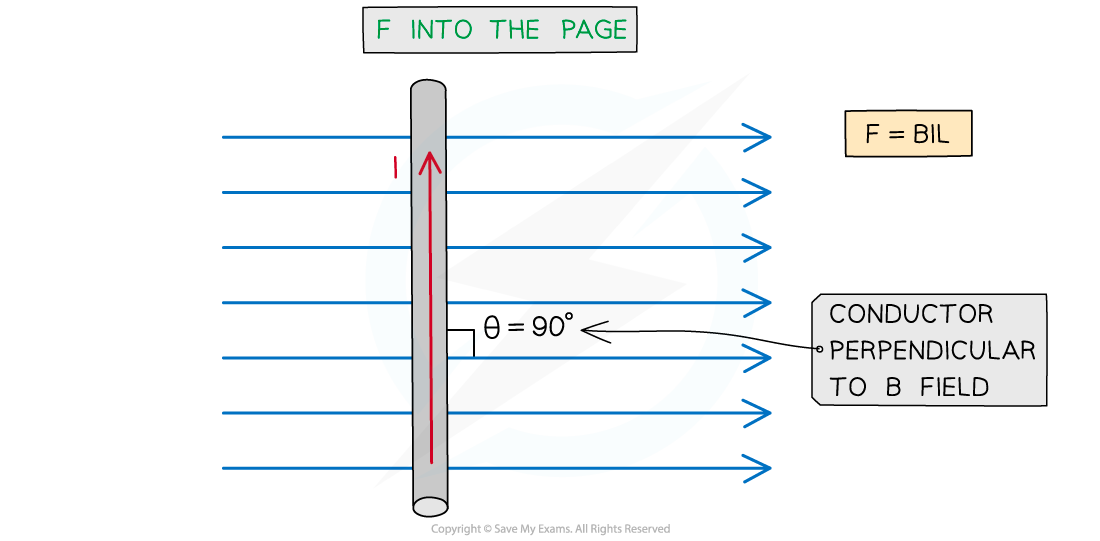
A current-carrying conductor (e.g. a wire) will experience the maximum magnetic force if the current through it is perpendicular to the direction of the magnetic field lines
It experiences no force if it is parallel to magnetic field lines
The maximum force occurs when
This means and the conductor is perpendicular to the field
The equation for the magnetic force becomes:
The minimum force, i.e. , is when
This means and the conductor is parallel to the field
It is important to note that a current-carrying conductor will experience no force if the current in the conductor is parallel to the field
This is because the , and must be perpendicular to each other
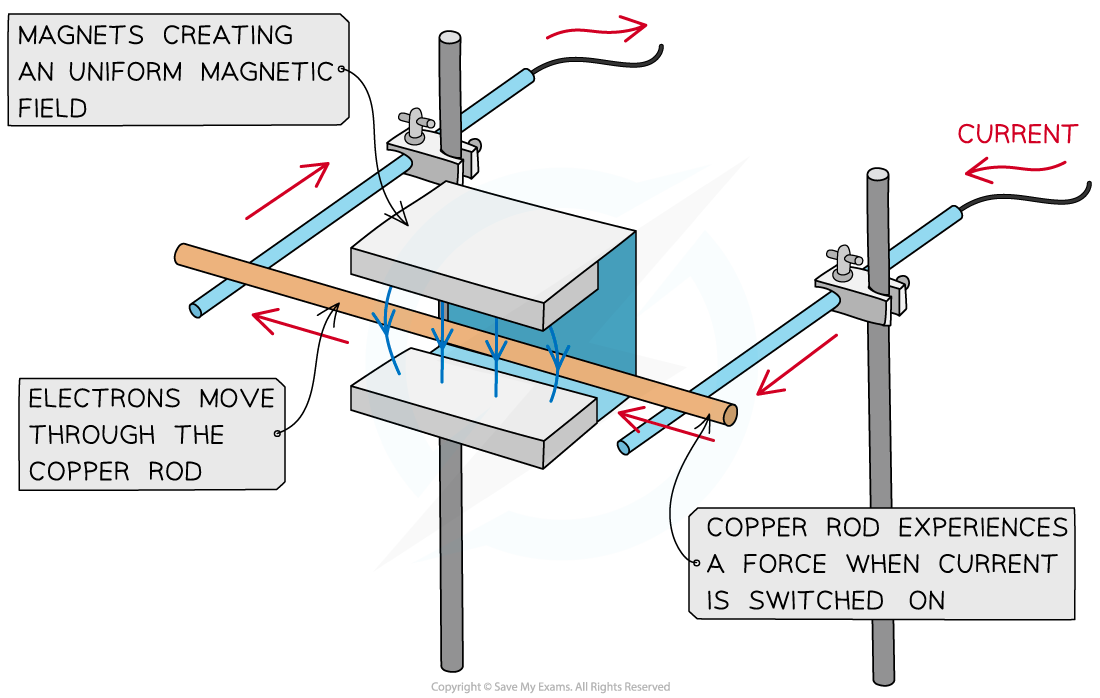
Observing the force on a current-carrying conductor
The force due to a magnetic field can be observed by:
placing a copper rod in a uniform magnetic field
connecting the copper rod to a circuit
When current is passed through the copper rod, it experiences a force
This causes it to accelerate in the direction of the force
Worked Example
A current of 0.87 A flows in a wire of length 1.4 m placed at 30° to a magnetic field of flux density 80 mT.
Calculate the force on the wire.
[2]
Answer:
Step 1: Write down the known quantities
Magnetic flux density,
Current,
Length of wire,
Angle between the wire and the magnetic field,
Step 2: Write down the equation for force on a current-carrying conductor
Step 3: Substitute in values and calculate
[1 mark]
[1 mark]
Examiner Tips and Tricks
Remember that the direction of current flow is the flow of positive charge (positive to negative), and this is in the opposite direction to the flow of electrons.

Unlock more, it's free!
Join the 100,000+ Students that ❤️ Save My Exams
the (exam) results speak for themselves:

Was this revision note helpful?
Build on this topic