Electrolysis (Cambridge (CIE) IGCSE Chemistry): Exam Questions

Exam code: 0620 & 0971

5 hours51 questions
1
1 mark

A student was investigating the electrolysis of zinc chloride. 

yuzRBqeD_q6

What is the correct reason for electrolysis not working? 

  • Solid zinc chloride has been used 

  • The electrodes don't conduct electricity 

  • The power supply is not connected properly 

  • The crucible is too small to allow ions to flow 

2
1 mark

Solid lead(II) bromide is heated until it is molten. The molten lead (II) bromide then undergoes electrolysis. 

Which substances are formed at each electrode?


anode

cathode

A

bromine

lead

B

lead

bromine

C

bromine

hydrogen

D

hydrogen

lead

    3
    1 mark

    The electrolysis of concentrated hydrochloric acid is shown.

    cie-igcse-5-1m-mcq3

    Which statement describes what happens to the electrons during the electrolysis?

    • They are removed from hydrogen ions at the negative electrode

    • They are added to hydrogen ions at the negative electrode

    • They are added to chloride ions at the positive electrode

    • They move through the electrolyte solution to the positive electrode

    4
    1 mark

    Concentrated aqueous sodium chloride can be electrolysed.

    Which statement is correct?

    • Hydrogen gas is formed at the anode, and chlorine gas is formed at the cathode.

    • Hydrogen gas is formed at the cathode, and chlorine gas is formed at the anode.

    • Sodium metal is formed at the anode, and chlorine gas is formed at the cathode.

    • Sodium metal is formed at the cathode, and chlorine gas is formed at the anode.

    5
    1 mark

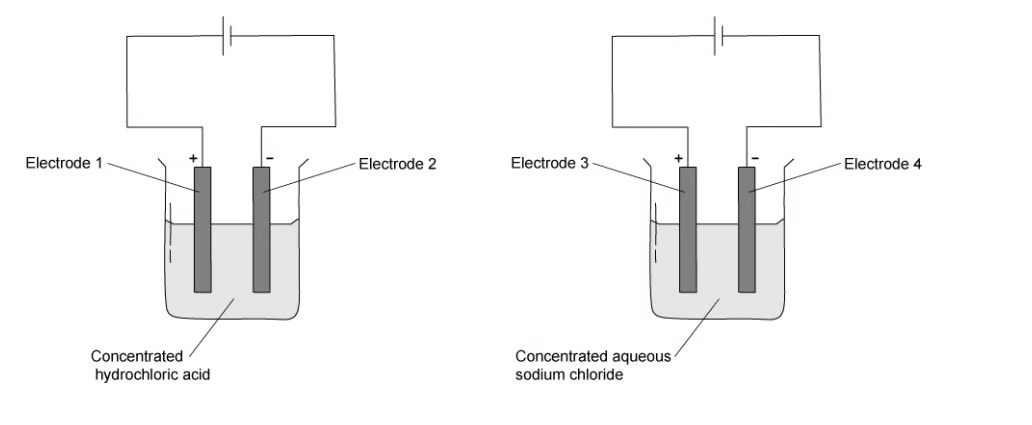
    The diagram shows the electrolysis of concentrated hydrochloric acid and concentrated aqueous sodium chloride using carbon electrodes.

    Diagram showing two electrochemical cells: one with concentrated hydrochloric acid and electrodes, the other with concentrated aqueous sodium chloride and electrodes.

    At which electrode(s) is hydrogen produced?

    • Electrode 1 only

    • Electrodes 1 and 3

    • Electrode 2 only

    • Electrodes 2 and 4

    1
    1 mark

    Which statement about electrolysis is correct?

    • Electrons move through the electrolyte from the cathode to the anode.

    • Electrons move towards the cathode in the external circuit.

    • Negative ions move towards the anode in the external circuit.

    • Positive ions move through the electrolyte towards the anode during electrolysis.

    2
    1 mark

    Dilute sulfuric acid is electrolysed using inert electrodes. 

    What are the products of this electrolysis?


    cathode

    anode

    A

    oxygen

    sulfur 

    B

    hydrogen

    sulfur dioxide

    C

    oxygen

    hydrogen

    D

    hydrogen

    oxygen

      3
      1 mark

      Electricity is passed through concentrated aqueous sodium chloride. Inert electrodes are used.

      q3-4-1-medium-cie-igcse-chemistry

      Which products are formed at the electrodes?


      cathode

      anode

      A

      hydrogen

      chlorine

      B

      hydrogen

      oxygen

      C

      sodium

      chlorine

      D

      sodium

      oxygen

        4
        1 mark

        The diagram shows the electrolysis of aqueous copper(II) sulfate.

        cie-igcse-5-1h-mcq4

        Which statement is correct?

        • Copper metal is deposited at the positive electrode.

        • In the external circuit the electrons move from negative to positive.

        • In the solution the electrons move from positive to negative.

        • Oxygen gas is produced at the positive electrode.

        5
        1 mark

        Concentrated aqueous potassium bromide solution is electrolysed using inert electrodes. The ions present in the solution are K+, Br, H+ and OH.

        To which electrodes are the ions attracted during this electrolysis?


        attracted to anode

        attracted to cathode

        A

        Br and K+

        H+ and OH

        B

        Br and OH

        H+ and K+

        C

        H+ and K+

        Br and OH

        D

        H+ and OH

        Br and K+

          6
          1 mark

          Which is the correct equation for the formation of chlorine gas at the anode during the electrolysis of concentrated sodium chloride solution?

          • Cl + e- → Cl-

          • 2Cl- + 2e- → Cl2

          • 2Cl- → Cl2 + 2e-

          • Cl- → Cl + e-

          1
          1 mark

          The diagram shows the electrolysis of concentrated aqueous sodium chloride.

          q1-4-3-hard-cie-igcse-chemistry

          What is the colour of the litmus at each electrode after five minutes?


          colour at anode

          colour at cathode

          A

          blue

          red

          B

          red

          blue

          C

          red

          colourless

          D

          colourless

          blue

            2
            1 mark

            Four substances are electrolysed. The substances are concentrated aqueous sodium chloride, concentrated hydrochloric acid, molten lead(II) bromide and molten sodium oxide.

            Which statement about these electrolysis reactions is correct?

            • A colourless gas is formed at the anode when molten sodium oxide is electrolysed.

            • A green gas is formed at the cathode when concentrated hydrochloric acid is electrolysed.

            • A metal is formed at the anode when molten lead(II) bromide is electrolysed.

            • A metal is formed at the cathode when concentrated aqueous sodium chloride is  electrolysed.

            3
            1 mark

            Four solutions are separately electrolysed.

            experiment

            solution

            electrodes

            1

            dilute aqueous sodium chloride

            carbon

            2

            aqueous copper(II) sulfate

            copper

            3

            concentrated hydrochloric acid

            carbon

            4

            dilute sulfuric acid

            carbon

            In which two experiments is a colourless gas evolved at the anode?

            • 1 & 2

            • 1 & 4

            • 2 & 3

            • 3 & 4

            4
            1 mark

            During electrolysis of brine, a gas is produced at the cathode. What is the half-equation for the reaction on the cathode?

            • 2Cl- → Cl2 + 2e-

            • 2Cl- + 2e- → Cl2

            • 2H+ + 2e- → H2

            • 2H+ → H2 + 2e-

            5
            1 mark

            The amount of gases P and Q are formed when substance X is electrolysed. 

            4-1-q9-cie-igcse-mcq-volume-of-gases-during-electrolysis

            What is substance X?

            • molten zinc bromide 

            • dilute sulfuric acid 

            • concentrated aqueous sodium bromide

            • concentrated hydrochloric acid 

            6
            1 mark

            Concentrated aqueous sodium chloride, dilute sulfuric acid and molten lead bromide were electrolysed separately in experiments 1, 2 and 3. 

            4-1-q10-cie-igcse-mcq-three-electrolysis-experiments

            Which statement about the electrode products is correct?

            • Metals were formed at the anode in experiments 1 and 3 only 

            • Metals were formed at the cathode in experiments 1 and 3 only

            • Gases are given off at the cathode in experiments 1 and 2 only 

            • Gases are given off at the anode in experiments 2 and 3 only 

            7
            1 mark

            A student wants to identify the gas produced at the negative electrode during the electrolysis of aqueous sodium chloride. 

            4-1-q11-cie-igcse-mcqgas-tests-for-products

            What is the correct test for the gas produced?

            • A glowing splint will relight

            • A burning splint gives a squeaky pop sound

            • Damp litmus paper bleaches

            • Damp red litmus paper turns blue