Product Moment Correlation Coefficient (PMCC) (AQA Level 3 Mathematical Studies (Core Maths): Paper 2A: Statistical Techniques): Revision Note
Exam code: 1350

Product Moment Correlation Coefficient (PMCC)
What is the product moment correlation coefficient?
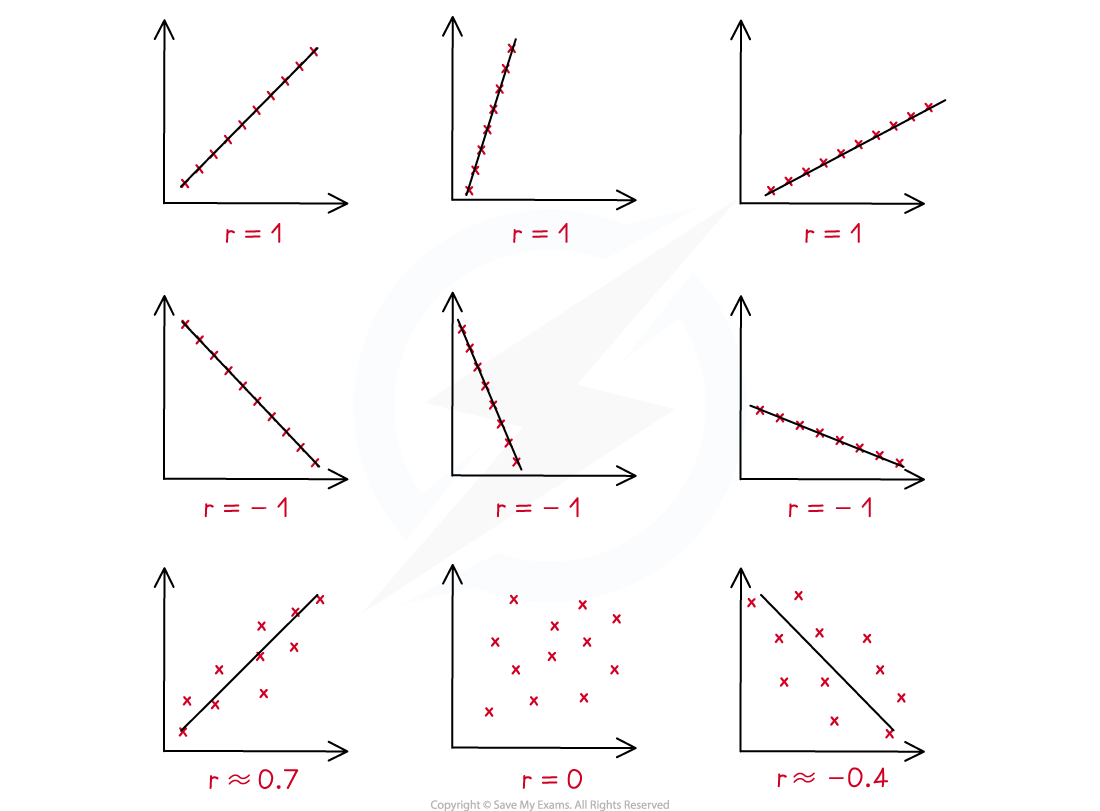
The product moment correlation coefficient (pmcc) is a way of giving a numerical value to linear correlation of bivariate data
The pmcc of a sample is denoted by the letter

- can take any value such that
format('truetype')%3Bfont-weight%3Anormal%3Bfont-style%3Anormal%3B%7D%3C%2Fstyle%3E%3C%2Fdefs%3E%3Ctext%20font-family%3D%22math1ca1a29523a31a98778ef30b146%22%20font-size%3D%2216%22%20text-anchor%3D%22middle%22%20x%3D%226.5%22%20y%3D%2216%22%3E%26%23x2212%3B%3C%2Ftext%3E%3Ctext%20font-family%3D%22Times%20New%20Roman%22%20font-size%3D%2218%22%20text-anchor%3D%22middle%22%20x%3D%2217.5%22%20y%3D%2216%22%3E1%3C%2Ftext%3E%3Ctext%20font-family%3D%22math1ca1a29523a31a98778ef30b146%22%20font-size%3D%2216%22%20text-anchor%3D%22middle%22%20x%3D%2230.5%22%20y%3D%2216%22%3E%26%23x2264%3B%3C%2Ftext%3E%3Ctext%20font-family%3D%22Times%20New%20Roman%22%20font-size%3D%2218%22%20font-style%3D%22italic%22%20text-anchor%3D%22middle%22%20x%3D%2241.5%22%20y%3D%2216%22%3Er%3C%2Ftext%3E%3Ctext%20font-family%3D%22math1ca1a29523a31a98778ef30b146%22%20font-size%3D%2216%22%20text-anchor%3D%22middle%22%20x%3D%2253.5%22%20y%3D%2216%22%3E%26%23x2264%3B%3C%2Ftext%3E%3Ctext%20font-family%3D%22Times%20New%20Roman%22%20font-size%3D%2218%22%20text-anchor%3D%22middle%22%20x%3D%2265.5%22%20y%3D%2216%22%3E1%3C%2Ftext%3E%3C%2Fsvg%3E)
A positive value of
describes positive correlationformat('truetype')%3Bfont-weight%3Anormal%3Bfont-style%3Anormal%3B%7D%3C%2Fstyle%3E%3C%2Fdefs%3E%3Ctext%20font-family%3D%22Times%20New%20Roman%22%20font-size%3D%2218%22%20font-style%3D%22italic%22%20text-anchor%3D%22middle%22%20x%3D%223.5%22%20y%3D%2216%22%3Er%3C%2Ftext%3E%3Ctext%20font-family%3D%22math17f39f8317fbdb1988ef4c628eb%22%20font-size%3D%2216%22%20text-anchor%3D%22middle%22%20x%3D%2215.5%22%20y%3D%2216%22%3E%3D%3C%2Ftext%3E%3Ctext%20font-family%3D%22Times%20New%20Roman%22%20font-size%3D%2218%22%20text-anchor%3D%22middle%22%20x%3D%2228.5%22%20y%3D%2216%22%3E1%3C%2Ftext%3E%3C%2Fsvg%3E) means perfect positive correlation
means perfect positive correlation
A negative value of
describes negative correlationformat('truetype')%3Bfont-weight%3Anormal%3Bfont-style%3Anormal%3B%7D%3C%2Fstyle%3E%3C%2Fdefs%3E%3Ctext%20font-family%3D%22Times%20New%20Roman%22%20font-size%3D%2218%22%20font-style%3D%22italic%22%20text-anchor%3D%22middle%22%20x%3D%223.5%22%20y%3D%2216%22%3Er%3C%2Ftext%3E%3Ctext%20font-family%3D%22math143f4d31b04031e49f5eb18baba%22%20font-size%3D%2216%22%20text-anchor%3D%22middle%22%20x%3D%2215.5%22%20y%3D%2216%22%3E%3D%3C%2Ftext%3E%3Ctext%20font-family%3D%22math143f4d31b04031e49f5eb18baba%22%20font-size%3D%2216%22%20text-anchor%3D%22middle%22%20x%3D%2232.5%22%20y%3D%2216%22%3E%26%23x2212%3B%3C%2Ftext%3E%3Ctext%20font-family%3D%22Times%20New%20Roman%22%20font-size%3D%2218%22%20text-anchor%3D%22middle%22%20x%3D%2245.5%22%20y%3D%2216%22%3E1%3C%2Ftext%3E%3C%2Fsvg%3E) means perfect negative correlation
means perfect negative correlation
The closer to 1 or -1, the stronger the correlation
If
format('truetype')%3Bfont-weight%3Anormal%3Bfont-style%3Anormal%3B%7D%3C%2Fstyle%3E%3C%2Fdefs%3E%3Ctext%20font-family%3D%22Times%20New%20Roman%22%20font-size%3D%2218%22%20font-style%3D%22italic%22%20text-anchor%3D%22middle%22%20x%3D%223.5%22%20y%3D%2216%22%3Er%3C%2Ftext%3E%3Ctext%20font-family%3D%22math17f39f8317fbdb1988ef4c628eb%22%20font-size%3D%2216%22%20text-anchor%3D%22middle%22%20x%3D%2215.5%22%20y%3D%2216%22%3E%3D%3C%2Ftext%3E%3Ctext%20font-family%3D%22Times%20New%20Roman%22%20font-size%3D%2218%22%20text-anchor%3D%22middle%22%20x%3D%2228.5%22%20y%3D%2216%22%3E0%3C%2Ftext%3E%3C%2Fsvg%3E) there is no correlation
there is no correlationThe closer the data points are to a straight line, the greater the strength of the correlation
The gradient does not change the value of

Worked Example
Two variables have a pmcc of -0.827.
Describe the correlation between the variables.
Answer:
The pmcc is negative so there is a negative correlation
It is also close to -1, so it is a strong correlation
The two variables have a strong, negative correlation
Calculating PMCC
How is the product moment correlation coefficient calculated?
You must learn how to use your calculator to calculate value of the pmcc,
 , for the correlation between two variables
All calculators are different and you should make sure you can calculate the pmcc on your personal calculator
You may need to know how to put your calculator into the statistics mode
You will be given the option to turn the frequency on or off, choose off for most calculations of the pmcc
With the statistics mode switched on on your calculator, there will be a ‘statistics’ option, followed by a regression option in the form A + BX
Your calculator will give you two columns into which you can input the
 and
and  data values
Once the data has been entered into your calculator, choose the ‘
’ value from the ‘STAT’ options
Worked Example
The table below shows data for a sample of 8 people comparing the maximum number of pull-ups they are able to complete, x, with the maximum number of press-ups, y.
Number of pull-ups (x) | 5 | 10 | 8 | 3 | 6 | 8 | 1 | 4 | ||||
Number of press-ups (y) | 24 | 34 | 36 | 18 | 30 | 35 | 11 | 19 | ||||
(a) Work out the pmcc for the data.
Answer:
Enter the data into your calculator to find the pmcc
0.955914...
Round
pmcc = 0.956 (3 s.f.)
(b) Comment on the relationship between the two variables.
Answer:
Comment on the strength and type of correlation
Relate this to the actual variables in context
There is a strong, positive correlation between the number of pull-ups that a person can do and the number of press-ups that they can do
As the number of press-ups that a person can do increases, the number of pull-ups that they can do also increases

Unlock more, it's free!
Join the 100,000+ Students that ❤️ Save My Exams
the (exam) results speak for themselves:

Was this revision note helpful?
