The Strange Case of Dr Jekyll and Mr Hyde (OCR GCSE English Literature): Exam Questions

Exam code: J352

9 hours123 questions
1
40 marks

How does Stevenson present Mr Hyde as an inhuman and disturbing member of society, in this extract and elsewhere in the novel?

In this extract, Poole describes seeing someone at Jekyll’s cabinet who is clearly not his master, highlighting Hyde’s unsettling and unnatural presence.

“That's it!” said Poole. “It was this way. I came suddenly into the theatre from the garden. It seems he had slipped out to look for this drug, or whatever it is; for the cabinet door was open, and there he was at the far end of the room digging among the crates. He looked up when I came in, gave a kind of cry, and whipped upstairs into the cabinet. It was but for one minute that I saw him, but the hair stood up on my head like quills. Sir, if that was my master, why had he a mask upon his face? If it was my master, why did he cry out like a rat, and run from me? I have served him long enough. And then …”, the man paused and passed his hand over his face.


“These are all very strange circumstances,” said Mr. Utterson, “but I think I begin to see daylight. Your master, Poole, is plainly seized with one of those maladies that both torture and deform the sufferer; hence, for aught I know, the alteration of his voice; hence the mask and his avoidance of his friends; hence his eagerness to find this drug, by means of which the poor soul retains some hope of ultimate recovery – God grant that he be not deceived. There is my explanation; it is sad enough, Poole, ay, and appalling to consider; but it is plain and natural, hangs well together, and delivers us from all exorbitant alarms.”


“Sir,” said the butler, turning to a sort of mottled pallor, “that thing was not my master, and there’s the truth. My master” – here he looked round him and began to whisper – “is a tall, fine build of a man, and this was more of a dwarf.” Utterson attempted to protest. “O sir,” cried Poole, “do you think I do not know my master after twenty years? do you think I do not know where his head comes to in the cabinet door, where I saw him every morning of my life? No, sir, that thing in the mask was never Dr. Jekyll – God knows what it was, but it was never Dr. Jekyll; and it is the belief of my heart that there was murder done.”  

[40 marks]

2
40 marks

How does Stevenson use settings to create a disturbing and threatening atmosphere, in this extract and elsewhere in the novel?

In this extract, Utterson and Poole arrive at Dr Jekyll’s house on a cold, wild night, with the streets deserted and the servants anxious, highlighting the sense of unease and danger.

It was a wild, cold, seasonable night of March, with a pale moon, lying on her back as though the wind had tilted her, and a flying wrack of the most diaphanous and lawny texture. The wind made talking difficult, and flecked the blood into the face. It seemed to have swept the streets unusually bare of passengers, besides; for Mr. Utterson thought he had never seen that part of London so deserted. He could have wished it otherwise; never in his life had he been conscious of so sharp a wish to see and touch his fellow-creatures; for, struggle as he might, there was borne in upon his mind a crushing anticipation of calamity. The square, when they got there, was all full of wind and dust, and the thin trees in the garden were lashing themselves along the railing. Poole, who had kept all the way a pace or two ahead, now pulled up in the middle of the pavement, and, in spite of the biting weather, took off his hat and mopped his brow with a red pocket-handkerchief. But for all the hurry of his coming, these were not the dews of exertion that he wiped away, but the moisture of some strangling anguish; for his face was white, and his voice, when he spoke, harsh and broken.


“Well, sir,” he said, “here we are, and God grant there be nothing wrong.” “Amen, Poole,” said the lawyer. 


Thereupon the servant knocked in a very guarded manner; the door was opened on the chain; and a voice asked from within, “Is that you, Poole?” 


“It's all right,” said Poole. “Open the door.” 


The hall, when they entered it, was brightly lighted up; the fire was built high; and about the hearth the whole of the servants, men and women, stood huddled together like a flock of sheep. At the sight of Mr. Utterson, the housemaid broke into hysterical whimpering; and the cook, crying out “Bless God! it's Mr. Utterson,” ran forward as if to take him in her arms.


“What, what? Are you all here?” said the lawyer peevishly. “Very irregular, very unseemly; your master would be far from pleased.” 


“They're all afraid,” said Poole.

[40 marks]

3
40 marks

How does Stevenson present Dr Jekyll as a mysterious character, in this extract and elsewhere in the novel?

In this extract, Utterson reflects on Jekyll’s periods of seclusion and sudden changes in behaviour, highlighting the sense of mystery surrounding him.

Time ran on; thousands of pounds were offered in reward, for the death of Sir Danvers was resented as a public injury; but Mr. Hyde had disappeared out of the ken of the police as though he had never existed. Much of his past was unearthed, indeed, and all disreputable: tales came out of the man’s cruelty, at once so callous and violent, of his vile life, of his strange associates, of the hatred that seemed to have surrounded his career; but of his present whereabouts, not a whisper. From the time he had left the house in Soho on the morning of the murder, he was simply blotted out; and gradually, as time drew on, Mr. Utterson began to recover from the hotness of his alarm, and to grow more at quiet with himself. The death of Sir Danvers was, to his way of thinking, more than paid for by the disappearance of Mr. Hyde. Now that that evil influence had been withdrawn, a new life began for Dr. Jekyll. He came out of his seclusion, renewed relations with his friends, became once more their familiar guest and entertainer; and whilst he had always been known for charities, he was now no less distinguished for religion. He was busy, he was much in the open air, he did good; his face seemed to open and brighten, as if with an inward consciousness of service; and for more than two months the doctor was at peace.


On the 8th of January Utterson had dined at the doctor’s with a small party; Lanyon had been there; and the face of the host had looked from one to the other as in the old days when the trio were inseparable friends. On the 12th, and again on the 14th, the door was shut against the lawyer. “The doctor was confined to the house,” Poole said, “and saw no one.” On the 15th he tried again, and was again refused; and having now been used for the last two months to see his friend almost daily, he found this return of solitude to weigh upon his spirits. The fifth night he had in Guest to dine with him; and the sixth he betook himself to Dr. Lanyon’s.

[40 marks]

4
40 marks

How does Stevenson present the duality of human nature, in this extract and elsewhere in the novel?

In this extract, Jekyll reflects on the two natures that exist within him and the possibility of separating good and evil into distinct identities.

With every day, and from both sides of my intelligence, the moral and the intellectual, I thus drew steadily nearer to that truth, by whose partial discovery I have been doomed to such a dreadful shipwreck: that man is not truly one, but truly two. I say two, because the state of my own knowledge does not pass beyond that point. Others will follow, others will outstrip me on the same lines; and I hazard the guess that man will be ultimately known for a mere polity of multifarious, incongruous and independent denizens. I for my part, from the nature of my life, advanced infallibly in one direction and in one direction only. It was on the moral side, and in my own person, that I learned to recognize the thorough and primitive duality of man; I saw that, of the two natures that contended in the field of my consciousness, even if I could rightly be said to be either, it was only because I was radically both; and from an early date, even before the course of my scientific discoveries had begun to suggest the most naked possibility of such a miracle, I had learned to dwell with pleasure, as a beloved daydream, on the thought of the separation of these elements. If each, I told myself, could but be housed in separate identities, life would be relieved of all that was unbearable; the unjust might go his way, delivered from the aspirations and remorse of his more upright twin; and the just could walk steadfastly and securely on his upward path, doing the good things in which he found his pleasure, and no longer exposed to disgrace and penitence by the hands of this extraneous evil. It was the curse of mankind that these incongruous faggots* were thus bound together — that in the agonized womb of consciousness, these polar twins should be continuously struggling.

*Faggots = bundles of sticks that are tied together

[40 marks]

5
40 marks

How does Stevenson present secrecy and reputation, in this extract and elsewhere in the novel?

In this extract, Utterson questions Jekyll about a letter and urges caution about his reputation.

“I have — I have received a letter; and I am at a loss whether I should show it to the police. I should like to leave it in your hands, Utterson; you would judge wisely I am sure; I have so great a trust in you.”

“You fear, I suppose, that it might lead to his detection?” asked the lawyer.

“No,” said the other. “I cannot say that I care what becomes of Hyde; I am quite done with him. I was thinking of my own character, which this hateful business has rather exposed.”

Utterson ruminated awhile; he was surprised at his friend’s selfishness, and yet relieved by it. “Well,’ said he, at last, ‘let me see the letter.”

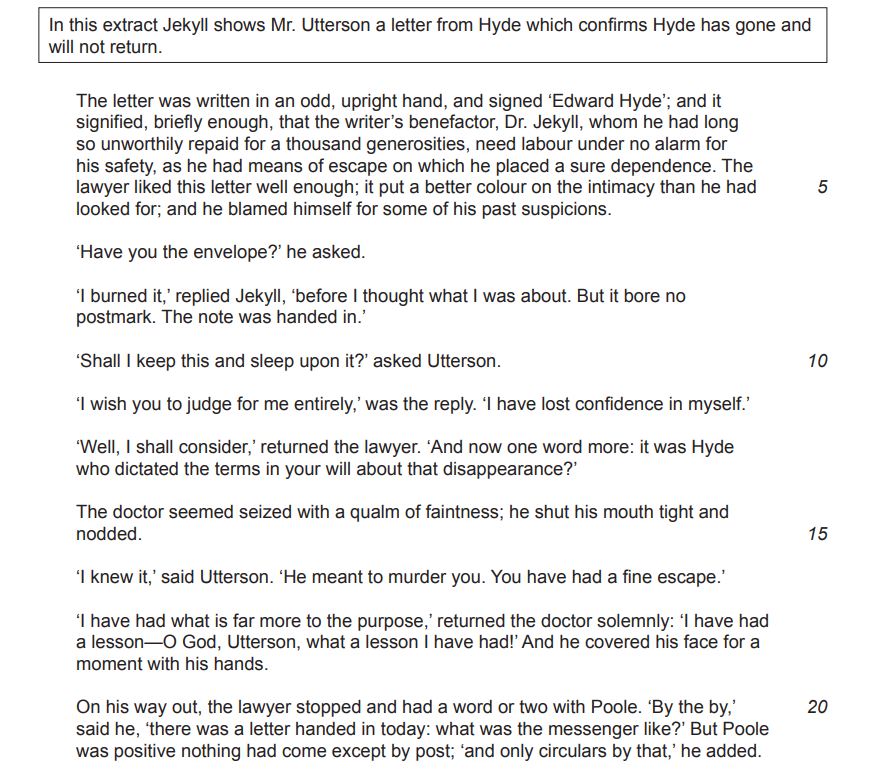
The letter was written in an odd, upright hand and signed “Edward Hyde”: and it signified, briefly enough, that the writer’s benefactor, Dr Jekyll, whom he had long so unworthily repaid for a thousand generosities, need labour under no alarm for his safety as he had means of escape on which he placed a sure dependence. The lawyer liked this letter well enough; it put a better colour on the intimacy than he had looked for; and he blamed himself for some of his past suspicions.

“Have you the envelope?” he asked.

“I burned it,” replied Jekyll, “before I thought what I was about.”

[40 marks]

6
40 marks

The Strange Case of Dr Jekyll and Mr Hyde by Robert Louis Stevenson

Case Study

Text excerpt from “Strange Case of Dr Jekyll and Mr Hyde” where Jekyll reveals a letter from Hyde to Mr Utterson, discussing recent events and suspicions.

You should spend about 45 minutes on this section.

How does Stevenson present secrecy and deception, in this extract and elsewhere in the novel?

7
40 marks

Use the extract given in Question 6 as your reference.

You should spend about 45 minutes on this section.

‘The end of the story gives Jekyll what he deserves.’ How far do you agree with this view?

Explore at least two moments from the novel to support your ideas.

8
40 marks

The Strange Case of Dr Jekyll and Mr Hyde by Robert Louis Stevenson

Case Study

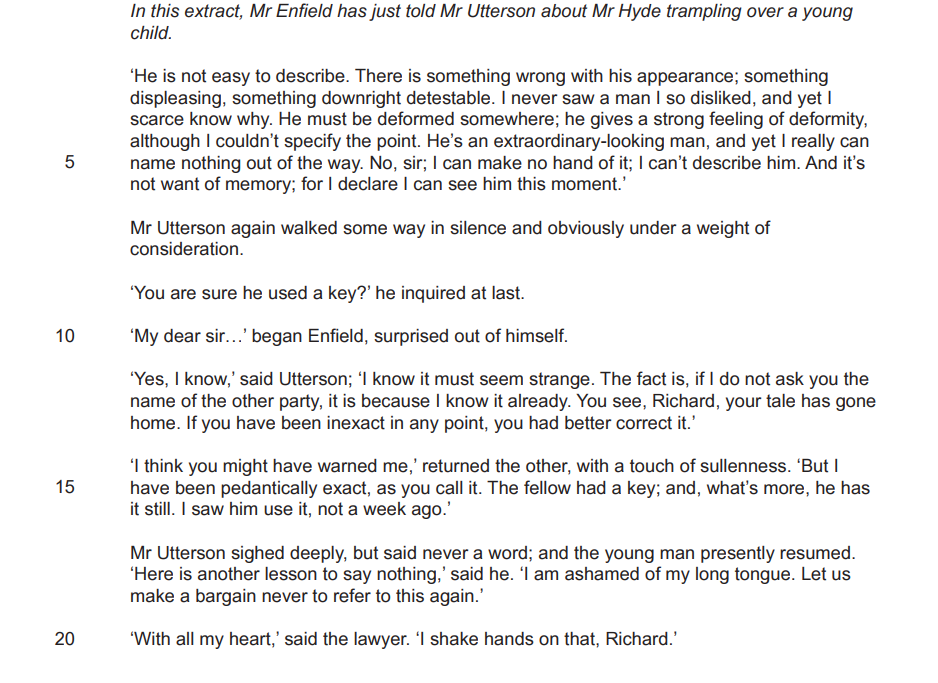
Text excerpt from "Dr. Jekyll and Mr. Hyde" involving a discussion between Mr Enfield and Mr Utterson about Mr Hyde's unsettling appearance and actions.

You are advised to spend about 45 minutes on this section.

How does Stevenson present the importance of reputation, in this extract and elsewhere in the novel?

9
40 marks

Use the extract given in Question 8 as your reference.

‘Dr Jekyll and Mr Hyde are very different from each other.’

How far do you agree with this view?

Explore at least two moments from the novel to support your ideas.

10
40 marks

The Strange Case of Dr Jekyll and Mr Hyde by Robert Louis Stevenson

Case Study

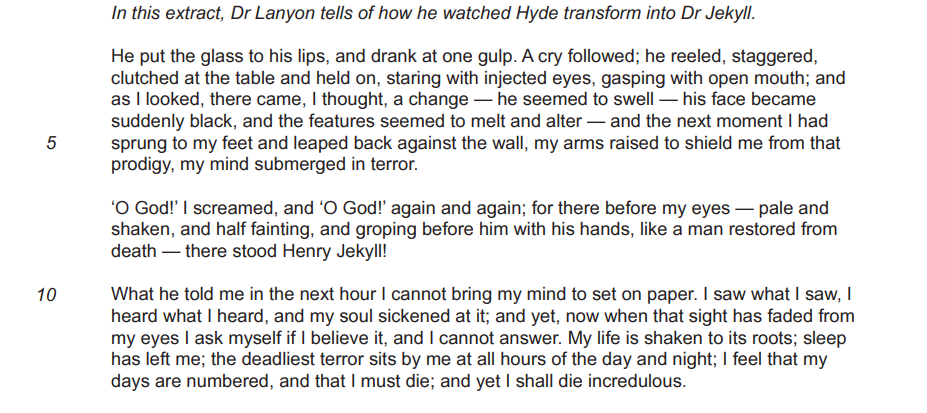
Text from Dr Lanyon describing witnessing Hyde's transformation into Dr Jekyll, expressing terror and disbelief at the horrifying event.

Explore how Stevenson presents an incident that is shocking, in this extract and elsewhere in the novel.

11
40 marks

Use the extract given in Question 10 as your reference.

‘It is difficult to have sympathy for Dr Jekyll.’ How far do you agree with this view?

Explore at least two moments from the novel to support your ideas.