Describing Motion (AQA GCSE Physics): Flashcards
Exam code: 8463
1/930Still learning
Know0
Define distance.

Was this flashcard helpful?
Cards in this collection (93)
Define distance.
Distance is a measure of how far an object travels. It is a scalar quantity, so direction is not important.
Define displacement.
Displacement is a measure of how far something is from its starting position, along with its direction. It is a vector quantity, describing both magnitude and direction.
In a 300 m race, what is the total distance travelled by the athletes from start to finish?
The total distance travelled is 300 m.
In the same 300 m race, the athletes finish 100 m from their starting position. What is their displacement?
Their displacement is 100 m in the direction from start to finish.
If the athletes ran the full 400 m and returned to their starting position, their final displacement would be ______.
If the athletes ran the full 400 m and returned to their starting position, their final displacement would be zero.
True or False?
In the 300 m race example, distance and displacement have the same value.
False.
The distance travelled is 300 m, but the displacement is only 100 m, because displacement only measures the straight-line distance from the start to the finish position.
Define speed.
Speed is the distance an object travels every second. It is a scalar quantity, containing only magnitude and no direction.
Define non-uniform motion.
Non-uniform motion refers to motion that is changing — this can mean the object's speed, direction, or both are changing.
What is the equation for average speed?
format('truetype')%3Bfont-weight%3Anormal%3Bfont-style%3Anormal%3B%7D%3C%2Fstyle%3E%3C%2Fdefs%3E%3Ctext%20font-family%3D%22Times%20New%20Roman%22%20font-size%3D%2218%22%20text-anchor%3D%22middle%22%20x%3D%2220.5%22%20y%3D%2230%22%3Espeed%3C%2Ftext%3E%3Ctext%20font-family%3D%22math17f39f8317fbdb1988ef4c628eb%22%20font-size%3D%2216%22%20text-anchor%3D%22middle%22%20x%3D%2249.5%22%20y%3D%2230%22%3E%3D%3C%2Ftext%3E%3Cline%20stroke%3D%22%23000000%22%20stroke-linecap%3D%22square%22%20stroke-width%3D%221%22%20x1%3D%2260.5%22%20x2%3D%22189.5%22%20y1%3D%2223.5%22%20y2%3D%2223.5%22%2F%3E%3Ctext%20font-family%3D%22Times%20New%20Roman%22%20font-size%3D%2218%22%20text-anchor%3D%22middle%22%20x%3D%2291.5%22%20y%3D%2216%22%3Edistance%3C%2Ftext%3E%3Ctext%20font-family%3D%22Times%20New%20Roman%22%20font-size%3D%2218%22%20text-anchor%3D%22middle%22%20x%3D%22156.5%22%20y%3D%2216%22%3Etravelled%3C%2Ftext%3E%3Ctext%20font-family%3D%22Times%20New%20Roman%22%20font-size%3D%2218%22%20text-anchor%3D%22middle%22%20x%3D%22104.5%22%20y%3D%2241%22%3Etime%3C%2Ftext%3E%3Ctext%20font-family%3D%22Times%20New%20Roman%22%20font-size%3D%2218%22%20text-anchor%3D%22middle%22%20x%3D%22143.5%22%20y%3D%2241%22%3Etaken%3C%2Ftext%3E%3C%2Fsvg%3E)
In what units is speed measured, and why?
Speed is measured in metres per second (m/s), because distance is measured in metres and time in seconds.
True or False?
A typical average speed for a hiker is 6.0 m/s.
False.
A typical average speed for a hiker is around 1.5 m/s. An average speed of 6.0 m/s is more typical for a cyclist.
Cars are constantly ______ up and slowing down throughout a journey.
Cars are constantly speeding up and slowing down throughout a journey.
True or False?
A car travelling at a constant speed in a straight line is undergoing non-uniform motion.
False.
Non-uniform motion means the speed, direction, or both are changing; a car moving at constant speed in a straight line has neither changing, so its motion is uniform.
What is a typical speed for a person walking?
About 1.5 m/s.
What factors can affect the typical speed of a person walking?
Terrain, age, fitness, and the length of the journey.
What factors can affect the typical speeds of transportation systems such as cars or planes?
Their shape, design, cost, and purpose.
What is a typical value for the speed of sound in air?
About 330 m/s.
What is the simplest way to measure the speed of a moving object?
Time how long it takes to travel a known distance, then use speed = distance ÷ time.
Define light gate.
A light gate is a piece of digital equipment that allows times to be measured more accurately. A flag on the moving object blocks a beam of light as it passes through, triggering a timer.
How can two light gates be used to measure the time taken for an object to travel a known distance?
The first light gate starts the timer when the object's flag blocks its beam; a second light gate (at a known distance away) stops the timer when the object passes through it.
How can a single light gate be used to measure the speed of an object as it passes through?
The timer measures how long the light gate is blocked; the distance travelled is given by the length of the flag, and these values are used in the speed equation.
It would not be practical to use a metre rule to measure the length of an athletics track — a better choice would be a tape measure or a ______.
It would not be practical to use a metre rule to measure the length of an athletics track — a better choice would be a tape measure or a trundle wheel.
True or False?
Sound travels faster in air than in seawater.
False.
Sound travels faster in seawater than in air (typically 330 m/s in air).
What equation is used to calculate the speed of an object moving at a constant speed?
format('truetype')%3Bfont-weight%3Anormal%3Bfont-style%3Anormal%3B%7D%3C%2Fstyle%3E%3C%2Fdefs%3E%3Ctext%20font-family%3D%22Times%20New%20Roman%22%20font-size%3D%2218%22%20font-style%3D%22italic%22%20text-anchor%3D%22middle%22%20x%3D%224.5%22%20y%3D%2230%22%3Ev%3C%2Ftext%3E%3Ctext%20font-family%3D%22math17f39f8317fbdb1988ef4c628eb%22%20font-size%3D%2216%22%20text-anchor%3D%22middle%22%20x%3D%2218.5%22%20y%3D%2230%22%3E%3D%3C%2Ftext%3E%3Cline%20stroke%3D%22%23000000%22%20stroke-linecap%3D%22square%22%20stroke-width%3D%221%22%20x1%3D%2229.5%22%20x2%3D%2240.5%22%20y1%3D%2223.5%22%20y2%3D%2223.5%22%2F%3E%3Ctext%20font-family%3D%22Times%20New%20Roman%22%20font-size%3D%2218%22%20font-style%3D%22italic%22%20text-anchor%3D%22middle%22%20x%3D%2234.5%22%20y%3D%2216%22%3Es%3C%2Ftext%3E%3Ctext%20font-family%3D%22Times%20New%20Roman%22%20font-size%3D%2218%22%20font-style%3D%22italic%22%20text-anchor%3D%22middle%22%20x%3D%2234.5%22%20y%3D%2241%22%3Et%3C%2Ftext%3E%3C%2Fsvg%3E) where v = speed (m/s), s = distance travelled (m), t = time taken (s).
where v = speed (m/s), s = distance travelled (m), t = time taken (s).A plane flies at 250 m/s for 2 hours. What distance does it travel?
1 800 000 m, found using s = v × t, with the time converted to 7200 s.
Why must the time in the plane example be converted before calculating the distance travelled?
Because 2 hours is not in standard units; it must be converted to seconds (2 × 60 × 60 = 7200 s) before being used in the equation.
What equation is used to calculate the average speed of an object undergoing non-uniform motion?
format('truetype')%3Bfont-weight%3Anormal%3Bfont-style%3Anormal%3B%7D%3C%2Fstyle%3E%3C%2Fdefs%3E%3Ctext%20font-family%3D%22Times%20New%20Roman%22%20font-size%3D%2218%22%20text-anchor%3D%22middle%22%20x%3D%2228.5%22%20y%3D%2230%22%3Eaverage%3C%2Ftext%3E%3Ctext%20font-family%3D%22Times%20New%20Roman%22%20font-size%3D%2218%22%20text-anchor%3D%22middle%22%20x%3D%2280.5%22%20y%3D%2230%22%3Espeed%3C%2Ftext%3E%3Ctext%20font-family%3D%22math17f39f8317fbdb1988ef4c628eb%22%20font-size%3D%2216%22%20text-anchor%3D%22middle%22%20x%3D%22109.5%22%20y%3D%2230%22%3E%3D%3C%2Ftext%3E%3Cline%20stroke%3D%22%23000000%22%20stroke-linecap%3D%22square%22%20stroke-width%3D%221%22%20x1%3D%22120.5%22%20x2%3D%22249.5%22%20y1%3D%2223.5%22%20y2%3D%2223.5%22%2F%3E%3Ctext%20font-family%3D%22Times%20New%20Roman%22%20font-size%3D%2218%22%20text-anchor%3D%22middle%22%20x%3D%22151.5%22%20y%3D%2216%22%3Edistance%3C%2Ftext%3E%3Ctext%20font-family%3D%22Times%20New%20Roman%22%20font-size%3D%2218%22%20text-anchor%3D%22middle%22%20x%3D%22216.5%22%20y%3D%2216%22%3Etravelled%3C%2Ftext%3E%3Ctext%20font-family%3D%22Times%20New%20Roman%22%20font-size%3D%2218%22%20text-anchor%3D%22middle%22%20x%3D%22164.5%22%20y%3D%2241%22%3Etime%3C%2Ftext%3E%3Ctext%20font-family%3D%22Times%20New%20Roman%22%20font-size%3D%2218%22%20text-anchor%3D%22middle%22%20x%3D%22203.5%22%20y%3D%2241%22%3Etaken%3C%2Ftext%3E%3C%2Fsvg%3E)
The same equation as for constant speed, applied to the whole journey.
Florence Griffith Joyner ran the women's 100 m world record in 10.49 s. Calculate her average speed.
average speed = 100 ÷ 10.49 = 9.53 m/s.
To find the distance travelled from speed and time, the equation v = s/t is rearranged to give s = ______.
To find the distance travelled from speed and time, the equation v = s/t is rearranged to give s = v × t.
True or False?
The same equation, distance ÷ time, is used to calculate both constant speed and average speed.
True.
Speed = distance ÷ time applies whether an object moves at a constant speed or with varying (non-uniform) speed — in the latter case, it gives the average speed over the whole journey.
Define velocity.
Velocity is similar to speed, except it also describes the object's direction. It is a vector quantity, describing both magnitude and direction.
Why is speed a scalar quantity but velocity a vector quantity?
Speed only has a magnitude, whereas velocity has both a magnitude and a direction.
Give an example of how velocity might be expressed.
For example, "15 m/s south" or "250 mph on a bearing of 030°".
Velocity example: "250 mph on a ______ of 030°".
Velocity example: "250 mph on a bearing of 030°".
True or False?
Two objects moving at the same speed always have the same velocity.
False.
Velocity also depends on direction, so two objects with the same speed but travelling in different directions have different velocities.
Define a scalar quantity.
A scalar quantity describes a magnitude only, e.g. a room temperature of 16°C.
Define a vector quantity.
A vector quantity describes both magnitude and direction, e.g. a large pot of rice exerting a force of 40 N downwards on a cooker.
All quantities in physics are either ______ or ______.
All quantities in physics are either vectors or scalars.
True or False?
A force of 40 N downwards is a scalar quantity.
False.
It is a vector quantity, because it includes both a magnitude (40 N) and a direction (downwards).
Define velocity.
Velocity is the speed of an object in a given direction; it is a vector quantity.
Explain why an object moving in a circle at a constant speed has a changing velocity.
Velocity is a vector quantity, so it depends on both speed and direction. Although the speed stays constant in circular motion, the direction of travel continually changes, so the velocity is continually changing.
The International Space Station orbits the Earth at a constant ______ of about 7660 m/s, but its direction - and therefore its velocity - is continuously changing.
The International Space Station orbits the Earth at a constant speed of about 7660 m/s, but its direction - and therefore its velocity - is continuously changing.
True or False?
An object moving in a circle with a constant speed has a constant velocity.
False.
Even though the speed is constant, the direction of motion is always changing, so the velocity is not constant.
What does a straight line on a distance-time graph represent?
A straight line represents an object moving at a constant speed.
What does a curved line on a distance-time graph represent?
A curved line represents an object moving at a changing speed. If the curve becomes steeper, the object is accelerating; if it becomes less steep, the object is decelerating.
What does a flat, horizontal line on a distance-time graph represent?
A flat, horizontal line represents an object that is stationary (not moving).
Define the gradient of a distance-time graph.
The gradient of a distance-time graph represents the speed of the moving object, calculated using
format('truetype')%3Bfont-weight%3Anormal%3Bfont-style%3Anormal%3B%7D%3C%2Fstyle%3E%3C%2Fdefs%3E%3Ctext%20font-family%3D%22Times%20New%20Roman%22%20font-size%3D%2218%22%20text-anchor%3D%22middle%22%20x%3D%2220.5%22%20y%3D%2230%22%3Espeed%3C%2Ftext%3E%3Ctext%20font-family%3D%22math17f39f8317fbdb1988ef4c628eb%22%20font-size%3D%2216%22%20text-anchor%3D%22middle%22%20x%3D%2249.5%22%20y%3D%2230%22%3E%3D%3C%2Ftext%3E%3Ctext%20font-family%3D%22Times%20New%20Roman%22%20font-size%3D%2218%22%20text-anchor%3D%22middle%22%20x%3D%2287.5%22%20y%3D%2230%22%3Egradient%3C%2Ftext%3E%3Ctext%20font-family%3D%22math17f39f8317fbdb1988ef4c628eb%22%20font-size%3D%2216%22%20text-anchor%3D%22middle%22%20x%3D%22125.5%22%20y%3D%2230%22%3E%3D%3C%2Ftext%3E%3Cline%20stroke%3D%22%23000000%22%20stroke-linecap%3D%22square%22%20stroke-width%3D%221%22%20x1%3D%22136.5%22%20x2%3D%22161.5%22%20y1%3D%2223.5%22%20y2%3D%2223.5%22%2F%3E%3Ctext%20font-family%3D%22Times%20New%20Roman%22%20font-size%3D%2218%22%20font-style%3D%22italic%22%20text-anchor%3D%22middle%22%20x%3D%22144.5%22%20y%3D%2216%22%3E%26%23x394%3B%3C%2Ftext%3E%3Ctext%20font-family%3D%22Times%20New%20Roman%22%20font-size%3D%2218%22%20font-style%3D%22italic%22%20text-anchor%3D%22middle%22%20x%3D%22154.5%22%20y%3D%2216%22%3Ey%3C%2Ftext%3E%3Ctext%20font-family%3D%22Times%20New%20Roman%22%20font-size%3D%2218%22%20font-style%3D%22italic%22%20text-anchor%3D%22middle%22%20x%3D%22144.5%22%20y%3D%2241%22%3E%26%23x394%3B%3C%2Ftext%3E%3Ctext%20font-family%3D%22Times%20New%20Roman%22%20font-size%3D%2218%22%20font-style%3D%22italic%22%20text-anchor%3D%22middle%22%20x%3D%22154.5%22%20y%3D%2241%22%3Ex%3C%2Ftext%3E%3C%2Fsvg%3E)
A very steep slope on a distance-time graph means the object is moving with a ______ speed.
A very steep slope on a distance-time graph means the object is moving with a large speed.
True or False?
In the worked example, Ose spent 40 minutes reading on the bench.
True.
The flat section of the distance-time graph (section B) lasted 40 minutes, representing the time Ose spent stationary while reading.
How is the total distance travelled by an object found from a distance-time graph?
The total distance travelled is given by the value on the distance axis at the final point of the line.
Define tangent.
A tangent is a straight line that touches a curve at one particular point, without crossing it elsewhere nearby.
How is the instantaneous speed of an object found from a curved distance-time graph?
The instantaneous speed at a particular time is found by drawing a tangent to the curve at that point and calculating the gradient of the tangent.
What does it mean if a distance-time graph curves upwards?
It means the object is accelerating (speeding up).
What does it mean if a distance-time graph curves downwards?
It means the object is decelerating (slowing down).
If an object's speed is changing, its distance-time graph will be a ______ rather than a straight line.
If an object's speed is changing, its distance-time graph will be a curve rather than a straight line.
True or False?
On a distance-time graph, the gradient of a tangent to a curve gives the average speed over the whole journey.
False.
The gradient of a tangent gives the instantaneous speed at that specific point on the curve, not the average speed of the whole journey.
Define acceleration.
Acceleration is the rate of change of velocity.
What equation is used to calculate acceleration?
format('truetype')%3Bfont-weight%3Anormal%3Bfont-style%3Anormal%3B%7D%3C%2Fstyle%3E%3C%2Fdefs%3E%3Ctext%20font-family%3D%22Times%20New%20Roman%22%20font-size%3D%2218%22%20font-style%3D%22italic%22%20text-anchor%3D%22middle%22%20x%3D%224.5%22%20y%3D%2230%22%3Ea%3C%2Ftext%3E%3Ctext%20font-family%3D%22math17f39f8317fbdb1988ef4c628eb%22%20font-size%3D%2216%22%20text-anchor%3D%22middle%22%20x%3D%2217.5%22%20y%3D%2230%22%3E%3D%3C%2Ftext%3E%3Cline%20stroke%3D%22%23000000%22%20stroke-linecap%3D%22square%22%20stroke-width%3D%221%22%20x1%3D%2228.5%22%20x2%3D%2253.5%22%20y1%3D%2223.5%22%20y2%3D%2223.5%22%2F%3E%3Ctext%20font-family%3D%22Times%20New%20Roman%22%20font-size%3D%2218%22%20font-style%3D%22italic%22%20text-anchor%3D%22middle%22%20x%3D%2236.5%22%20y%3D%2216%22%3E%26%23x394%3B%3C%2Ftext%3E%3Ctext%20font-family%3D%22Times%20New%20Roman%22%20font-size%3D%2218%22%20font-style%3D%22italic%22%20text-anchor%3D%22middle%22%20x%3D%2246.5%22%20y%3D%2216%22%3Ev%3C%2Ftext%3E%3Ctext%20font-family%3D%22Times%20New%20Roman%22%20font-size%3D%2218%22%20font-style%3D%22italic%22%20text-anchor%3D%22middle%22%20x%3D%2240.5%22%20y%3D%2241%22%3Et%3C%2Ftext%3E%3C%2Fsvg%3E)
where a = acceleration (m/s²), Δv = change in velocity (m/s), and t = time taken (s).
How is the change in velocity, Δv, calculated?
format('truetype')%3Bfont-weight%3Anormal%3Bfont-style%3Anormal%3B%7D%3C%2Fstyle%3E%3C%2Fdefs%3E%3Ctext%20font-family%3D%22Times%20New%20Roman%22%20font-size%3D%2218%22%20font-style%3D%22italic%22%20text-anchor%3D%22middle%22%20x%3D%226.5%22%20y%3D%2216%22%3E%26%23x394%3B%3C%2Ftext%3E%3Ctext%20font-family%3D%22Times%20New%20Roman%22%20font-size%3D%2218%22%20font-style%3D%22italic%22%20text-anchor%3D%22middle%22%20x%3D%2216.5%22%20y%3D%2216%22%3Ev%3C%2Ftext%3E%3Ctext%20font-family%3D%22math143f4d31b04031e49f5eb18baba%22%20font-size%3D%2216%22%20text-anchor%3D%22middle%22%20x%3D%2230.5%22%20y%3D%2216%22%3E%3D%3C%2Ftext%3E%3Ctext%20font-family%3D%22Times%20New%20Roman%22%20font-size%3D%2218%22%20font-style%3D%22italic%22%20text-anchor%3D%22middle%22%20x%3D%2243.5%22%20y%3D%2216%22%3Ev%3C%2Ftext%3E%3Ctext%20font-family%3D%22math143f4d31b04031e49f5eb18baba%22%20font-size%3D%2216%22%20text-anchor%3D%22middle%22%20x%3D%2257.5%22%20y%3D%2216%22%3E%26%23x2212%3B%3C%2Ftext%3E%3Ctext%20font-family%3D%22Times%20New%20Roman%22%20font-size%3D%2218%22%20font-style%3D%22italic%22%20text-anchor%3D%22middle%22%20x%3D%2270.5%22%20y%3D%2216%22%3Eu%3C%2Ftext%3E%3C%2Fsvg%3E)
where v is the final velocity and u is the initial velocity.
What does a negative value of acceleration indicate?
A negative acceleration indicates the object is slowing down (decelerating).
What are the units of acceleration?
The units of acceleration are metres per second squared (m/s²).
What does the slope (gradient) of a velocity-time graph represent?
The slope of a velocity-time graph represents the magnitude of acceleration (or deceleration).
What does a flat, horizontal line on a velocity-time graph represent?
A flat, horizontal line represents zero acceleration - the object is moving at a constant velocity.
How is acceleration calculated from a velocity-time graph?
Acceleration is calculated as the gradient of the graph:
format('truetype')%3Bfont-weight%3Anormal%3Bfont-style%3Anormal%3B%7D%3C%2Fstyle%3E%3C%2Fdefs%3E%3Ctext%20font-family%3D%22Times%20New%20Roman%22%20font-size%3D%2218%22%20font-style%3D%22italic%22%20text-anchor%3D%22middle%22%20x%3D%224.5%22%20y%3D%2230%22%3Ea%3C%2Ftext%3E%3Ctext%20font-family%3D%22Times%20New%20Roman%22%20font-size%3D%2218%22%20font-style%3D%22italic%22%20text-anchor%3D%22middle%22%20x%3D%2212.5%22%20y%3D%2230%22%3Ec%3C%2Ftext%3E%3Ctext%20font-family%3D%22Times%20New%20Roman%22%20font-size%3D%2218%22%20font-style%3D%22italic%22%20text-anchor%3D%22middle%22%20x%3D%2220.5%22%20y%3D%2230%22%3Ec%3C%2Ftext%3E%3Ctext%20font-family%3D%22Times%20New%20Roman%22%20font-size%3D%2218%22%20font-style%3D%22italic%22%20text-anchor%3D%22middle%22%20x%3D%2228.5%22%20y%3D%2230%22%3Ee%3C%2Ftext%3E%3Ctext%20font-family%3D%22Times%20New%20Roman%22%20font-size%3D%2218%22%20font-style%3D%22italic%22%20text-anchor%3D%22middle%22%20x%3D%2234.5%22%20y%3D%2230%22%3El%3C%2Ftext%3E%3Ctext%20font-family%3D%22Times%20New%20Roman%22%20font-size%3D%2218%22%20font-style%3D%22italic%22%20text-anchor%3D%22middle%22%20x%3D%2241.5%22%20y%3D%2230%22%3Ee%3C%2Ftext%3E%3Ctext%20font-family%3D%22Times%20New%20Roman%22%20font-size%3D%2218%22%20font-style%3D%22italic%22%20text-anchor%3D%22middle%22%20x%3D%2248.5%22%20y%3D%2230%22%3Er%3C%2Ftext%3E%3Ctext%20font-family%3D%22Times%20New%20Roman%22%20font-size%3D%2218%22%20font-style%3D%22italic%22%20text-anchor%3D%22middle%22%20x%3D%2255.5%22%20y%3D%2230%22%3Ea%3C%2Ftext%3E%3Ctext%20font-family%3D%22Times%20New%20Roman%22%20font-size%3D%2218%22%20font-style%3D%22italic%22%20text-anchor%3D%22middle%22%20x%3D%2261.5%22%20y%3D%2230%22%3Et%3C%2Ftext%3E%3Ctext%20font-family%3D%22Times%20New%20Roman%22%20font-size%3D%2218%22%20font-style%3D%22italic%22%20text-anchor%3D%22middle%22%20x%3D%2266.5%22%20y%3D%2230%22%3Ei%3C%2Ftext%3E%3Ctext%20font-family%3D%22Times%20New%20Roman%22%20font-size%3D%2218%22%20font-style%3D%22italic%22%20text-anchor%3D%22middle%22%20x%3D%2273.5%22%20y%3D%2230%22%3Eo%3C%2Ftext%3E%3Ctext%20font-family%3D%22Times%20New%20Roman%22%20font-size%3D%2218%22%20font-style%3D%22italic%22%20text-anchor%3D%22middle%22%20x%3D%2282.5%22%20y%3D%2230%22%3En%3C%2Ftext%3E%3Ctext%20font-family%3D%22math17f39f8317fbdb1988ef4c628eb%22%20font-size%3D%2216%22%20text-anchor%3D%22middle%22%20x%3D%2296.5%22%20y%3D%2230%22%3E%3D%3C%2Ftext%3E%3Ctext%20font-family%3D%22Times%20New%20Roman%22%20font-size%3D%2218%22%20font-style%3D%22italic%22%20text-anchor%3D%22middle%22%20x%3D%22109.5%22%20y%3D%2230%22%3Eg%3C%2Ftext%3E%3Ctext%20font-family%3D%22Times%20New%20Roman%22%20font-size%3D%2218%22%20font-style%3D%22italic%22%20text-anchor%3D%22middle%22%20x%3D%22117.5%22%20y%3D%2230%22%3Er%3C%2Ftext%3E%3Ctext%20font-family%3D%22Times%20New%20Roman%22%20font-size%3D%2218%22%20font-style%3D%22italic%22%20text-anchor%3D%22middle%22%20x%3D%22124.5%22%20y%3D%2230%22%3Ea%3C%2Ftext%3E%3Ctext%20font-family%3D%22Times%20New%20Roman%22%20font-size%3D%2218%22%20font-style%3D%22italic%22%20text-anchor%3D%22middle%22%20x%3D%22132.5%22%20y%3D%2230%22%3Ed%3C%2Ftext%3E%3Ctext%20font-family%3D%22Times%20New%20Roman%22%20font-size%3D%2218%22%20font-style%3D%22italic%22%20text-anchor%3D%22middle%22%20x%3D%22139.5%22%20y%3D%2230%22%3Ei%3C%2Ftext%3E%3Ctext%20font-family%3D%22Times%20New%20Roman%22%20font-size%3D%2218%22%20font-style%3D%22italic%22%20text-anchor%3D%22middle%22%20x%3D%22146.5%22%20y%3D%2230%22%3Ee%3C%2Ftext%3E%3Ctext%20font-family%3D%22Times%20New%20Roman%22%20font-size%3D%2218%22%20font-style%3D%22italic%22%20text-anchor%3D%22middle%22%20x%3D%22154.5%22%20y%3D%2230%22%3En%3C%2Ftext%3E%3Ctext%20font-family%3D%22Times%20New%20Roman%22%20font-size%3D%2218%22%20font-style%3D%22italic%22%20text-anchor%3D%22middle%22%20x%3D%22161.5%22%20y%3D%2230%22%3Et%3C%2Ftext%3E%3Ctext%20font-family%3D%22math17f39f8317fbdb1988ef4c628eb%22%20font-size%3D%2216%22%20text-anchor%3D%22middle%22%20x%3D%22173.5%22%20y%3D%2230%22%3E%3D%3C%2Ftext%3E%3Cline%20stroke%3D%22%23000000%22%20stroke-linecap%3D%22square%22%20stroke-width%3D%221%22%20x1%3D%22184.5%22%20x2%3D%22209.5%22%20y1%3D%2223.5%22%20y2%3D%2223.5%22%2F%3E%3Ctext%20font-family%3D%22Times%20New%20Roman%22%20font-size%3D%2218%22%20font-style%3D%22italic%22%20text-anchor%3D%22middle%22%20x%3D%22192.5%22%20y%3D%2216%22%3E%26%23x394%3B%3C%2Ftext%3E%3Ctext%20font-family%3D%22Times%20New%20Roman%22%20font-size%3D%2218%22%20font-style%3D%22italic%22%20text-anchor%3D%22middle%22%20x%3D%22202.5%22%20y%3D%2216%22%3Ey%3C%2Ftext%3E%3Ctext%20font-family%3D%22Times%20New%20Roman%22%20font-size%3D%2218%22%20font-style%3D%22italic%22%20text-anchor%3D%22middle%22%20x%3D%22192.5%22%20y%3D%2241%22%3E%26%23x394%3B%3C%2Ftext%3E%3Ctext%20font-family%3D%22Times%20New%20Roman%22%20font-size%3D%2218%22%20font-style%3D%22italic%22%20text-anchor%3D%22middle%22%20x%3D%22202.5%22%20y%3D%2241%22%3Ex%3C%2Ftext%3E%3C%2Fsvg%3E)
A steep slope on a velocity-time graph means the object has a ______ acceleration.
A steep slope on a velocity-time graph means the object has a large acceleration.
True or False?
A flat, horizontal line on a velocity-time graph represents an object accelerating at a constant rate.
False.
A flat, horizontal line represents zero acceleration (constant velocity), not constant acceleration.
Which section of the velocity-time graph shows the largest acceleration, and why?
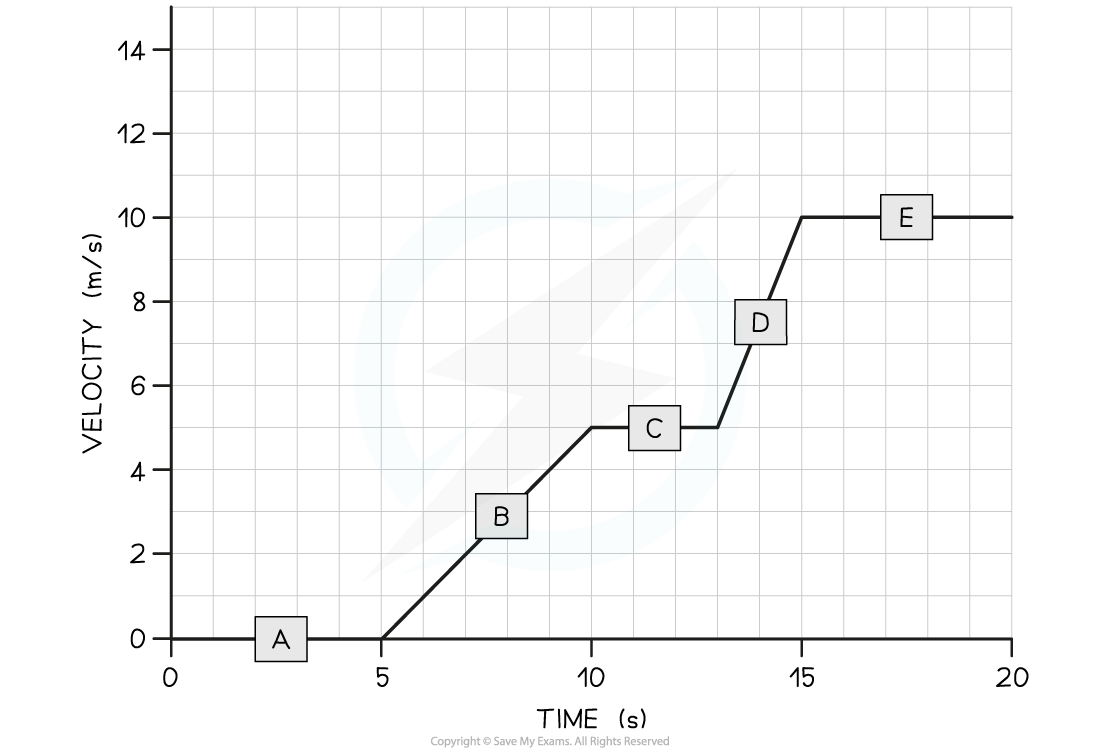
Section D, because it had the steepest slope of all the sections showing acceleration (sections B and D).
What does the area under a velocity-time graph represent?
The area under a velocity-time graph represents the displacement (or distance travelled) by the object.
Define the area of a triangle formula used under a velocity-time graph.
Area = ½ × Base × Height, used when the object is accelerating or decelerating (the area beneath the graph forms a triangle).
What formula is used to calculate the area under a velocity-time graph when an object moves at a constant velocity?
Area = Base × Height, since a constant velocity forms a rectangle shape beneath the graph.
How is the distance travelled estimated when a velocity-time graph is a curve (changing acceleration)?
The distance is estimated by counting the squares underneath the curve, then multiplying the number of squares by the distance represented by each square.
If an object moves with ______ acceleration, its velocity-time graph will be made up of straight lines, and the distance travelled can be calculated exactly using enclosed rectangles and triangles.
If an object moves with constant acceleration, its velocity-time graph will be made up of straight lines, and the distance travelled can be calculated exactly using enclosed rectangles and triangles.
True or False?
The equation distance = speed × time can always be used to find distance from a velocity-time graph, even if the object's speed is changing.
False.
This equation only works for constant speed. If the speed is changing, the distance must be found from the area under the graph (or estimated by counting squares for a curve).
In the worked example with five enclosed areas, how is the total distance travelled by the car found?
The total distance is found by calculating the area of each of the five enclosed shapes (triangles and rectangles) and adding them together.
Which equation of motion applies to objects moving with uniform (constant) acceleration?
v^2^ = u^2^ + 2as
In the equation v^2^ = u^2^ + 2as, what do the symbols u, v, a and s represent?
u = initial speed in metres per second (m/s)
v = final speed in metres per second (m/s)
a = acceleration in metres per second squared (m/s2)
s = distance travelled in metres (m)
When is the equation v^2^ = u^2^ + 2as particularly useful to use?
It is used to calculate initial or final speed, acceleration, or distance travelled in cases where the time taken is not known.
The equation v^2^ = u^2^ + 2as applies to objects moving with ______ acceleration.
The equation v^2^ = u^2^ + 2as applies to objects moving with uniform (constant) acceleration.
True or False?
The equation v^2^ = u^2^ + 2as can be used to calculate the time taken for an object to accelerate.
False.
This equation does not include time. It is used to find distance, speed or acceleration when the time taken is not known.
Define terminal velocity.
Terminal velocity is the constant speed reached by a falling object when air resistance becomes equal to its weight, so the resultant force is zero.
Define g (the acceleration due to gravity).
g is the acceleration due to gravity, equal to 9.8 m/s^2^ near the Earth's surface in the absence of air resistance.
In the absence of air resistance, how does the acceleration of falling objects compare?
All objects fall with the same acceleration, regardless of their mass.
How can the weight of an object be calculated using its mass and g?
weight = mass × *g*
What two forces act on a skydiver as they fall?
Weight (due to gravity) and air resistance (due to friction).
Why does a skydiver accelerate immediately after jumping from a plane?
Their weight is much larger than the air resistance (which is initially very small), producing a large resultant force downwards.
What happens to air resistance as a skydiver's falling speed increases?
It increases, until it grows large enough to balance the downwards weight force.
Once air resistance equals weight, the resultant force is ______, so the skydiver travels at a constant speed called terminal velocity.
Once air resistance equals weight, the resultant force is zero, so the skydiver travels at a constant speed called terminal velocity.
True or False?
A skydiver's weight decreases as they speed up, which is why they reach terminal velocity.
False.
The skydiver's weight stays constant. It is the air resistance that increases with speed until it balances the weight.
What does the gradient (slope) of a velocity-time graph represent?
The acceleration of the object.
How does the gradient of a velocity-time graph change as an object reaches terminal velocity?
It decreases, from being very large down to zero.
What does a negative gradient on a velocity-time graph indicate?
Deceleration (the object is slowing down).
A velocity-time graph can show how an object's velocity changes over time as it reaches ______ velocity.
A velocity-time graph can show how an object's velocity changes over time as it reaches terminal velocity.
True or False?
A skydiver decelerates suddenly when they open their parachute, because air resistance becomes greater than their weight.
True.
Opening the parachute greatly increases air resistance, creating a large unbalanced upwards force that decelerates the skydiver.
Sign up to unlock flashcards
or