NEET Statistics 2026: What UK Students Really Think About Work

Written by: Emma Dow
Reviewed by: Holly Barrow
Published
Contents
NEET in the UK: An Overview
NEET stands for Not in Education, Employment, or Training. It's a term used to describe young people - aged 16 to 24 in the UK - who aren’t studying, aren’t working, and aren’t in any form of formal training or vocational programme.
The NEET classification is a key measure of youth economic engagement. It matters because time spent NEET is associated with poorer long-term outcomes:
Lower earnings
Reduced job quality
Worse physical and mental health
A greater risk of long-term unemployment
The students who are currently in education are still preparing for exams, thinking about their futures, and trying to work out what comes next. This report focuses on them.
Save My Exams surveyed 1,460 UK-based students aged 14-18 to find out:
How worried they are about getting a job
What aspects of working life concern them most
How much careers support they're getting at school
How prepared they really feel for the world of work
We've combined that original data with the latest figures from the ONS, the Department for Education, the House of Commons Library, and others to create the most complete picture of NEET and youth employment available in 2026.
Key Takeaways: Top NEET Statistics
60% of students say finding a job is one of their biggest working life concerns.
55% of students are worried about getting a full-time job after education - including 13% who are very worried.
More than half of students are worried about going to a job interview.
35% of students say they would not feel confident at a job interview.
37% of students say their school or college is not doing enough to help them get a job after education.
Nearly 1 in 3 students (29%) say personalised careers support at school is rare or non-existent.
38% of students have applied for a part-time job and received no response - and 17% say this has happened many times.
Nationally, 1.01 million young people aged 16–24 were NEET in January to March 2026 - the highest figure in over a decade (House of Commons Library).
Student Attitudes to Work & Employment (Primary Data)
The national NEET figures capture what happens after young people leave education.
But what's happening during education? How do students who are still at school, still sitting exams, still working out what they want to do feel about work?
This is less well documented. This section fills that gap.
Who We Surveyed: Student Demographics
Our survey captured responses from 1,460 UK-based students. Here's how the sample broke down:
Level of study:
47% - A Level
45% - GCSE
7% - IGCSE
0.5% - IB
0.5% - Other
Students were based across England, Wales, Scotland, and Northern Ireland
How Worried Are Students About Getting a Job?
Worries about the future are common among secondary school students.
55% of students are worried about getting a full-time job after completing their education - including 13% who describe themselves as very worried.
30% say they're not particularly worried, and just 8% say they're not worried at all and feel confident they'll find a job.
A further 7% of students say they haven't thought about it yet.
A Level students feel the pressure more acutely. 61% of A Level students express some level of worry about finding work after education, compared to 50% of GCSE students.
This gap makes sense given that A Level students are closer to potential employment.
When also asked students which specific aspects of working life concern them:
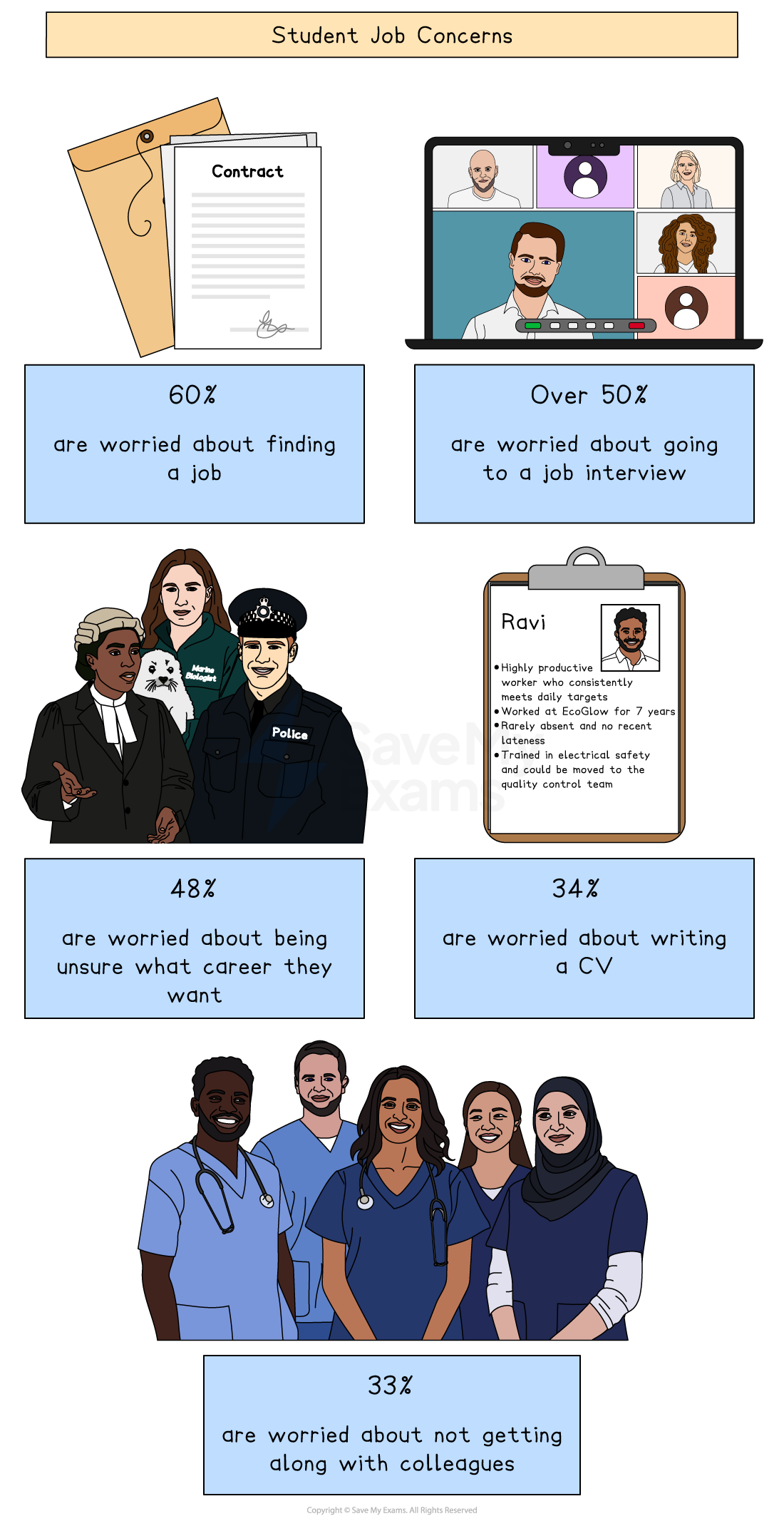
60% are worried about finding a job - the most commonly cited concern by some distance.
Just over half of students are worried about going to a job interview.
48% are worried about not knowing which career they want to pursue.
34% worry about writing a CV.
A third of students worry about not getting along with colleagues.
27% worry about being perceived as lazy by colleagues.
26% are worried about their mental health affecting their ability to work.
16% are anxious about attending an office multiple times a week.
13% worry about taking sick leave.
Just 9% say none of these aspects worry them.
Students aren't just anxious about getting a job. They're anxious about lots of aspects of working life, from managing relationships with colleagues to showing up in person every day.
Confidence Going Into the Workplace
Our data suggests that for a significant proportion of students, they can’t picture themselves feeling confident in the workplace.
Just 12% of students say they would feel very confident if asked to attend a job interview.
46% say they would feel only slightly confident - capable enough, but far from assured.
28% say they would not feel very confident, and a further 7% say they would not feel confident at all.
Combined, 35% of students - more than 1 in 3 - say they lack confidence going into a job interview setting.
7% say they simply don't know how they'd feel.
The confidence gap is consistent across both GCSE and A Level students. 29% of GCSE students say they wouldn't feel very or not at all confident in an interview, compared to 28% of A Level students.
Careers Support at School & College
One of the most significant findings in this survey is the gap between the careers support students receive and the support they need.
For many, it's an occasional event rather than a consistent thread through their education.
Just 16% of students say their school or college offers personalised careers support very regularly.
48% say it happens only occasionally.
29% say it happens rarely or not at all - meaning nearly 1 in 3 students has virtually no access to personalised careers guidance.
When it comes to whether enough is being done overall:
57% of students feel their school is providing at least some help and support with post-education employment.
But 37% say not enough is being done - including 7% who say there is no help at all.
A further 6% don't even know what support is available to them.
Does School Prepare Students for Work?
Most students believe that what they're learning at school has some relevance to their future working lives.
81% of students feel that school or college learning will be at least somewhat transferable to the workplace.
But only 16% feel it is very transferable - meaning the majority of those who answer positively do so with reservations.
14% of students say school learning is not very transferable to the workplace at all
A further 5% of students are unsure.
Student Use of AI to Get Job-Ready
AI tools are already part of how students revise and study. Our data shows they're also beginning to move into job preparation.
39% of students say they have used or would be willing to use AI tools (such as ChatGPT, Claude, or Gemini) to write a CV or prepare for a job interview.
21% are not sure, meaning 60% are either open to or undecided about using AI for this purpose.
41% of students say they would not use AI to get job-ready.
A Level students are slightly more likely than GCSE students to be open to AI job prep: 40% of A Level students say they have used or would consider using AI, compared to 37% of GCSE students.
Student Job-Search Experience So Far
Even before they finish their exams, many students are already getting a taste of the job market, and for a significant number, that early experience includes the reality of applying for a role and not hearing back.
46% of students have never applied for a job at all (part-time, weekend, or holiday work).
38% of all students have applied for a job and received no response - including 17% who say this has happened many times.
Just 12% say they have always heard back when they've applied.
The gap in experience by level of study is stark. 58% of A Level students have applied for a job and been ghosted at least once, compared to just 21% of GCSE students.
This makes sense given that A Level students are older and more likely to have been actively job-hunting. But it also means that a majority of students approaching the end of their formal education have already experienced what it feels like to be ignored by an employer.
Awareness of Pathways
Before students can make good decisions about what comes after school, they need to know what their options are. Some pathways are far more visible than others.
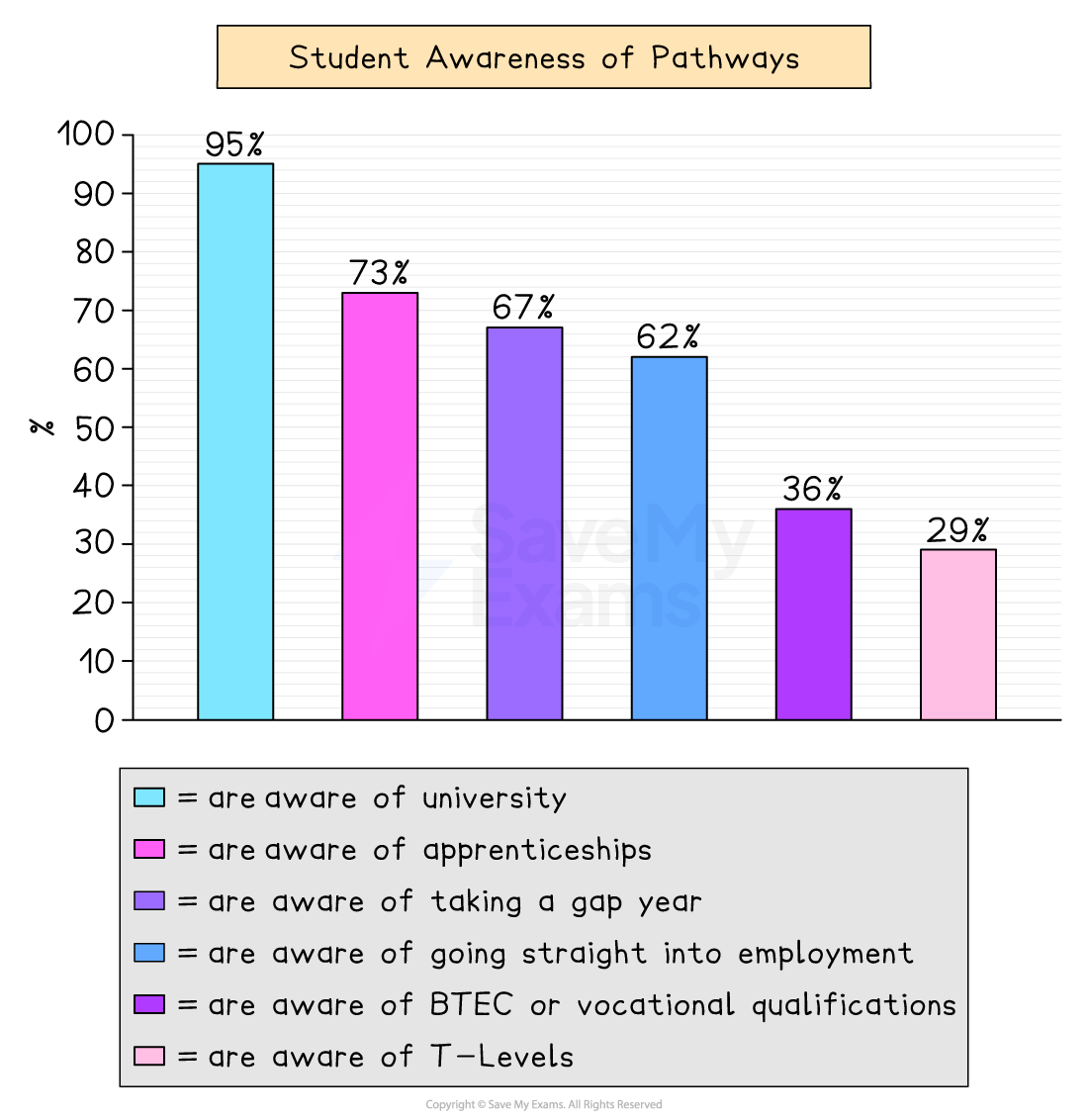
95% of students are aware of university, by far the best-known post-18 pathway.
73% are aware of apprenticeships - well-established as an alternative route.
67% are aware of taking a gap year.
62% are aware of going straight into employment.
36% are aware of BTEC or vocational qualifications.
29% are aware of T-Levels - the newest qualification on the list and by far the least-known.
Introduced in 2020, T Levels are designed to be a direct alternative to A Levels for students wanting a more vocational, work-based qualification.
T-Levels remain invisible to nearly three quarters of secondary school students. If students don't know a pathway exists, they can't choose it, and that limits the range of futures they can imagine for themselves.
UK NEET Rates & Youth Unemployment Statistics
Why Being NEET Matters Right Now
The number of young people aged 16–24 who are NEET in the UK crossed the one million mark in early 2026 for the first time in over a decade.
This UK youth unemployment crisis has focused renewed political attention on the issue.
1.01 million young people aged 16–24 were NEET in January to March 2026 - 14% of all people in that age group (House of Commons Library).
The youth unemployment rate for those aged 16–24 was 16% in April 2026 (Youth Employment UK).
Of the 1.01 million NEET young people, 553,000 were young men and 459,000 were young women. (ONS, 2026).
The 16–17 age group has a significantly lower NEET rate of 6% in 2024, partly due to the legal requirement that means young people have to remain in education or training until 18 in England (Department for Education).
NEET Trends Over Time
The current NEET crisis is not a new problem.
The NEET rate peaked at 17% in 2011, in the aftermath of the global financial crisis (House of Commons Library).
The NEET rate has only fallen below 10% once in 25 years, during the COVID-19 pandemic. (Department for Work and Pensions).
The proportion of NEET young people who are economically inactive (not working and not looking for work) has reached its highest level since 2006, at 7% of all 16–24-year-olds (ONS).
Long-term unemployment among NEET young people has increased, with 2% unemployed for more than six months - the highest rate since 2014 (GOV.uk (opens in a new tab)).
NEET Rates by Region
Youth unemployment is not evenly distributed across the UK. Where a young person grows up has an impact on their employment prospects.
Youth unemployment is highest in London at 25% (London Youth).
Northern Ireland has the lowest youth unemployment rate at 9% (Department for the Economy Northern Ireland).
The North East of England consistently has the highest economic inactivity rate of any UK region, at 28.1%, while the South West has the lowest at 17.2% (ONS Regional Labour Market).
Why Young People Become NEET
Over half of those NEET had a health condition in 2025, with 1 in 5 reporting a mental health condition specifically (GOV.uk (opens in a new tab)).
12% of NEET young people in England recorded Learning Difficulties or Autism Spectrum Condition as their primary health condition in 2025 - up from 8% in 2021 (Department of Work and Pensions).
In response, the government launched a Youth Guarantee in November 2025, backed by £820 million over three years, aimed at ensuring every young person has access to education, employment, or training (House of Commons Library, Youth Guarantee).
Looking Ahead - What Needs to Change
The data from our NEET survey shows that:
More than half of UK students are worried about finding work after education.
Over a third feel under-supported by their school.
Nearly 1 in 3 lacks confidence in a job interview setting.
Almost 1 in 4 has already been ghosted by an employer before they've even finished their exams.
That's a lot of anxiety to be carrying alongside revision and coursework.
However, students are aware of their options - most of them, anyway. And they’re open to new tools, including AI.
What they need is:
More support to bridge the gap between the classroom and the workplace.
More frequent and personalised careers guidance.
More information about what pathways, including T-Levels, BTECs, and apprenticeships, exist and what they lead to.
More skills development to write a CV and prepare for an interview.
That's what the Save My Exams Learning Hub is built for.
Whether you're weighing up university vs an apprenticeship, trying to understand what a T-Level actually involves, or looking for practical guidance on writing a CV and preparing for interviews, the Learning Hub has in-depth guides for every major post-16 pathway - written clearly, without the jargon.
From revision notes to career guides, Save My Exams is with you every step of the way.
Appendix: Full List of NEET Statistics
55% of students are worried about getting a full-time job after completing their education - including 13% who describe themselves as very worried (Save My Exams Survey, 2026)
30% say they're not particularly worried, and just 8% say they're not worried at all and feel confident they'll find a job (Save My Exams Survey, 2026)
7% of students say they haven't thought about it yet (Save My Exams Survey, 2026)
61% of A Level students express some level of worry about finding work after education, compared to 50% of GCSE students (Save My Exams Survey, 2026)
60% are worried about finding a job - the most commonly cited concern by some distance (Save My Exams Survey, 2026)
Just over half of students are worried about going to a job interview (Save My Exams Survey, 2026)
48% of students are worried about not knowing which career they want to pursue (Save My Exams Survey, 2026)
34% of students worry about writing a CV (Save My Exams Survey, 2026)
A third of students worry about not getting along with colleagues (Save My Exams Survey, 2026)
27% of students worry about being perceived as lazy by colleagues (Save My Exams Survey, 2026)
26% of students are worried about their mental health affecting their ability to work (Save My Exams Survey, 2026)
16% of students are anxious about attending an office multiple times a week (Save My Exams Survey, 2026)
13% of students worry about taking sick leave (Save My Exams Survey, 2026)
Just 9% of students say none of these aspects worry them (Save My Exams Survey, 2026)
Just 12% of students say they would feel very confident if asked to attend a job interview (Save My Exams Survey, 2026)
46% say they would feel only slightly confident - capable enough, but far from assured (Save My Exams Survey, 2026)
28% say they would not feel very confident, and a further 7% say they would not feel confident at all (Save My Exams Survey, 2026)
Combined, 35% of students - more than 1 in 3 - say they lack confidence going into a job interview setting (Save My Exams Survey, 2026)
7% of students say they simply don't know how they'd feel (Save My Exams Survey, 2026)
29% of GCSE students say they wouldn't feel very or not at all confident in an interview, compared to 28% of A Level students (Save My Exams Survey, 2026)
Just 16% of students say their school or college offers personalised careers support very regularly (Save My Exams Survey, 2026)
48% say it happens only occasionally (Save My Exams Survey, 2026)
29% say it happens rarely or not at all - meaning nearly 1 in 3 students has virtually no access to personalised careers guidance (Save My Exams Survey, 2026)
57% of students feel their school is providing at least some help and support with post-education employment (Save My Exams Survey, 2026)
But 37% say not enough is being done - including 7% who say there is no help at all.
A further 6% don't even know what support is available to them (Save My Exams Survey, 2026)
81% of students feel that school or college learning will be at least somewhat transferable to the workplace (Save My Exams Survey, 2026)
But only 16% feel it is very transferable - meaning the majority of those who answer positively do so with reservations (Save My Exams Survey, 2026)
14% of students say school learning is not very transferable to the workplace at all (Save My Exams Survey, 2026)
A further 5% of students are unsure about their learning being transferable (Save My Exams Survey, 2026)
39% of students say they have used or would be willing to use AI tools (such as ChatGPT, Claude, or Gemini) to write a CV or prepare for a job interview (Save My Exams Survey, 2026)
21% are not sure, meaning 60% are either open to or undecided about using AI for this purpose (Save My Exams Survey, 2026)
41% of students say they would not use AI to get job-ready (Save My Exams Survey, 2026)
40% of A Level students say they have used or would consider using AI, compared to 37% of GCSE students (Save My Exams Survey, 2026)
46% of students have never applied for a job at all (part-time, weekend, or holiday work)
38% of all students have applied for a job and received no response - including 17% who say this has happened many times (Save My Exams Survey, 2026)
Just 12% say they have always heard back when they've applied (Save My Exams Survey, 2026)
58% of A Level students have applied for a job and been ghosted at least once, compared to just 21% of GCSE students (Save My Exams Survey, 2026)
95% of students are aware of university, by far the best-known post-18 pathway (Save My Exams Survey, 2026)
73% are aware of apprenticeships - well-established as an alternative route (Save My Exams Survey, 2026)
67% are aware of taking a gap year (Save My Exams Survey, 2026)
62% are aware of going straight into employment (Save My Exams Survey, 2026)
36% are aware of BTEC or vocational qualifications (Save My Exams Survey, 2026)
29% are aware of T-Levels - the newest qualification on the list and by far the least-known (Save My Exams Survey, 2026)
1.01 million young people aged 16–24 were NEET in January to March 2026 - 13.5% of all people in that age group (House of Commons Library)
The youth unemployment rate for those aged 16–24 was 16% in April 2026 (Youth Employment UK)
Of the 1.01 million NEET young people, 553,000 were young men and 459,000 were young women (ONS)
The 16–17 age group has a significantly lower NEET rate of 6% in 2024, partly due to the legal requirement that means young people have to remain in education or training until 18 in England (Department for Education)
The NEET rate peaked at 17% in 2011, in the aftermath of the global financial crisis (House of Commons Library)
The NEET rate has only fallen below 10% once in 25 years, during the COVID-19 pandemic. (Department for Work and Pensions)
The proportion of NEET young people who are economically inactive (not working and not looking for work) has reached its highest level since 2006, at 7% of all 16–24-year-olds (ONS)
Long-term unemployment among NEET young people has increased, with 2% unemployed for more than six months - the highest rate since 2014 (GOV.uk (opens in a new tab))
Northern Ireland has the lowest youth unemployment rate at 9% (Department for the Economy Northern Ireland)
The North East of England consistently has the highest economic inactivity rate of any UK region, at 28.1%, while the South West has the lowest at 17.2% (ONS Regional Labour Market)
Over half of those NEET had a health condition in 2025, with 1 in 5 reporting a mental health condition specifically (GOV.uk (opens in a new tab))
12% of NEET young people in England recorded Learning Difficulties or Autism Spectrum Condition as their primary health condition in 2025 - up from 8% in 2021 (Department of Work and Pensions)
In response, the government launched a Youth Guarantee in November 2025, backed by £820 million over three years, aimed at ensuring every young person has access to education, employment, or training (House of Commons Library, Youth Guarantee)
References
Primary Data
Save My Exams NEET Survey, 2026
Secondary Data
House of Commons Library (opens in a new tab)
Youth Employment UK (opens in a new tab)
ONS (opens in a new tab)
Department for Education (opens in a new tab)
Department for Work and Pensions (opens in a new tab)
GOV.uk (opens in a new tab) (opens in a new tab)
London Youth (opens in a new tab)
Department for the Economy Northern Ireland (opens in a new tab)
ONS Regional Labour Market (opens in a new tab)
House of Commons Library, Youth Guarantee (opens in a new tab)
Was this article helpful?
Sign up for articles sent directly to your inbox
Receive news, articles and guides directly from our team of experts.

Share this article

 written revision resources that improve your