Social Media Statistics UK 2026: Insights from 1,000+ UK Students

Written by: Emma Dow
Reviewed by: Holly Barrow
Last updated
Contents
- 1. Social Media Use in the UK: An Overview
- 2. Key Takeaways
- 3. UK Student Social Media Use (Primary Data)
- 4. How Much Time Do UK Students Spend on Social Media?
- 5. Social Media and Studying (Primary Data)
- 6. How Social Media Affects UK Students
- 7. Are UK Students Cutting Back on Social Media?
- 8. Social Media Use Trends (Secondary Data)
- 9. The Future of Social Media and Student Life
- 10. Appendix: Full List of Statistics
- 11. References
Social Media Use in the UK: An Overview
Students spend a significant amount of time on social media – whether they’re messaging friends, watching videos, discovering music, or even revising for exams.
But the conversation has shifted. With the social media ban for under-16s being introduced from Spring 2027, the debate about young people and social media has never been more live.
Headlines tend to be extreme - social media is either destroying a generation or being unfairly blamed. But the debate is more nuanced. And very little research is asking what life online looks like for a 15-year-old revising for their GCSEs.
That’s what we wanted to find out. Save My Exams surveyed 1,081 UK students aged 14-18 - studying GCSEs, A Levels, the IB, and the IGCSE - about their:
Social media habits
How they use platforms to support their studies
How it makes them feel
How their behaviour shifts during exam season
We've combined that original data with the latest figures from Ofcom, UNICEF, and others to build the most detailed picture of student social media use in the UK in 2026.
Key Takeaways
YouTube is the most widely used platform among UK students, with 84% using it.
43% of students spend two or more hours on social media on a school day.
Half of all students (51%) use social media in bed before going to sleep on a school night.
83% of students use social media to watch study or revision videos.
74% of students agree that social media has helped them learn or understand something for their studies.
64% of students agree that social media makes it harder for them to concentrate.
89% of students agree that social media helps them stay connected to their friends.
71% of students say their social media use decreases during exam season.
77% of students have tried to cut down on or take a break from social media.
UK Student Social Media Use (Primary Data)
Who We Surveyed: Student Demographics
Our survey captured responses from 1,081 UK-based students aged 14-18. Here's how the sample broke down:
Level of study:
48% - GCSE
44% - A Level
6% - IGCSE
1% - IB
1% - Other
Gender:
64% - female
32% - male
3% - prefer not to say
1% - non-binary
The majority were based in England (97%), with further responses from Scotland, Wales, and Northern Ireland
Only UK-based student responses were included in the analysis.
Most-Used Social Media Platforms Among UK Students
Students are on many platforms. Our survey asked students which platforms they use, and the spread reflects the varied role social media plays in their lives: entertainment, connection, learning, and everything in between.
YouTube is the most widely used platform overall, with 84% of students using it.
Snapchat (67%), Instagram (65%) and TikTok (65%) are all used by around two thirds of students.
Pinterest is more popular than many might expect among this age group, used by 56% of students.
Reddit (15%), X/Twitter (10%) and Facebook (10%) are used by smaller shares.
Just 3% of students say they don't use any social media platforms at all.
When students name the single platform they use the most, the picture changes:
TikTok leads as the most-used platform at 39%, despite not being the most widely used.
YouTube comes second at 24%.
Instagram (15%) and Snapchat (14%) are close behind.
Pinterest is named by 5% as their most-used platform.
Just 0.5% name Reddit and 0.4% name Facebook.
The gap between YouTube's reach (84% use it) and its share of primary use (24%) is telling. YouTube is everywhere, but TikTok is where students spend the most concentrated time.
Gender shapes platform preferences too.
Female students are more likely to name TikTok as their most-used platform (41%) compared to male students (35%).
Male students are almost twice as likely to name YouTube as their primary platform (33%) compared to female students (18%).
How Much Time Do UK Students Spend on Social Media?
Average Daily Time on Social Media on a School Day
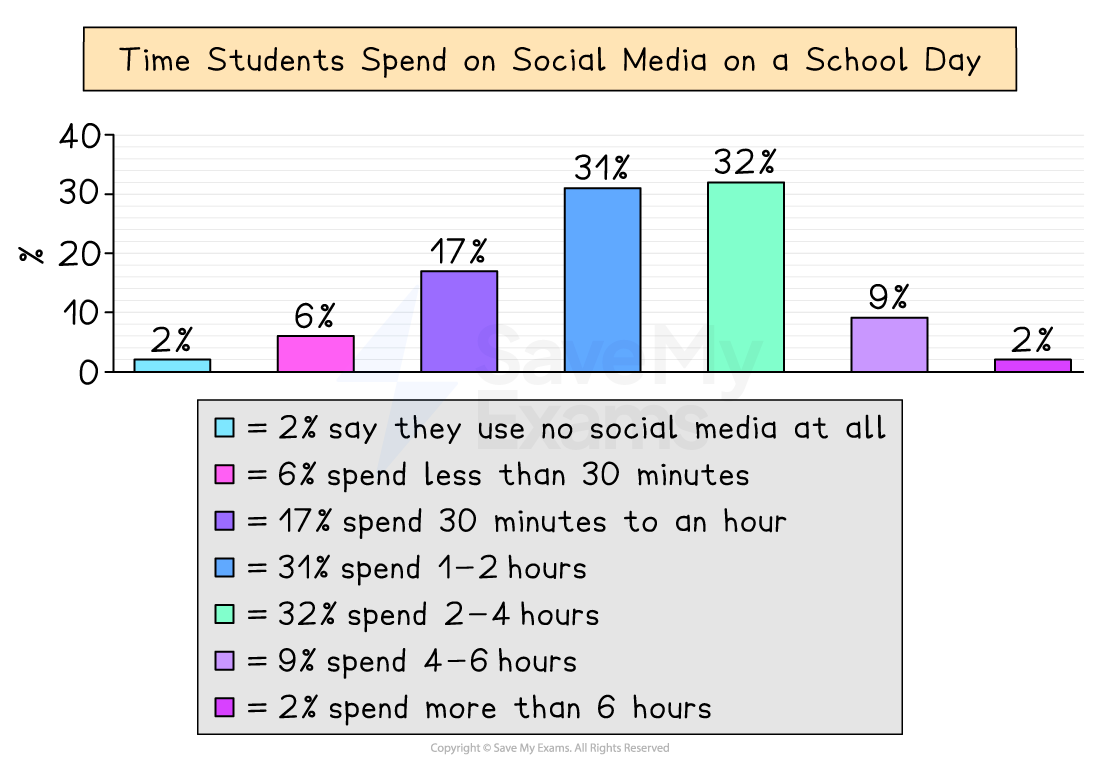
Even on a school or college day when lessons and revision compete for attention, most students are spending time on social media.
31% of students spend 1-2 hours on social media on a school day.
32% spend 2-4 hours making this the single most common time band.
9% spend 4-6 hours, and 2.0% spend more than 6 hours
Combined, 43% of students spend two or more hours on social media on a school day.
11% spend four or more hours on a day that also includes school, homework, and revision.
At the other end, 6% spend less than 30 minutes and 17% spend 30 minutes to an hour, meaning 23% of students keep daily social media use under an hour.
Just 2% say they use no social media at all on a school day.
When Students Use Social Media Across the Day
The pattern of when students use social media reveals how deeply integrated social media has become into the rhythms of a school day.
Straight after school is the peak time for social media use, cited by 66% of students.
51% use social media in bed before sleep, meaning half of all students are on platforms as part of their bedtime routine on school nights.
30% use social media before school, starting the day with platforms before lessons begin.
A quarter of students use social media while doing homework or revision.
16% of students use it during school breaks or lessons.
15% use social media during the night.
The bedtime and overnight figures are concerning as late-night social media use is associated with disrupted sleep. (opens in a new tab)
For students in the middle of exam preparation, poor sleep has direct consequences for performance and memory consolidation.
Social Media and Studying (Primary Data)
How Students Use Social Media to Support Their Studies
Social media and studying feel like they’re opposites. But that’s not true. For the vast majority of students, social media plays an active role in how they learn.
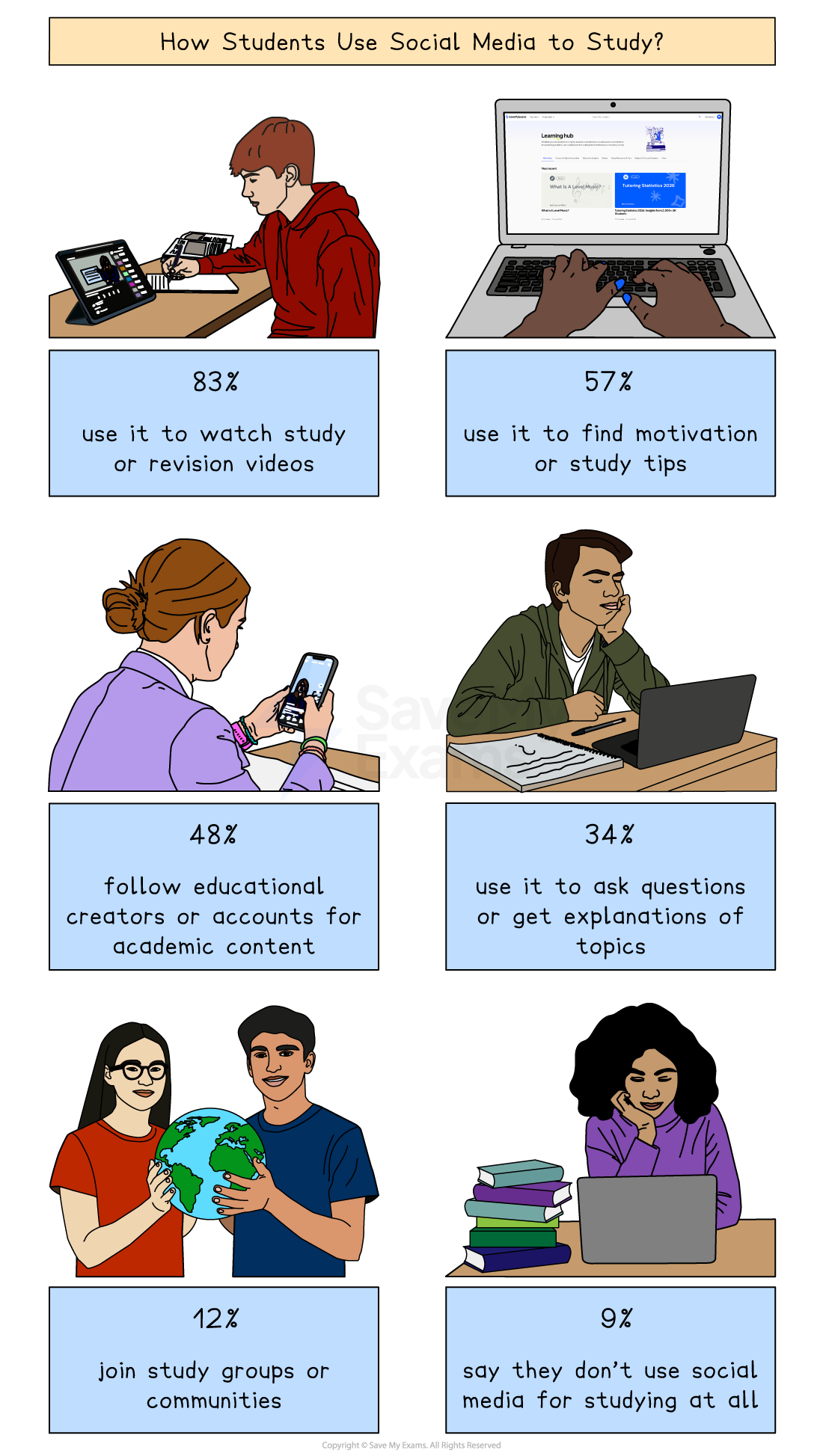
83% of students use social media to watch study or revision videos, making this by far the most common academic use of social platforms.
57% of students use social media to find motivation or study tips.
48% follow educational creators or accounts specifically for academic content.
34% use social media to ask questions or get explanations of topics they're struggling with.
12% join study groups or communities through social platforms.
Just 9% say they don't use social media for studying at all.
The rise of educational content on platforms like YouTube, TikTok, and Instagram has created an alternative to traditional revision resources.
StudyTok, revision accounts, and subject-specific creators have built large followings among GCSE and A Level students.
For many students, a well-explained two-minute video is a more accessible entry point to a difficult topic than a textbook page.
Does Social Media Help Students to Learn?
The answer, according to students themselves, is a clear yes, with very few exceptions.
74% of students agree or strongly agree that social media has helped them learn or understand something for their studies.
17% of students neither agree nor disagree that social media has helped them learn.
Only 6% disagree that social media has helped their learning.
That's nearly three quarters of students crediting social media with a contribution to their education.
Whether it's a YouTube explainer on photosynthesis, a TikTok breaking down a poetry technique, or an Instagram carousel walking through a maths method, educational content on social platforms is reaching students in ways that feel accessible and relevant.
Is Social Media a Distraction?
Alongside its educational value, social media also presents a concentration challenge. Students are aware of this.
64% of students agree or strongly agree that social media makes it harder for them to concentrate on their studies.
20% neither agree nor disagree that social media affects their concentration.
Just 14% disagree that social media affects their concentration.
There is overlap between the students who say social media helps them learn (74%) and those who say it makes concentration harder (64%). Both things can be true.
The concentration challenge is more acute for older students.
70% of A Level students agree that social media makes it harder to concentrate, compared to 58% of GCSE students.
This may reflect A Level students spending more time studying independently - away from the structured environment of a classroom, where the temptation to check a phone is more present.
Social Media Use During Exam Season
When exams arrive, social media habits change.
71% of students say their social media use decreases during exam season, including 29% who say it decreases a lot.
15% of students say their use stays the same.
12% of students say their use increases, including 3% who say it increases a lot.
The fact that seven in ten students consciously reduce their social media use during exams suggests that most students do recognise the impact of social media on their focus.
How Social Media Affects UK Students
How Social Media Makes Students Feel
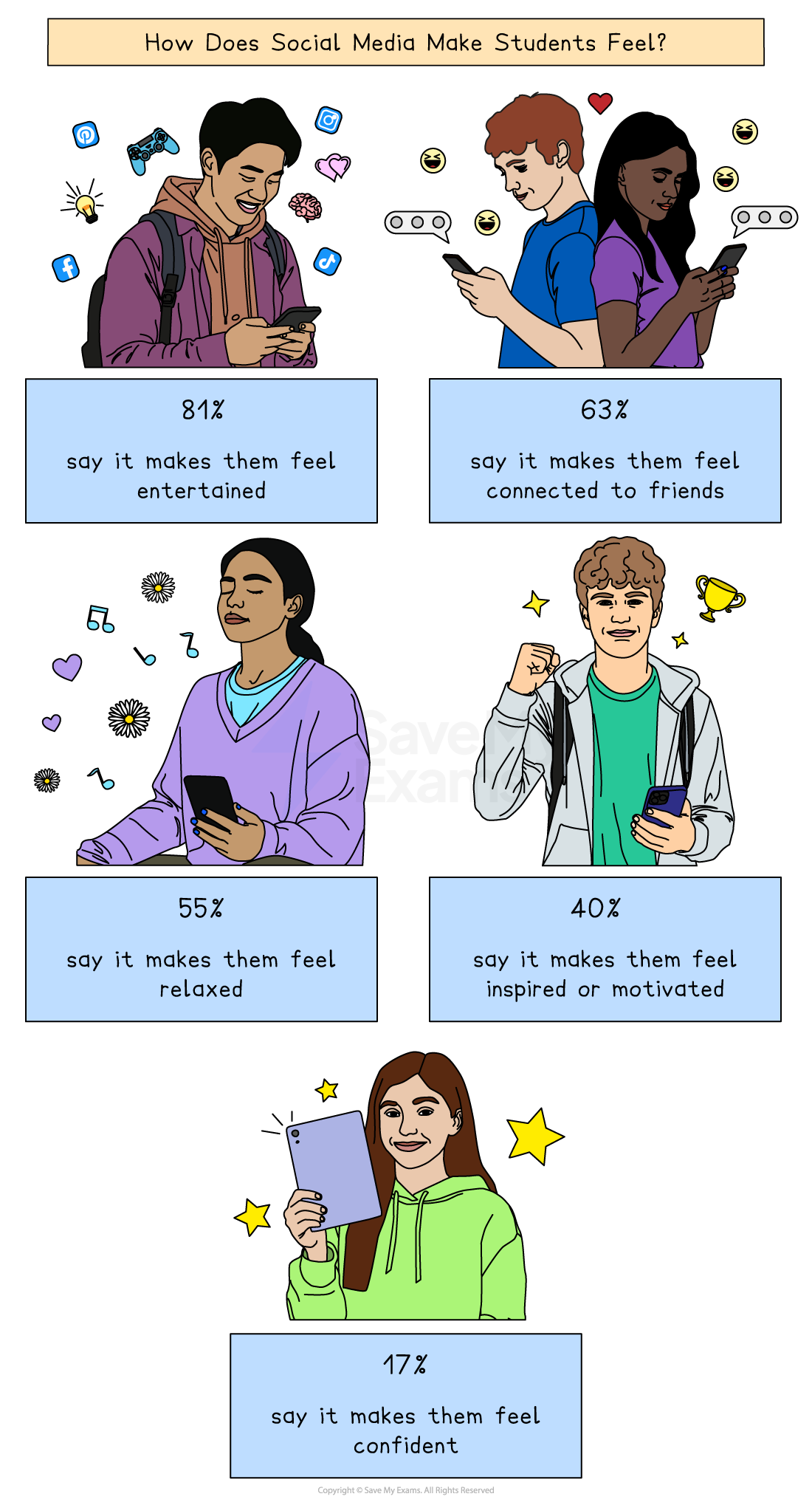
When we asked students how social media usually makes them feel, the responses were balanced. The most common feelings were positive ones, but the pressures and anxieties of social media were also present.
81% of students say social media usually makes them feel entertained.
63% of students say it makes them feel connected to friends.
55% of students say it makes them feel relaxed.
40% of students say it makes them feel inspired or motivated.
17% of students say it makes them feel confident.
But alongside those positives:
46% of students say social media usually makes them feel distracted.
17% of students say it makes them feel pressured to look a certain way.
16% of students experience FOMO (fear of missing out).
14% of students say social media makes them feel anxious.
Are UK Students Cutting Back on Social Media?
Most students have, at some point, tried to use social media less. The question is whether those attempts stick.
77% of students have tried to cut down on or take a break from social media at some point.
Of those who tried, 42% went back to their previous habits.
35% say they succeeded in cutting down or taking a break.
9% of students say they've never tried to cut back but would like to.
Just 13% say they've never wanted to reduce their social media use.
Social Media Use Trends (Secondary Data)
Growth in UK Social Media Use
Social media use in the UK continues to rise.
There are 55.5 million social media user identities in the UK - equivalent to 80% of the total population (DataReportal).
99% of Gen Z and Millennials in the UK use at least one social platform every day (Youth Sport Trust).
UK users spend an average of 1 hour 46 minutes per day on social media (Ofcom).
Smartphone Usage and Platform Growth
97% of UK teenagers aged 13 to 15 now own a mobile phone (GOV.uk (opens in a new tab)).
91% of 13-18-year-olds use social media regularly (Children’s Commissioner).
WhatsApp's reach extends to 92% of UK online adult smartphone users, making it the most-visited smartphone app in the UK (Ofcom).
TikTok has 30 million active users in the UK each month (TikTok).
Instagram has 35.5 million users in the UK, with its reach increasing to 81% among 18–34-year-olds (Statista).
Reddit has 46 million users in the UK (World Population Review).
20% of all TV journeys for 4-15 year olds start with YouTube (Ofcom Media Nation Report).
80% of 16-24-year-olds go online to get their news, and 75% specifically go to social media (BBC Bitesize).
Social Media and Young People: The Policy Debate
Social media's role in young people's lives has become a contested issue in UK politics.
Instagram, YouTube, TikTok, Snapchat, Facebook and X are due to be banned for children aged under 16 in the UK from Spring 2027 (Department for Science, Innovation and Technology).
Australia introduced a social media ban for under-16s in late 2024 - the first country in the world to do so (UNICEF Australia).
41% of Gen Z (14-29 year olds) use social media platforms (especially TikTok and Instagram) as their primary search engines (Sprout Social).
Social media is not simply good or bad for young people - it’s both, and often at the same time.
The students in our survey reflect that complicated nuance. They're entertained and distracted, connected and anxious, learning and struggling to focus. This is why the policy debate remains so live.
The Future of Social Media and Student Life
The social media platforms that dominate student life also host some of the most effective educational content available, and the connection they provide to friends is important.
Students are navigating the challenge of using social media effectively:
To get the study tips and revision videos without the distraction.
To stay connected without losing hours to the scroll.
To cut back during exam season without feeling left out.
With the potential social media ban for young people under 16 being introduced from Spring 2027, the future of student life and social media is uncertain.
It’s clear from the survey data that young people are making choices, cutting back during exams, using platforms to learn, and have an awareness of the effect social media is having on their wellbeing.
That balance deserves to be worked on. Because not everything online is a distraction.
Appendix: Full List of Statistics
YouTube is the most widely used platform overall, with 84% of students using it.
Snapchat (67%), Instagram (65%) and TikTok (65%) are all used by around two thirds of students.
Pinterest is more popular than many might expect among this age group, used by 56% of students.
Reddit (15%), X/Twitter (10%) and Facebook (10%) are used by smaller shares.
Just 3% of students say they don't use any social media platforms at all.
TikTok leads as the most-used platform at 39%, despite not being the most widely used.
YouTube comes second at 24%.
Instagram (15%) and Snapchat (14%) are close behind.
Pinterest is named by 5% as their most-used platform.
Just 0.5% name Reddit and 0.4% name Facebook as their most-used platform.
Female students are more likely to name TikTok as their most-used platform (41%) compared to male students (35%).
Male students are almost twice as likely to name YouTube as their primary platform (33%) compared to female students (18%).
31% of students spend 1-2 hours on social media on a school day.
32% spend 2-4 hours making this the single most common time band.
9% spend 4-6 hours, and 2.0% spend more than 6 hours
Combined, 43% of students spend two or more hours on social media on a school day.
11% spend four or more hours on a day that also includes school, homework, and revision.
At the other end, 6% spend less than 30 minutes and 17% spend 30 minutes to an hour, meaning 23% of students keep daily social media use under an hour.
Just 2% say they use no social media at all on a school day.
Straight after school is the peak time for social media use, cited by 66% of students.
51% use social media in bed before sleep, meaning half of all students are on platforms as part of their bedtime routine on school nights.
30% use social media before school, starting the day with platforms before lessons begin.
A quarter of students use social media while doing homework or revision.
16% of students use it during school breaks or lessons.
15% of students use social media during the night.
83% of students use social media to watch study or revision videos, making this by far the most common academic use of social platforms.
57% of students use social media to find motivation or study tips.
48% follow educational creators or accounts specifically for academic content.
34% use social media to ask questions or get explanations of topics they're struggling with.
12% join study groups or communities through social platforms.
Just 9% say they don't use social media for studying at all.
74% of students agree or strongly agree that social media has helped them learn or understand something for their studies.
17% of students neither agree nor disagree that social media has helped them learn.
Only 6% disagree that social media has helped their learning.
64% of students agree or strongly agree that social media makes it harder for them to concentrate on their studies.
20% neither agree nor disagree that social media affects their concentration.
Just 14% disagree that social media affects their concentration.
70% of A Level students agree that social media makes it harder to concentrate, compared to 58% of GCSE students.
71% of students say their social media use decreases during exam season, including 29% who say it decreases a lot.
15% of students say their use stays the same.
12% of students say their use increases, including 3% who say it increases a lot.
81% of students say social media usually makes them feel entertained.
63% of students say it makes them feel connected to friends.
55% of students say it makes them feel relaxed.
40% of students say it makes them feel inspired or motivated.
17% of students say it makes them feel confident.
46% of students say social media usually makes them feel distracted.
17% of students say it makes them feel pressured to look a certain way.
16% of students experience FOMO (fear of missing out).
14% of students say social media makes them feel anxious.
77% of students have tried to cut down on or take a break from social media at some point.
Of those who tried, 42% went back to their previous habits.
35% say they succeeded in cutting down or taking a break.
9% of students say they've never tried to cut back but would like to.
Just 13% say they've never wanted to reduce their social media use.
There are 55.5 million social media user identities in the UK - equivalent to 80% of the total population (DataReportal)
99% of Gen Z and Millennials in the UK use at least one social platform every day (Youth Sport Trust)
UK users spend an average of 1 hour 46 minutes per day on social media (Ofcom)
WhatsApp's reach extends to 92% of UK online adult smartphone users, making it the most-visited smartphone app in the UK (Ofcom)
TikTok has 30 million active users in the UK each month (TikTok)
Instagram has 35.5 million users in the UK, with its reach increasing to 81% among 18–34-year-olds (Statista)
Reddit has 46 million users in the UK (World Population Review)
80% of 16-24-year-olds go online to get their news, and 75% specifically go to social media (BBC Bitesize)
20% of all TV journeys for 4-15 year olds start with YouTube (Ofcom Media Nation Report)
97% of UK teenagers aged 13 to 15 now own a mobile phone (GOV.uk (opens in a new tab))
91% of 13-18-year-olds use social media regularly (Children’s Commissioner)
Instagram, YouTube, TikTok, Snapchat, Facebook and X are due to be banned for children aged under 16 in the UK from Spring 2027 (Department for Science, Innovation and Technology)
Australia introduced a social media ban for under-16s in late 2024 - the first country in the world to do so (UNICEF Australia)
41% of Gen Z (14-29 year olds) use social media platforms (especially TikTok and Instagram) as their primary search engines (Sprout Social)
References
Primary Data
Save My Exams Social Media Statistics Survey, 2026
Secondary Data
DataReportal (opens in a new tab)
Youth Sport Trust (opens in a new tab)
Ofcom (opens in a new tab)
TikTok (opens in a new tab)
Statista (opens in a new tab)
World Population Review (opens in a new tab)
Ofcom Media Nation Report (opens in a new tab)
GOV.uk (opens in a new tab) (opens in a new tab)
Children’s Commissioner (opens in a new tab)
Department for Science, Innovation and Technology (opens in a new tab)
UNICEF Australia (opens in a new tab)
Sprout Social (opens in a new tab)
BBC Bitesize (opens in a new tab)
PMC - Social Media Use and Sleep Disturbance among Adolescents: A Cross-Sectional Study (opens in a new tab)
Was this article helpful?
Sign up for articles sent directly to your inbox
Receive news, articles and guides directly from our team of experts.

Share this article

 written revision resources that improve your