Tutoring Statistics 2026: Insights from 2,000+ UK Students

Written by: Emma Dow
Reviewed by: Holly Barrow
Published
Contents
- 1. Key Takeaways: Top Statistics About Tutoring
- 2. Tutoring Among UK Students (Primary Data)
- 3. Tutoring Trends in the UK
- 4. The Cost of Tutoring in the UK
- 5. How Tutoring Impacts Academic Outcomes
- 6. Inequality & Access to Tutoring
- 7. AI, Revision Platforms & The Future of Tutoring
- 8. Future Revision & Learning Trends
- 9. Appendix: Full List of Tutoring Statistics
- 10. References
The conversation around tutoring rarely starts with students.
The bulk of the research focuses on market size, regional patterns, or socioeconomic access. Less attention is paid to why students seek tutoring, what difference it makes to their confidence and grades, and what those without a tutor do instead.
That's what this report sets out to explore.
Save My Exams surveyed 2,095 UK students aged 14–18 studying GCSEs, A Levels, the IB, and IGCSEs. We asked about:
Their tutoring habits
Their revision behaviour
How they access academic support
We've combined that original data with the latest research from the Sutton Trust, the Education Endowment Foundation, and others to build the most detailed tutoring statistics for 2026.
Here's what we found.
Key Takeaways: Top Statistics About Tutoring
56% of students have had a private tutor at some point.
83% of students say their tutor has helped improve their grades.
Maths is the most tutored subject, with 73% of tutored students receiving Maths support.
79% of students with a tutor say it has improved their confidence going into exams.
65% of all students - with or without a tutor - agree that having a private tutor gives students an unfair advantage over those who cannot access one.
Among students without a tutor, 93% use revision platforms and 56% use AI tools for extra academic support.
Tutoring Among UK Students (Primary Data)
This section focuses on our original survey of 2,095 UK students to explore tutoring usage, motivation, subject demand, and the alternatives students rely on when a tutor isn't available.
Who We Surveyed: Student Demographics
Total UK respondents: 2,095
Level of study:
School type:
60% - state school
21% - private/independent
15% - grammar school
4% - other
Tutoring Usage Statistics
More than half of all students we surveyed have had a private tutor at some point in their secondary education.
31% of students currently have a private tutor, while a further 25% have had one in the past but don't currently - meaning 56% have accessed private tutoring at some point.
16% don't have a tutor but would like one, suggesting demand is even higher than usage figures alone would indicate.
29% say they don't have a tutor and don't feel they need one.
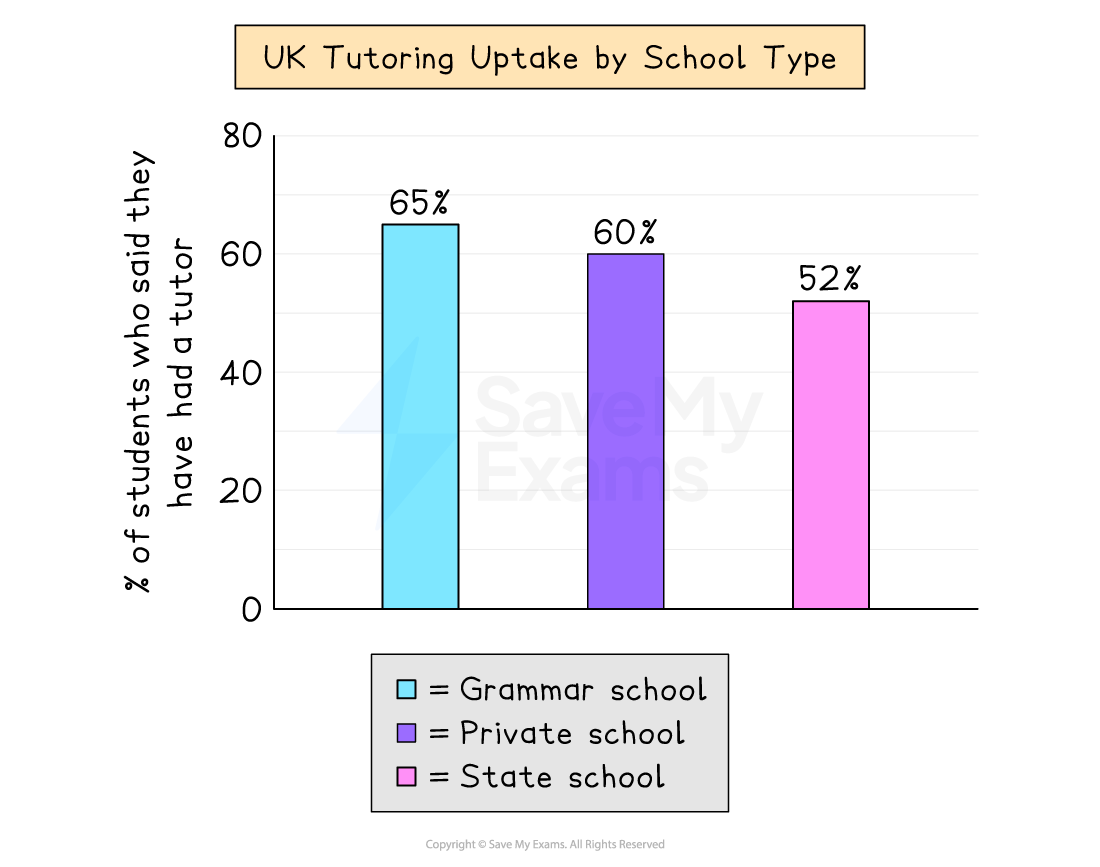
Tutoring rates vary by school type.
Grammar school students were the most likely to have ever had a tutor, with 65% saying they'd had one at some point.
Private school students came next at 60%.
State school students were least likely at 52% - though that still means more than half of state school students have accessed private tutoring.
GCSE and IGCSE students were slightly more likely than A Level students to have ever had a tutor:
GCSE: 56% have had a tutor.
IGCSE: 58% have had a tutor.
A Level: 54% have had a tutor.
When it comes to format, online tutoring now dominates:
41% of tutored students are taught online only (via video call).
3 in 10 students use a mix of online and in-person.
28% are taught in person only.
Combined, 71% of tutored students receive at least some of their tutoring online.
In the vast majority of cases, tutoring is a parental investment rather than a student-led one. Among those with a tutor:
93% say their parents arranged and paid for it.
3% found and paid for tutoring themselves.
2% have their tutoring provided by their school.
1% are supported by a charity or external organisation.
Subject-Specific Tutoring Demand
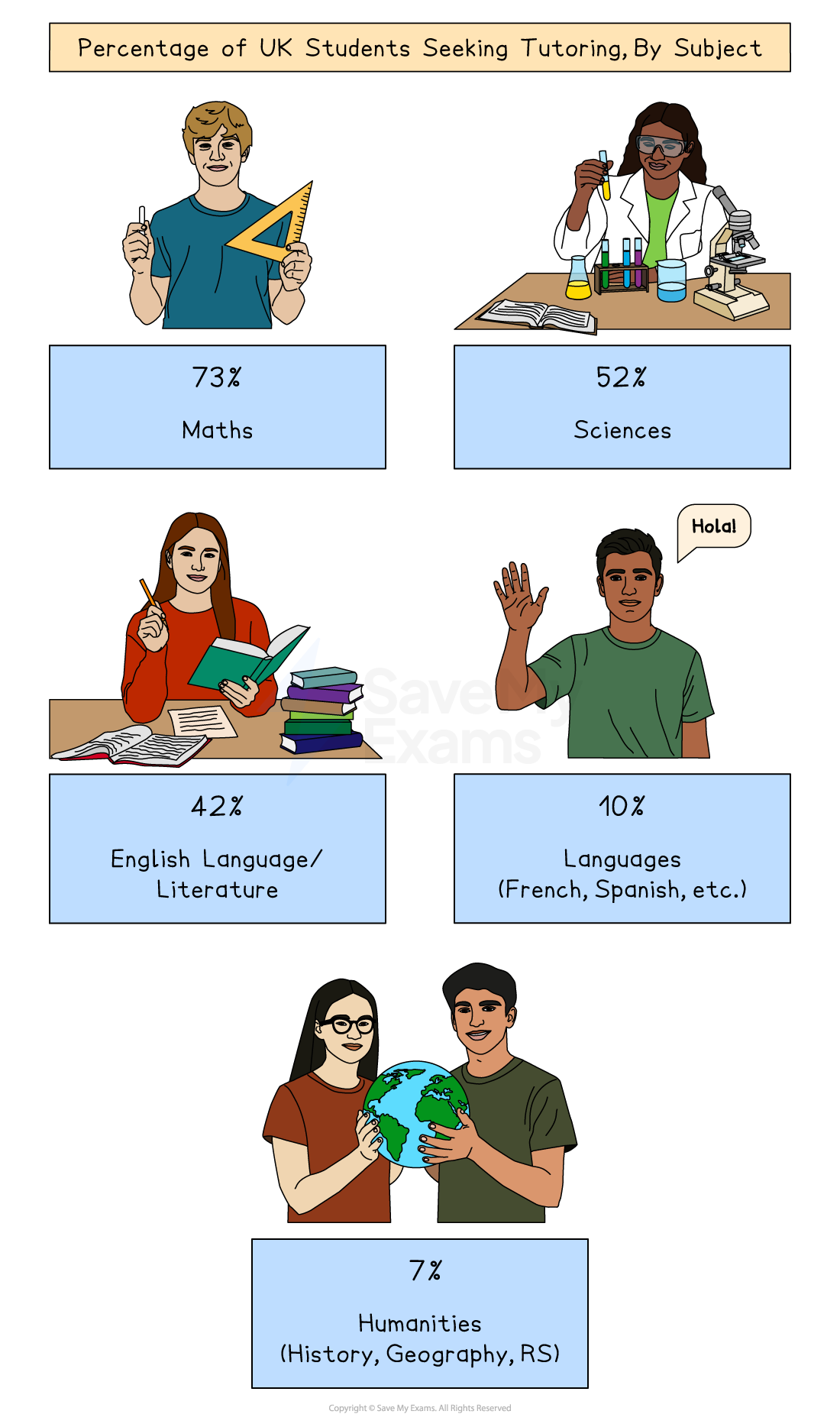
Maths dominates tutoring demand and the sciences are not far behind.
Here’s a breakdown of the subject areas most sought after by students when accessing tutoring:
Maths: 73%
Sciences (Biology, Chemistry, Physics): 52%
English Language / English Literature: 42%
Languages (French, Spanish, etc.): 10%
Humanities (History, Geography, RS): 7%
It’s not surprising Maths dominates given its importance as a core subject in the curriculum. Students at GCSE level need to score a 4 to have the widest variety of post-16 options.
Exam Stress & Tutoring Motivation
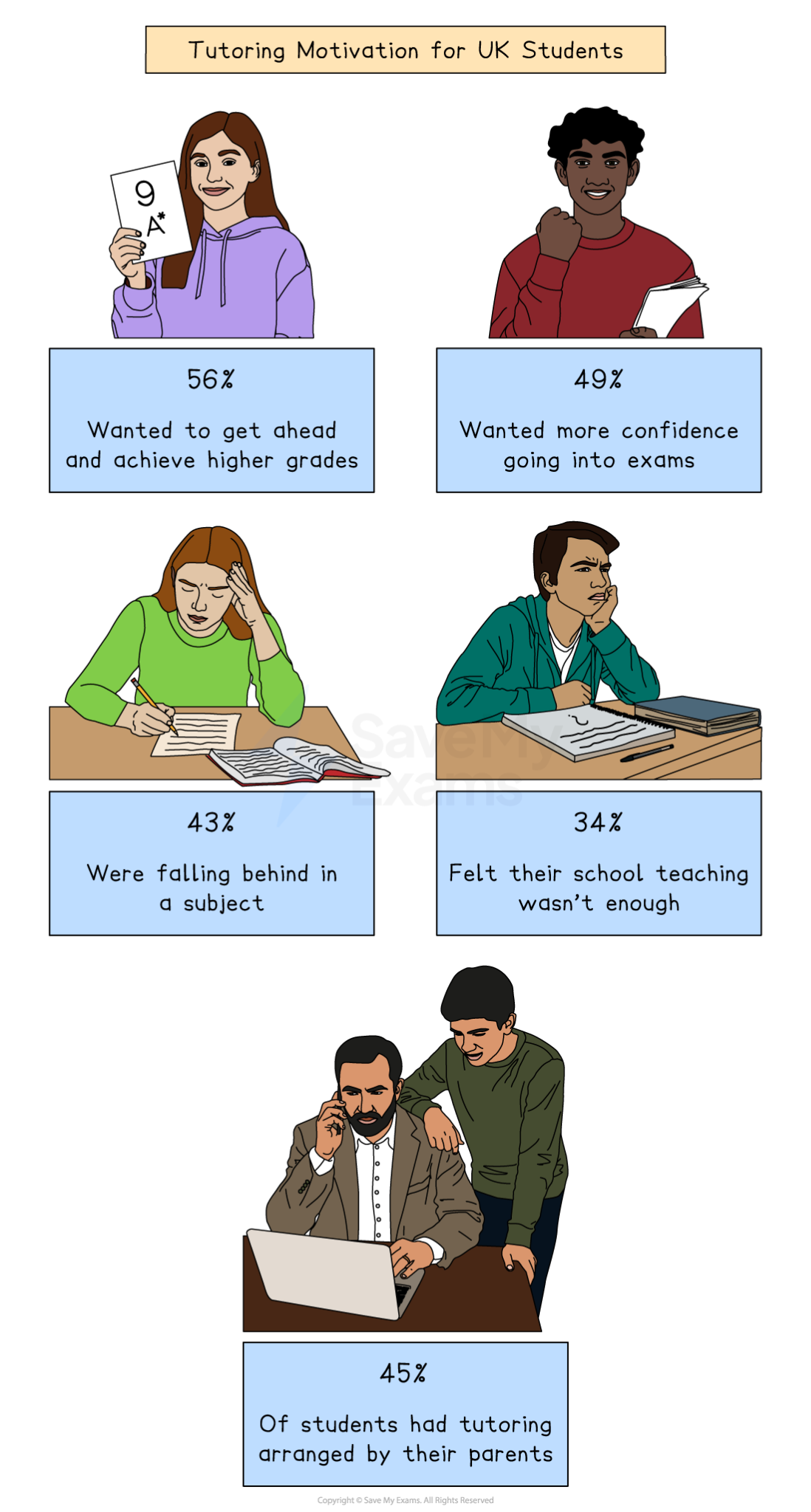
Why do students start having tutoring? For the 1,163 students in our survey who have had a tutor, exam anxiety and ambition influence that decision.
56% wanted to get ahead and achieve higher grades, making academic ambition the biggest driver of tutoring demand.
49% wanted more confidence going into exams, showing that emotional readiness matters as much as knowledge.
43% were falling behind in a subject, while a further 34% felt their school teaching wasn't enough to get them where they needed to be
45% of students had tutoring arranged by their parents.
The data suggests that tutoring isn’t solely an intervention. More students seek it to improve performance rather than to rescue themselves from falling behind.
Revision Behaviour & Study Habits
For students without a tutor, the question is: what do they use instead? The answer is digital and shows how central online platforms have become to student revision.
The primary sources of extra academic support for the 932 students without a tutor were:
Revision platforms (e.g. Save My Exams, etc): 93%
YouTube tutorials: 66%
AI tools (e.g. ChatGPT): 56%
School-run revision sessions: 46%
Peer study / study groups with friends: 29%
No extra support at all: 1%
The near-blanket use of online revision platforms among non-tutored students - 93% - is striking. For the majority of students who don't have a tutor, structured digital revision resources have become a vital form of academic support.
Barriers to Tuition
Nearly 1 in 5 students cited cost as the main barrier to having a tutor - this underlines the affordability challenge in access to private tutoring.
The full breakdown of reasons for not having a tutor:
23% of respondents said they use other resources instead
22% felt they did not need a tutor.
1 in 5 students reported that they could not afford one
13% said they preferred to study independently.
A smaller proportion indicated that their parents did not think they needed a tutor (7%), that their school provided enough support (4%), or that they did not know how to find one (4%).
Tutoring Trends in the UK
Growth of Private Tutoring
Private tutoring in the UK has grown over the past two decades, and shows no sign of slowing down.
Parents spend an estimated £6 billion annually on private tutoring in the UK (Enterprise Skills).
The UK tutoring market is projected to reach USD 2.34 billion by 2026, reflecting consistent year-on-year growth since the pandemic (Fortune Business Insights).
Our own data puts the popularity of tutoring even greater than the Sutton Trust's national figures, with 56% of surveyed students saying they have had a tutor at some point.
This reflects the profile of our survey respondents - students who are actively engaged in their exam preparation.
Online Tutoring Trends
The shift to online tutoring has been one of the most significant changes in the sector since the pandemic.
71% of tutored students in our survey receive at least some of their tutoring online.
The UK made up 5% of the global online tutoring services market in 2024 (Grand View Research).
In 2026, 29% of secondary school students in England and Wales had private tutoring - up from 18% in 2006 (Sutton Trust).
Tutoring Demand by Age Group
Demand for tutoring peaks in the run-up to high-stakes exams, but the data suggests it's becoming embedded earlier in students' education too.
In 2023/24, 723,956 National Tutoring Programme courses took place in primary schools (gov.uk (opens in a new tab)).
Year 11 is the peak year for private tutoring, with 25% of pupils receiving tuition, followed by Year 10 at 10% (Sutton Trust).
The Department for Education made £500 million available to 16 to 19 providers so that they can offer tutoring demands (Ofsted).
The Cost of Tutoring in the UK
Average Tutoring Costs
Private tutoring comes at a significant cost for most families, and that cost varies depending on subject, level, format, and location.
Online tutoring costs, on average, £37.45 an hour (Tutorful).
A Level tuition averages at £30-60 an hour (Save My Exams).
Tuition delivered through the National Tutoring Programme is subsidised at an average cost of £167 – £180 per pupil for a 15-hour block (Education Endowment Fund).
For a family paying for weekly tutoring sessions throughout the academic year, the cost quickly adds up.
At an average of £38 per hour, one session per week across a 38-week school year would cost over £1,400 per subject. This is a huge outlay that places consistent tutoring beyond the reach of many households.
With the National Tutoring Programme having ended and no like-for-like replacement in place, families who can’t afford private rates have to rely on school-based support.
Socioeconomic Differences
There is a clear gap between wealthier and less affluent students’ ability to access private tutoring.
23% of students from the least affluent households have had private tutoring, compared to 30% from the most affluent (Sutton Trust, 2026).
Children from higher-income families in England were 20% more likely to get into a grammar school than children from low-income families due to private tutor access (Nuffield Foundation).
Access to tutoring is not evenly distributed.
In our survey, state school students (52%) were less likely to have ever had a tutor than grammar school (65%) or private school students (60%) - a gap of 13 percentage points between state and grammar school students.
How Tutoring Impacts Academic Outcomes
The evidence on tuition effectiveness is strong.
Access to tuition can help students make up to 5 months of additional academic progress (Education Endowment Fund).
Students having 1:1 tuition at school were 4% less likely to be absent (Fordham Institute).
In 2028, a low-cost tutoring pilot boosted struggling pupils’ maths results by +3 months (Education Endowment Fund).
Inequality & Access to Tutoring
Regional and Demographic Differences
Where a student lives has a bearing on whether they have access to private tutoring.
And the gap between state and independent school students in our survey is consistent across every measure
In London, 45% of pupils have had private tutoring, compared to 27% in the rest of England (Sutton Trust, 2026).
Tutoring is higher at grammar schools (23%) than state schools (18%) (Sutton Trust - New Landscape).
This mirrors our survey data: 65% of grammar school students vs 52.0% of state school students have had a private tutor (Save My Exams Survey, 2026).
AI, Revision Platforms & The Future of Tutoring
Rise of AI Learning Tools
AI has become a mainstream revision tool.
93% of students have used AI tools for schoolwork or revision (Save My Exams).
In January 2026, the government announced plans to introduce AI tutoring tools in schools, targeted at disadvantaged pupils, with a pilot programme scheduled for 2027 (Sutton Trust, 2026).
Approximately 450,000 disadvantaged pupils could benefit from AI tutoring tools from 2027 (Department for Education).
Explore our AI in Education Statistics for more information.
Students Replacing Tutors with Digital Support
For many students, digital platforms have effectively replaced the role that a private tutor might once have played. The data is striking:
Since 2000, online learning has soared by 900% (Learn Direct).
Two-thirds of school leaders feel that digital technology improves academic achievement (Department for Education Report).
A study found that using both human and AI tutoring together helps students learn better than using AI tools on their own, especially for lower attaining students (Cornell University).
Future Revision & Learning Trends
The data is clear. Private tutoring is more common than ever, but access still depends on how much your family can afford.
Nearly 1 in 5 students without a tutor say cost is the reason why. The National Tutoring Programme has ended. In-school support is being cut back. And 65% of students already believe having a tutor gives students an unfair advantage over those who can't access one.
They're right. But 93% of students without a tutor are already helping themselves by using revision platforms, YouTube, AI tools, and study groups to fill the gap.
That's where Save My Exams comes in. Clear teacher-written revision notes, AI-powered Smart Mark, and past papers. All matched to your exact syllabus - and all without the £40-per-hour price tag.
Every student - whatever their school, whatever their background - deserves a shot at the grades they're capable of.
Appendix: Full List of Tutoring Statistics
56% of students have had a private tutor at some point (Save My Exams Survey, 2026)
Maths is by far the most tutored subject, with 73% of tutored students receiving Maths support (Save My Exams Survey, 2026)
79% of students with a tutor say it has improved their confidence going into exams (Save My Exams Survey, 2026)
83% say their tutor has helped improve their grades (Save My Exams Survey, 2026)
65% of all students - with or without a tutor - agree that having a private tutor gives students an unfair advantage over those who cannot access one (Save My Exams Survey, 2026)
Among students without a tutor, 93% use revision platforms and 56% use AI tools for extra academic support (Save My Exams Survey, 2026)
30% of 11–16-year-olds in England and Wales have had private tutoring - up from just 18% twenty years ago (Sutton Trust, 2026)
31% of students currently have a private tutor, while a further 25% have had one in the past but don't currently - meaning 56% have accessed private tutoring at some point (Save My Exams Survey, 2026)
16% don't have a tutor but would like one, suggesting demand is even higher than usage figures alone would indicate (Save My Exams Survey, 2026)
Just 29% say they don't have a tutor and don't feel they need one (Save My Exams Survey, 2026)
Grammar school students were the most likely to have ever had a tutor, with 65% saying they'd had one at some point (Save My Exams Survey, 2026)
Private school students came next at 60% (Save My Exams Survey, 2026)
State school students were least likely at 52% - though that still means more than half of state school students have accessed private tutoring (Save My Exams Survey, 2026)
41% of tutored students are taught online only (via video call) (Save My Exams Survey, 2026)
3 in 10 students use a mix of online and in-person (Save My Exams Survey, 2026)
28% of students are taught in person only (Save My Exams Survey, 2026)
71% of tutored students receive at least some of their tutoring online (Save My Exams Survey, 2026)
93% of students say their parents arranged and paid for it (Save My Exams Survey, 2026)
3% found and paid for tutoring themselves (Save My Exams Survey, 2026)
2% have their tutoring provided by their school (Save My Exams Survey, 2026)
1% are supported by a charity or external organisation (Save My Exams Survey, 2026)
56% of students wanted to get ahead and achieve higher grades, making academic ambition the biggest driver of tutoring demand (Save My Exams, 2026)
49% wanted more confidence going into exams, showing that emotional readiness matters as much as knowledge (Save My Exams, 2026)
43% were falling behind in a subject, while a further 34% felt their school teaching wasn't enough to get them where they needed to be (Save My Exams, 2026)
45% of students had tutoring arranged by their parents (Save My Exams, 2026)
93% of students without a tutor use revision platforms (e.g. Save My Exams, etc)
66% of students without a tutor use YouTube tutorials (Save My Exams Survey, 2026)
56% of students without a tutor use AI tools (e.g. ChatGPT) (Save My Exams Survey, 2026)
46% of students without a tutor access school-run revision sessions (Save My Exams Survey, 2026)
29% of students without a tutor access peer study / study groups with friends (Save My Exams Survey, 2026)
1% of student without a tutor access no extra support at all (Save My Exams Survey, 2026)
Nearly 1 in 5 students cited cost as the main barrier to having a tutor - this underlines the affordability challenge in access to private tutoring (Save My Exams Survey, 2026)
A smaller proportion indicated that their parents did not think they needed a tutor (7%), that their school provided enough support (4%), or that they did not know how to find one (4%) (Save My Exams Survey, 2026)
The UK tutoring market is projected to reach USD 2.34 billion by 2026, reflecting consistent year-on-year growth since the pandemic (Fortune Business Insights, 2026)
Parents spend an estimated £6 billion annually on private tutoring in the UK (Enterprise Skills)
Online tutoring costs, on average, £37.45 an hour, but this varies depending on tutor experience and subject offered (Tutorful)
The UK made up 5% of the global online tutoring services market in 2024 (Grand View Research)
The Department for Education made £500 million available to 16 to 19 providers so that they can offer tutoring demands (Ofsted)
In 2023/24, 723,956 National Tutoring Programme courses took place in primary schools (gov.uk (opens in a new tab))Tuition delivered through the National Tutoring Programme is subsidised at an average cost of £167 – £180 per pupil for a 15-hour block (Education Endowment Fund)
A Level tuition averages at £30-60 an hour (Save My Exams)
23% of students from the least affluent households have had private tutoring, compared to 30% from the best-off (Sutton Trust, 2026)
Children from higher-income families in England were 20% more likely to get into a grammar school than children from low-income families because of great private tutor access (Nuffield Foundation)
Students having 1:1 tuition at school were 4% less likely to be absent (Fordham Institute)
Access to tuition can help students make up to 5 months of additional academic progress (Education Endowment Fund)
In 2028, a low-cost tutoring pilot boosted struggling pupils’ maths results by +3 months (Education Endowment Fund)
In London, 45% of pupils have had private tutoring, compared to 27% in the rest of England (Sutton Trust, 2026)
Tutoring is higher at grammar schools (23%) than state schools (18%) (Sutton Trust - New Landscape)
In January 2026, the government announced plans to introduce AI tutoring tools in schools, targeted at disadvantaged pupils, with a pilot programme scheduled for 2027 (Sutton Trust, 2026)
93% of students have used AI tools for schoolwork or revision (Save My Exams)
Approximately 450,000 disadvantaged pupils could benefit from AI tutoring tools from 2027 (Department for Education)
Two-thirds of school leaders feel that digital technology improves academic achievement (Department for Education Report)
Since 2000, online learning has soared by 900% (Learn Direct)
A study found that using both human and AI tutoring together helps students learn better than using AI tools on their own, especially for lower attaining students (Cornell University)
References
Primary Data
Save My Exams Survey, 2026
Secondary Data
Sutton Trust (opens in a new tab)
Fortune Business Insights (opens in a new tab)
Tutorful (opens in a new tab)
Grand View Research (opens in a new tab)
Enterprise Skills (opens in a new tab)
Ofsted (opens in a new tab)
gov.uk (opens in a new tab) (opens in a new tab)
Education Endowment Fund (opens in a new tab)
Nuffield Foundation (opens in a new tab)
Fordham Institute (opens in a new tab)
Education Endowment Fund (opens in a new tab)
Sutton Trust - New Landscape (opens in a new tab)
Department for Education (opens in a new tab)
Department for Education Report (opens in a new tab)
Learn Direct (opens in a new tab)
Cornell University (opens in a new tab)
Was this article helpful?
Sign up for articles sent directly to your inbox
Receive news, articles and guides directly from our team of experts.

Share this article

 written revision resources that improve your