Screen Time Statistics 2026: Insights from 2,000+ UK Student

Written by: Emma Dow
Reviewed by: Holly Barrow
Published
Contents
- 1. Key Takeaways: Top Screen Time Statistics
- 2. Screen Time Among UK Students (Primary Data)
- 3. Screen Time Trends in the UK
- 4. Educational Screen Time & Digital Learning
- 5. Screen Time, Wellbeing & Balance
- 6. The Future of Digital Learning & Screen Use
- 7. Appendix: Full List of Screen Time Statistics
- 8. References
Screen time gets a bad press. But for today's secondary school students, screens aren't always a distraction. They're also where revision happens, where questions get answered, and where they find learning support.
Yes, phones interrupt revision sessions. Yes, social media competes for attention. But screens are also how students access revision platforms, watch tutorial videos, and use AI tools to work through difficult topics. For students, the screen is both the problem and the solution.
We wanted to dig into the detail, so Save My Exams surveyed 2,019 UK students aged 14–18 - studying GCSEs, A Levels, the IB, and the IGCSE - about:
Their daily screen habits
How they use screens to study
The devices they use
The sorts of sites they access
We've combined that original data with the latest research from Ofcom, the Department for Education, and others to build the most detailed picture of student screen time in the UK in 2026.
Key Takeaways: Top Screen Time Statistics
97% of students use revision platforms regularly for academic support.
1 in 5 students spend six or more hours on screens daily outside of school.
57% of students spend four or more hours on screens outside of school every day.
86% of students agree that screen-based tools help them study and revise more effectively.
69% of students agree that screen time negatively affects their concentration while studying.
29% of students check their phone or social media every 10–15 minutes or more while revising.
58% of students use AI tools for revision or academic support.
Social media is the number one screen activity outside of school hours, cited by 36% of students.
Screen Time Among UK Students (Primary Data)
Who We Surveyed: Student Demographics
Our survey captured responses from 2,019 UK-based students. Here's how the sample broke down:
Level of study:
56% - GCSE
34% - A Level
9% - IGCSE
1% - IB and other
Students were based across the UK, with the majority in England.
Daily Screen Time Statistics
Most secondary school students are spending a significant portion of their day on screens, and for the majority (57%), that's four hours or more outside of school time alone.
38% of students spend 2–4 hours on screens outside of school each day.
37% spend 4–6 hours on screens outside of school.
14% spend 6–8 hours, and a further 6% spend more than 8 hours, meaning 1 in 5 students are on screens for six or more hours every day outside of school.
Just 5% of students spend less than 2 hours on screens outside of school.
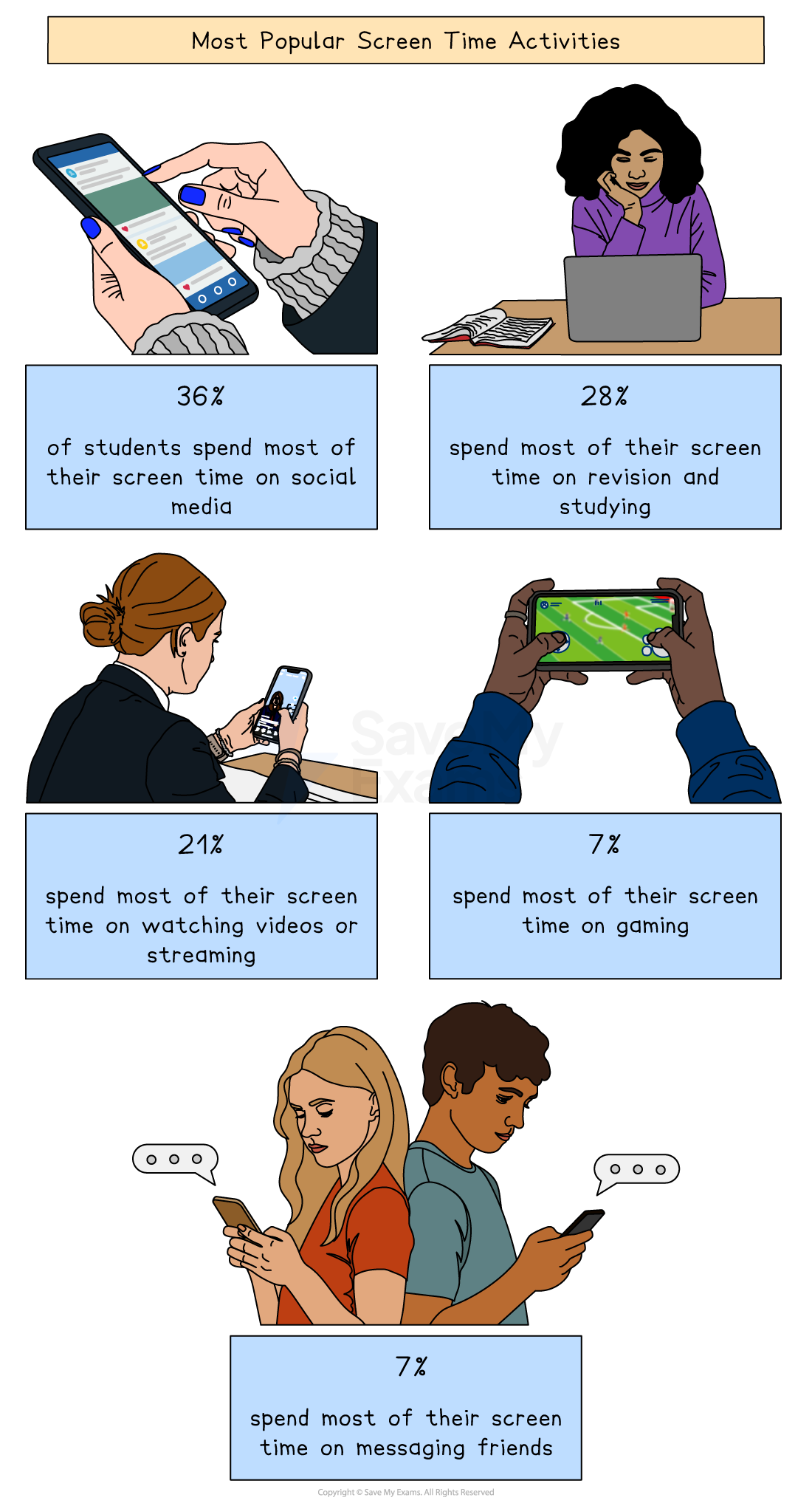
When it comes to what students are actually doing on those screens, the picture is more balanced:
Social media is the most common activity, cited by 36% of students as their primary screen use outside school.
Revision and studying comes second at 28% - a significant share, and one that challenges the idea that all student screen time is unproductive.
Watching videos or streaming (Netflix, YouTube) accounts for 21% of primary screen use.
Gaming and messaging friends each account for 7%.
The study-related screen time figures are striking. When we asked how much of students' daily screen time is spent on studying or revision:
41% spend 1–2 hours studying on screens each day.
33% spend 2–4 hours, and a further 15% spend more than 4 hours - meaning nearly half of all students (48%) spend two or more hours a day on screens for academic purposes.
Just 11% spend less than an hour on study-related screen time daily.
Screen Time & Revision Behaviour Statistics
Screens have become central to how students revise and the laptop is overwhelmingly the device of choice.
84% of students use a laptop or computer for studying or revision - making it by far the most common study device.
39% also use a tablet, and 35% use a smartphone for studying.
When it comes to the resources they turn to, 97% of students regularly use revision platforms - making structured online platforms the near-universal first port of call for academic support.
Phone distraction during revision is an issue for many students, but it's not universal:
39% of students check their phone or social media every 30 minutes while revising.
29% of students are interrupting their revision at least every 15 minutes.
27% rarely check their phone while revising, and 5% say they never do, so 1 in 3 students manage to keep phone distractions largely at bay.
Social Media, Distraction & Concentration
Students are under no illusions about the tension between screen use and concentration.
69% of students agree or strongly agree that their screen time negatively affects their concentration while studying - that's more than 2 in 3 students.
Just 12% disagree, meaning the vast majority of students are aware of the problem even if they haven't resolved it.
20% neither agree nor disagree - sitting in the middle, not committing either way.
Students know their phones are a distraction, but they check them anyway. Understanding why - and building the habit of putting the phone down during revision - is one of the most practical things a student can do to improve their study sessions.
AI & Digital Learning Behaviour
AI tools have morphed into an everyday revision habit. More than half of all students in our survey are already using them regularly.
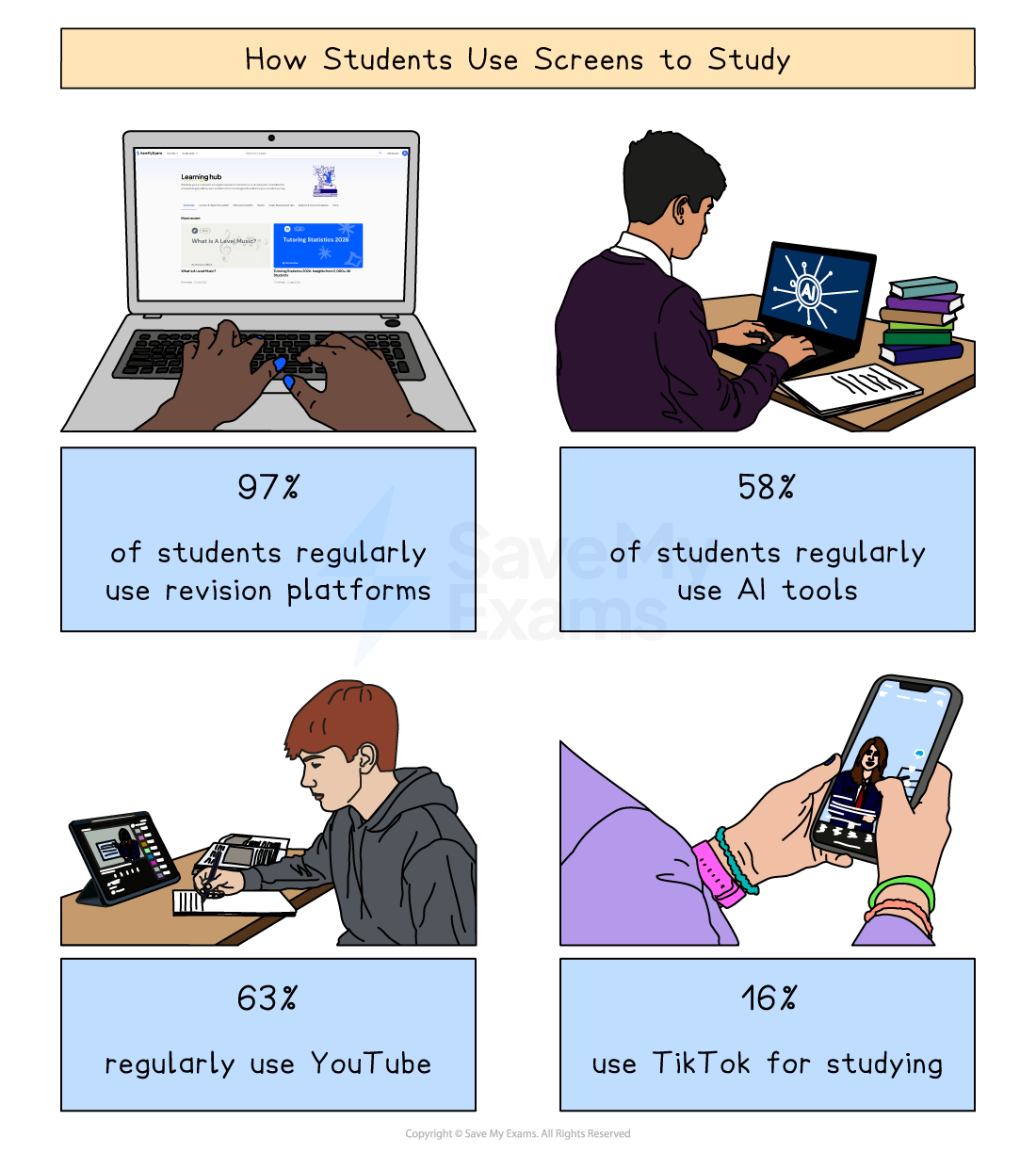
A huge 97% of students use revision platforms regularly.
58% of students regularly use AI tools (such as ChatGPT) for revision or academic support.
63% regularly use YouTube for revision or academic support.
16% use TikTok for studying.
The combination of revision platforms (97%), YouTube (63%), and AI tools (58%) shows that students use multiple tools in parallel.
Student Attitudes Towards Screen Time
86% agree or strongly agree that screen-based tools help them study and revise more effectively.
At the same time, 69% agree that screen time negatively affects their concentration.
The same device that hosts their revision platform also delivers their social media notifications. The same screen that shows them a worked solution also streams the next episode.
Learning to navigate that - to use screens purposefully rather than passively - is one of the core skills of secondary school life.
Are students satisfied with their screen balance? Options are divided.
48% of students say they are satisfied with their current balance between screen time and offline activities.
32% say they are dissatisfied - meaning nearly 1 in 3 students feel their screen habits are out of balance.
21% are neither satisfied nor dissatisfied.
Screen Time Trends in the UK
Growth in Teen Screen Time
Screen time among UK teenagers has been rising steadily for years and the numbers are now substantial.
Children aged 8–14 spend almost three hours online daily, rising to four hours for 13–14-year-olds (Ofcom).
There has been a 52% increase in children’s screen time between 2020 and 2022 (UK Parliament).
Two thirds of children aged five to fifteen now go online via a laptop, tablet or smartphone (BBC Bitesize).
Smartphone Usage Trends
62% of primary school-aged children in Wales own a smartphone (Senedd Research).
Students are on track to be on their smartphones for 25 years of their lives if their current average usage of 5.5 hours a day continues (Fluid Focus).
Social Media Consumption
Social media is a huge competitor for student attention.
72% of 13–17-year-olds say social media platforms help them feel closer to friends (Ofcom, 2025).
7 in 10 US teenagers visit YouTube every day (Pew Research Center).
75% of under-12s have at least one social media account (Youth Sport Trust).
Educational Screen Time & Digital Learning
Rise of Online Revision.
97% of students regularly use revision platforms, like Save My Exams (Save My Exams Survey, 2026).
71% of students find online learning more effective than classroom learning for exam prep (Save My Exams Online Learning Survey 2025).
Explore more online revision stats in our Online Learning Statistics survey data.
AI & Digital Study Tools
In January 2026, the government announced plans to introduce AI tutoring tools in schools, targeted at disadvantaged pupils, with a pilot programme scheduled for 2027 (Sutton Trust).
93% of students have used AI tools for schoolwork or revision (Save My Exams AI in Education Survey, 2026).
Explore more AI stats in our AI in Education survey data.
YouTube, StudyTok & Revision Platforms
63% of students regularly use YouTube for revision and academic support while 16% use TikTok (Save My Exams, 2026).
Children aged 8–14 spend about 48 minutes a day on YouTube (Ofcom).
Screen Time, Wellbeing & Balance
Sleep & Exam Stress
8-14 year olds spend between 4% and 10% of their time online between 11pm and 5am (Ofcom - Online Nations).
27% of teens logging four or more device hours each day reported anxiety symptoms in the prior fortnight (CDC NCHS).
Mental Wellbeing & Digital Habits
Screen time and mental wellbeing have a complex relationship.
Teenagers with problematic smartphone use are twice as likely to have anxiety (NIHR).
Young people who use social media often are more likely to report poor mental health (Royal College of Paediatrics and Child Health).
11% of children show signs of problematic social media behaviour and experience negative consequences (World Health Organisation).
The Future of Digital Learning & Screen Use
AI in Education
AI is part of how UK students revise and learn.
58% of students already use AI tools regularly for academic support (Save My Exams Survey, 2026).
62% of teachers use GenAI to plan lessons, while 1 in 10 use AI tools to support students with SEND (Department for Education).
ChatGPT is the most common AI tool used by students (Save My Exams AI in Education Survey, 2026).
The Future of Revision Culture
The revision culture of 2026 looks almost unrecognisable from a decade ago.
Textbooks still exist, but so do:
Revision platforms
YouTube tutorials (opens in a new tab)
AI tools
Each one plays a role in the study habits of a generation.
The tools are better than ever. But the distractions are more present than ever. Building the discipline to separate the two is one of the most important revision skills a student can develop.
Academic success doesn’t mean avoiding screens. It’s about choosing the right ones to look at. That's where Save My Exams comes in.
Whether you're working through revision notes, practising with past papers, or using AI-powered Smart Mark to check your answers, every one of our resources is built around your syllabus - so screen time becomes study time.
Appendix: Full List of Screen Time Statistics
1 in 5 students spend six or more hours on screens daily outside of school (Save My Exams Survey, 2026)
57% of students spend four or more hours on screens outside of school hours every day (Save My Exams Survey, 2026)
Social media is the number one screen activity outside of school hours, cited by 36% of students (Save My Exams Survey, 2026)
97% of students use revision platforms regularly for academic support (Save My Exams Survey, 2026)
86% of students agree that screen-based tools help them study and revise more effectively (Save My Exams Survey, 2026)
69% of students agree that screen time negatively affects their concentration while studying (Save My Exams Survey, 2026)
29% of students check their phone or social media every 10–15 minutes or more while revising (Save My Exams Survey, 2026)
58% use AI tools for revision or academic support (Save My Exams Survey, 2026)
38% of students spend 2–4 hours on screens outside of school each day (Save My Exams Survey, 2026)
37% spend 4–6 hours on screens outside of school (Save My Exams Survey, 2026)
14% spend 6–8 hours, and a further 6% spend more than 8 hours, meaning 1 in 5 students are on screens for six or more hours every day outside of school (Save My Exams Survey, 2026)
Just 5% of students spend less than 2 hours on screens outside of school (Save My Exams Survey, 2026)
Social media is the most common activity on screens, cited by 36% of students as their primary screen use outside school (Save My Exams Survey, 2026)
Revision and studying comes second at 28% - a significant share, and one that challenges the idea that all student screen time is unproductive (Save My Exams Survey, 2026)
Watching videos or streaming (Netflix, YouTube) accounts for 21% of primary screen use (Save My Exams Survey, 2026)
Gaming and messaging friends each account for 7% of primary screen use (Save My Exams Survey, 2026)
41% of students spend 1–2 hours studying on screens each day (Save My Exams Survey, 2026)
33% of students spend 2–4 hours, and a further 15% spend more than 4 hours - meaning nearly half of all students (48%) spend two or more hours a day on screens for academic purposes (Save My Exams Survey, 2026)
Just 11% spend less than an hour on study-related screen time daily (Save My Exams Survey, 2026)
84% of students use a laptop or computer for studying or revision - making it by far the most common study device (Save My Exams Survey, 2026)
39% also use a tablet, and 35% use a smartphone for studying (Save My Exams Survey, 2026)
97% of students regularly use revision platforms - making structured online platforms the near-universal first port of call for academic support (Save My Exams Survey, 2026)
39% of students check their phone or social media every 30 minutes while revising (Save My Exams Survey, 2026)
29% of students are interrupting their revision at least every 15 minutes (Save My Exams Survey, 2026)
27% rarely check their phone while revising, and 5% say they never do, so 1 in 3 students manage to keep phone distractions largely at bay (Save My Exams Survey, 2026)
69% of students agree or strongly agree that their screen time negatively affects their concentration while studying - that's more than 2 in 3 students (Save My Exams Survey, 2026)
Just 12% disagree, meaning the vast majority of students are aware of the problem even if they haven't resolved it (Save My Exams Survey, 2026)
20% neither agree nor disagree - sitting in the middle, not committing either way (Save My Exams Survey, 2026)
58% of students regularly use AI tools (such as ChatGPT) for revision or academic support (Save My Exams Survey, 2026)
63% regularly use YouTube for revision or academic support (Save My Exams Survey, 2026)
16% use TikTok for studying, reflecting the growth of StudyTok as an informal learning space (Save My Exams Survey, 2026)
58% of students regularly use AI tools (such as ChatGPT) for revision or academic support (Save My Exams Survey, 2026)
63% regularly use YouTube for revision or academic support (Save My Exams Survey, 2026)
16% use TikTok for studying, reflecting the growth of StudyTok as an informal learning space (Save My Exams Survey, 2026)
48% of students say they are satisfied with their current balance between screen time and offline activities (Save My Exams Survey, 2026)
32% say they are dissatisfied - meaning nearly 1 in 3 students feels their screen habits are out of balance (Save My Exams Survey, 2026)
21% are neither satisfied nor dissatisfied (Save My Exams Survey, 2026)
Children aged 8–14 spend almost three hours online daily, rising to four hours for 13–14-year-olds (Ofcom)
There has been a 52% increase in children’s screen time between 2020 and 2022 (UK Parliament)
Two thirds of children aged five to fifteen now go online via a laptop, tablet or smartphone (BBC Bitesize)
62% of primary school-aged children in Wales own a smartphone (Senedd Research)
Students are on track to be on their smartphones for 25 years of their lives if their current average usage of 5.5 hours a day continues (Fluid Focus)
72% of 13–17-year-olds say social media platforms help them feel closer to friends (Ofcom, 2025)
7 in 10 US teenagers visit YouTube every day (Pew Research Center)
75% of under-12s have at least one social media account (Youth Sport Trust)
In January 2026, the government announced plans to introduce AI tutoring tools in schools, targeted at disadvantaged pupils, with a pilot programme scheduled for 2027 (Sutton Trust, 2026)
93% of students have used AI tools for schoolwork or revision (Save My Exams AI in Education Survey, 2026)
Children aged 8–14 spend about 48 minutes a day on YouTube (Ofcom)
27% of teens logging four or more device hours each day reported anxiety symptoms in the prior fortnight (CDC NCHS)
8–14 year olds spend between 4% and 10% of their time online between 11pm and 5am (Ofcom - Online Nations)
Teenagers with problematic smartphone use are twice as likely to have anxiety (NIHR)
Young people who use social media often are more likely to report poor mental health (Royal College of Paediatrics and Child Health)
11% of children show signs of problematic social media behaviour and experience negative consequences (World Health Organisation)
62% of teachers use GenAI to plan lessons, while 1 in 10 use AI tools to support students with SEND (Department for Education)
ChatGPT is the most common AI tool used by students (Save My Exams AI in Education Survey, 2026)
References
Primary Data
Save My Exams Survey, 2026
Secondary Data
Ofcom (opens in a new tab)
UK Parliament (opens in a new tab)
BBC Bitesize (opens in a new tab)
Senedd Research (opens in a new tab)
Fluid Focus (opens in a new tab)
Pew Research Center (opens in a new tab)
Sutton Trust (opens in a new tab)
CDC (opens in a new tab)
Ofcom - Online Nations (opens in a new tab)
NIHR (opens in a new tab)
Royal College of Paediatrics and Child Health (opens in a new tab)
World Health Organisation (opens in a new tab)
Department for Education (opens in a new tab)
Was this article helpful?
Sign up for articles sent directly to your inbox
Receive news, articles and guides directly from our team of experts.

Share this article

 written revision resources that improve your