Size & Power of Test (Edexcel A Level Further Maths: Further Statistics 1): Revision Note
Exam code: 9FM0

Size
What is the size of a test?
The size of a test is the probability of rejecting H0 when it was in fact true
P(in critical region | H0 is true)
The situation being described is not a good outcome
Something has been rejected when it was actually true!
A better test has a smaller size
You want to minimise this error happening
Size is related to the significance level, α%
A better test has a smaller significance level (e.g. 1%)
For continuous distributions (e.g. normal)
Size = significance level, α
You can often write this down with no calculation
For discrete distributions (e.g. binomial, Poisson, geometric)
Size = actual significance level (≤α)
As close to α% as a discrete variable can get, whilst still being critical
How does size relate to Type I errors?
The size is exactly the same as the probability of a Type I error
Both want to know the probability of rejecting H0 when it was in fact true
Worked Example
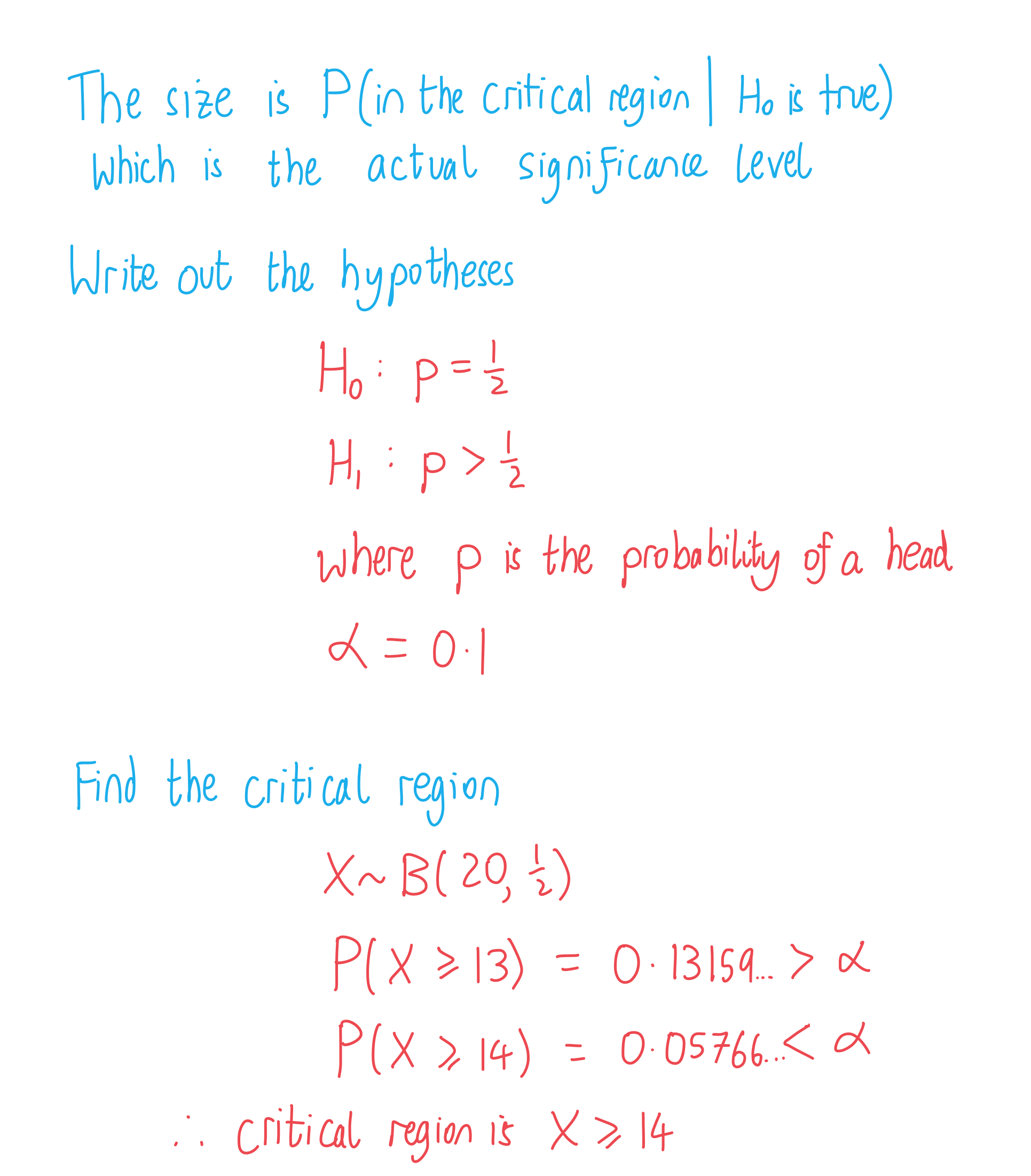
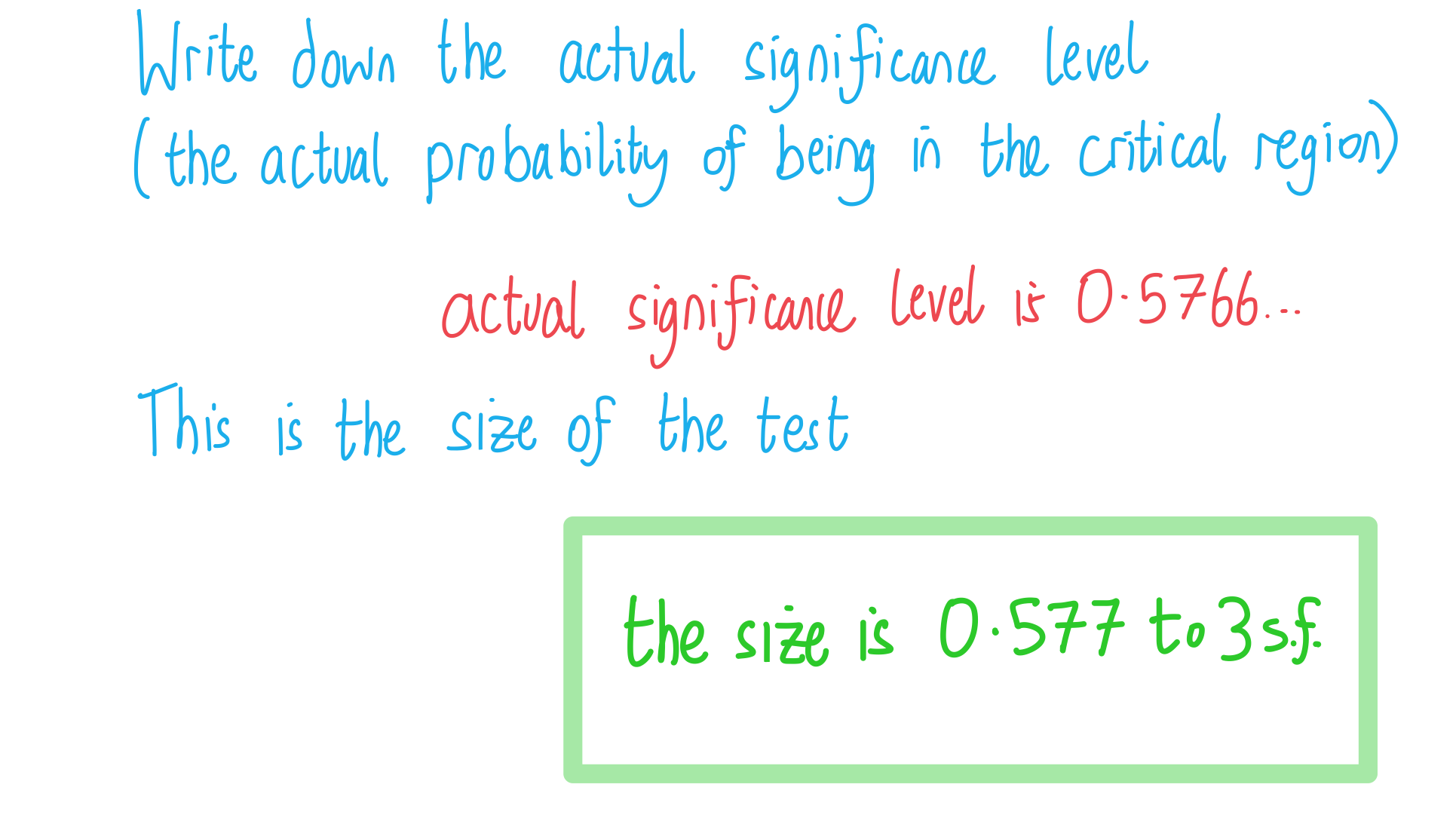
A student wants to test, at a 10% significant level, whether a coin is biased towards heads by counting the number of heads in 20 flips of the coin.
Calculate the size of this test.
Power
What is the power of a test?
The power of a test is the probability of rejecting H0 when it was false
P(in critical region | H0 is false)
The situation being described has a good outcome
The null hypothesis was false and it rightly got rejected
A better test has a higher power
You want to maximise this happening
In practice, you need to be given the actual population parameter to calculate the power
For example, H0 assumed but actually
This is more helpful than just saying
Power is P(in the critical region | actual population parameter)
How does power relate to Type II errors?
The power of a test is 1 - P(Type II error)
Power is when H0 is false and it gets rejected
That's a good outcome
A Type II error is when H0 is false and it does not get rejected
That's a bad outcome
You ideally want the power of a test to be greater than 0.5
That way it's less likely to produce a Type II error
And more likely to reach the correct conclusion
Worked Example
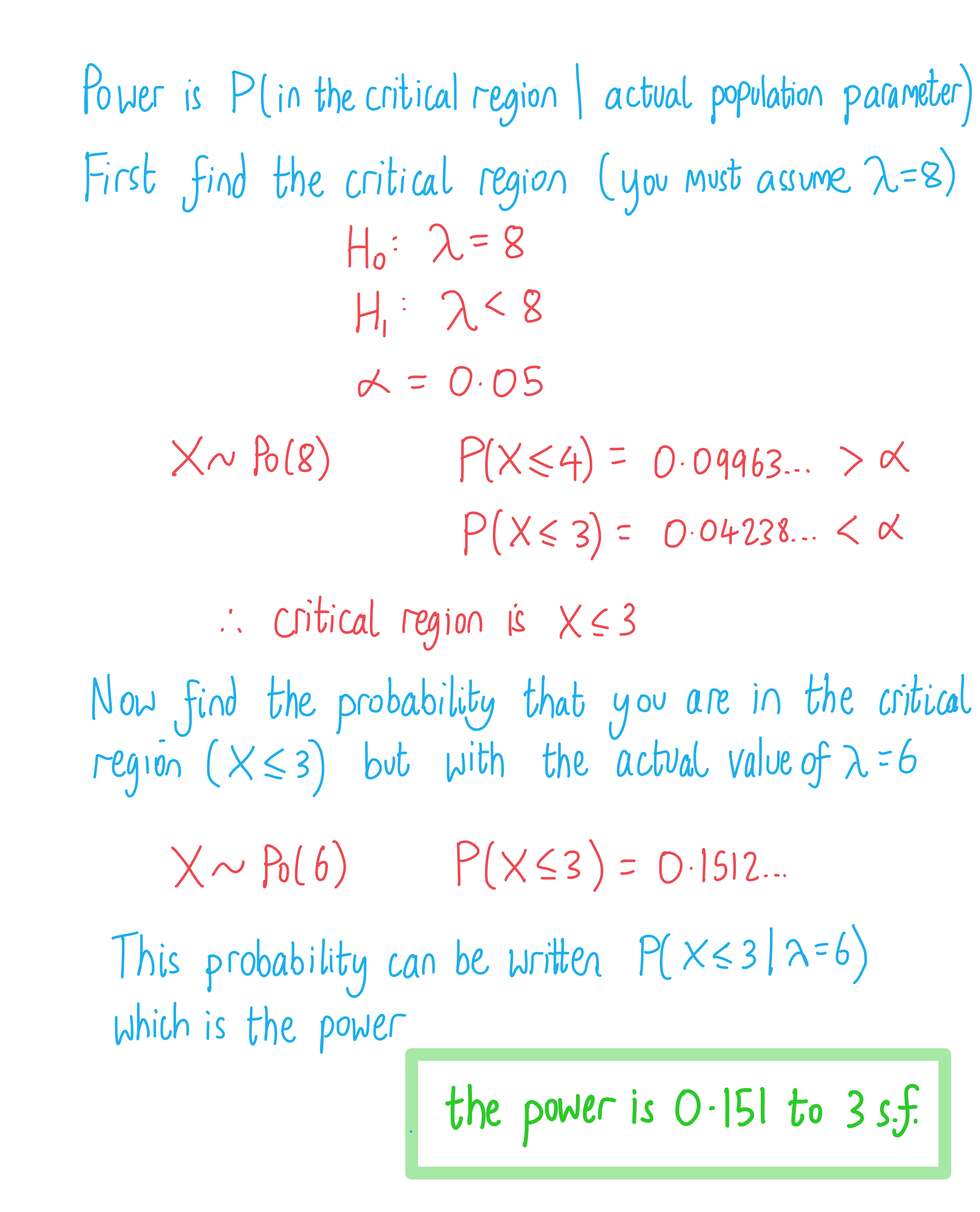
Let . A hypothesis test is conducted at the 5% significance level in which and .
If is later discovered that , find the power of the test.
Power functions
What is a power function?
The power function is the power of a test written algebraically
In terms of or
For when you're not given the actual population parameter in the question
In reality, it's very unlikely you'll know the actual population parameter anyway
Otherwise you wouldn't be doing a hypothesis test on it!
Power functions don't need this information
The power function is P(in the critical region | population parameter is )
Or, for Poisson
P(in the critical region | population parameter is )
How do I find power functions?
It's easier to show in an example
If the critical region is for a binomial hypothesis test with
Then the power function is P(in the critical region | population parameter is )
Let
Simplify
Factorise and collect like terms
The power function is
What can I do with power functions?
You can plot them against (or )
You can then see where the power is biggest
You can input different values of (or )
To compare two (or more) different hypothesis tests
The better test is the one with the higher power
To check if the power of a test is greater than 0.5
So that it's more likely to reach the correct conclusion
And less likely to produce a Type II error
Because Power = 1 - P(Type II error)
Worked Example
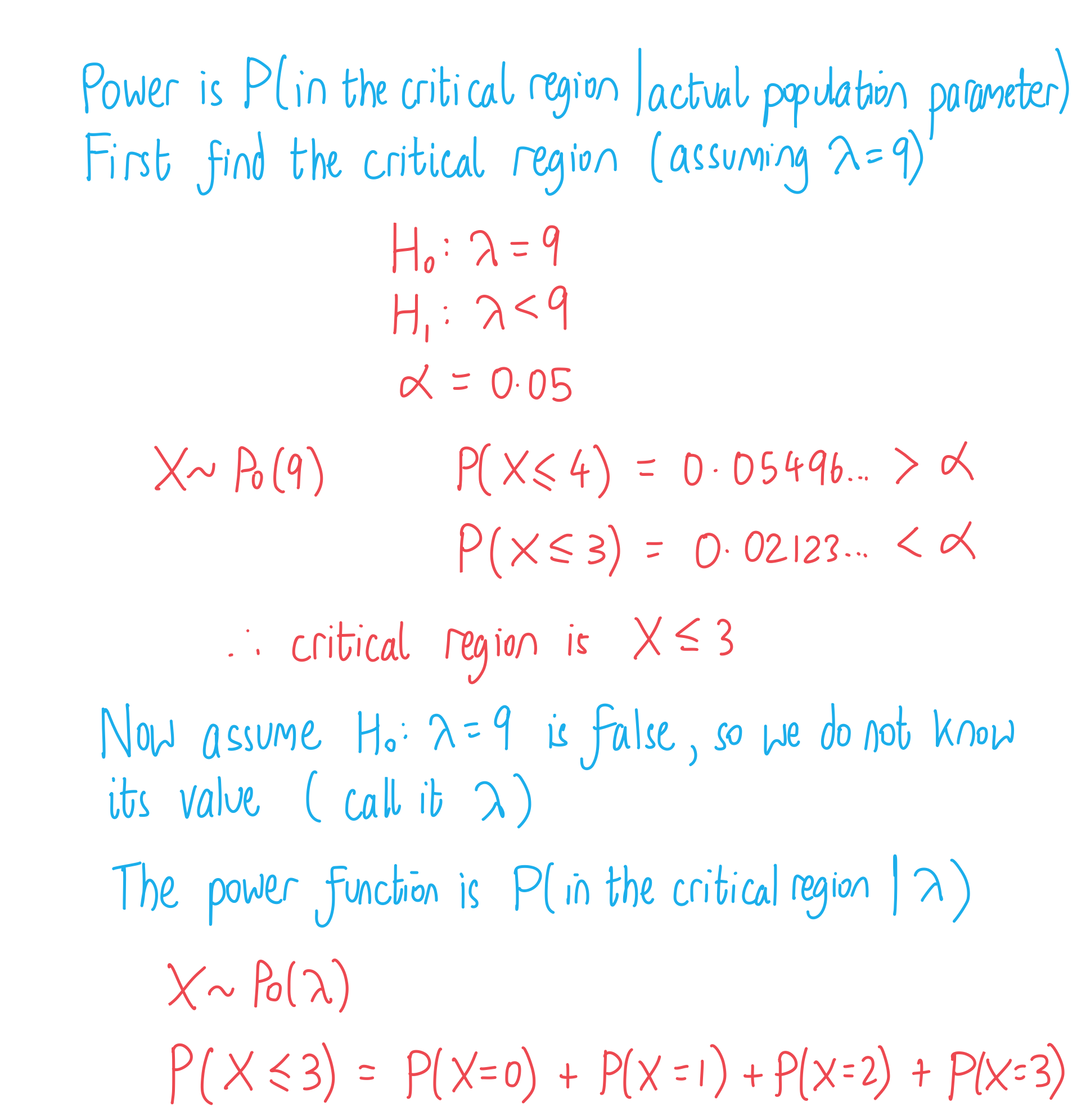
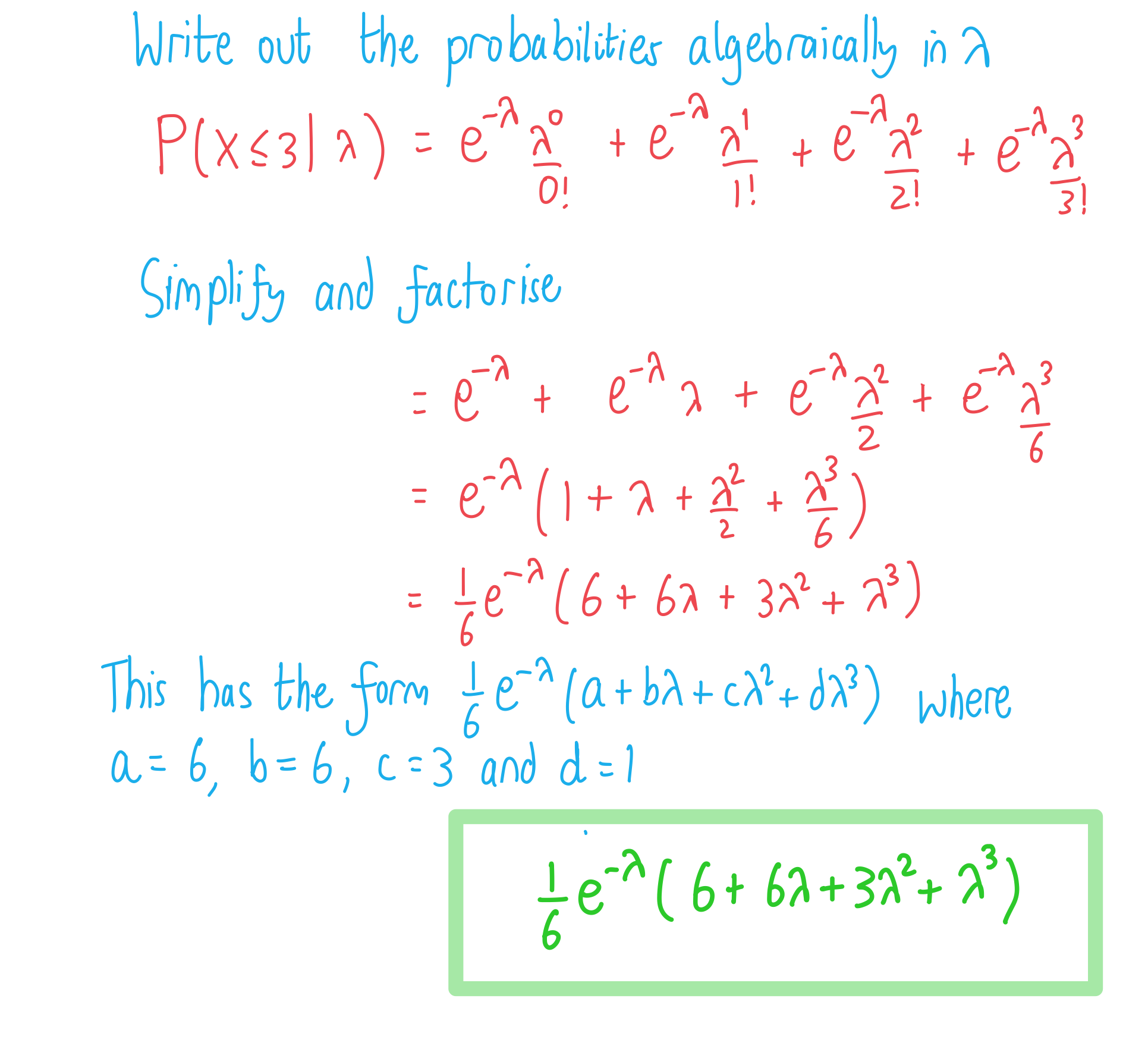
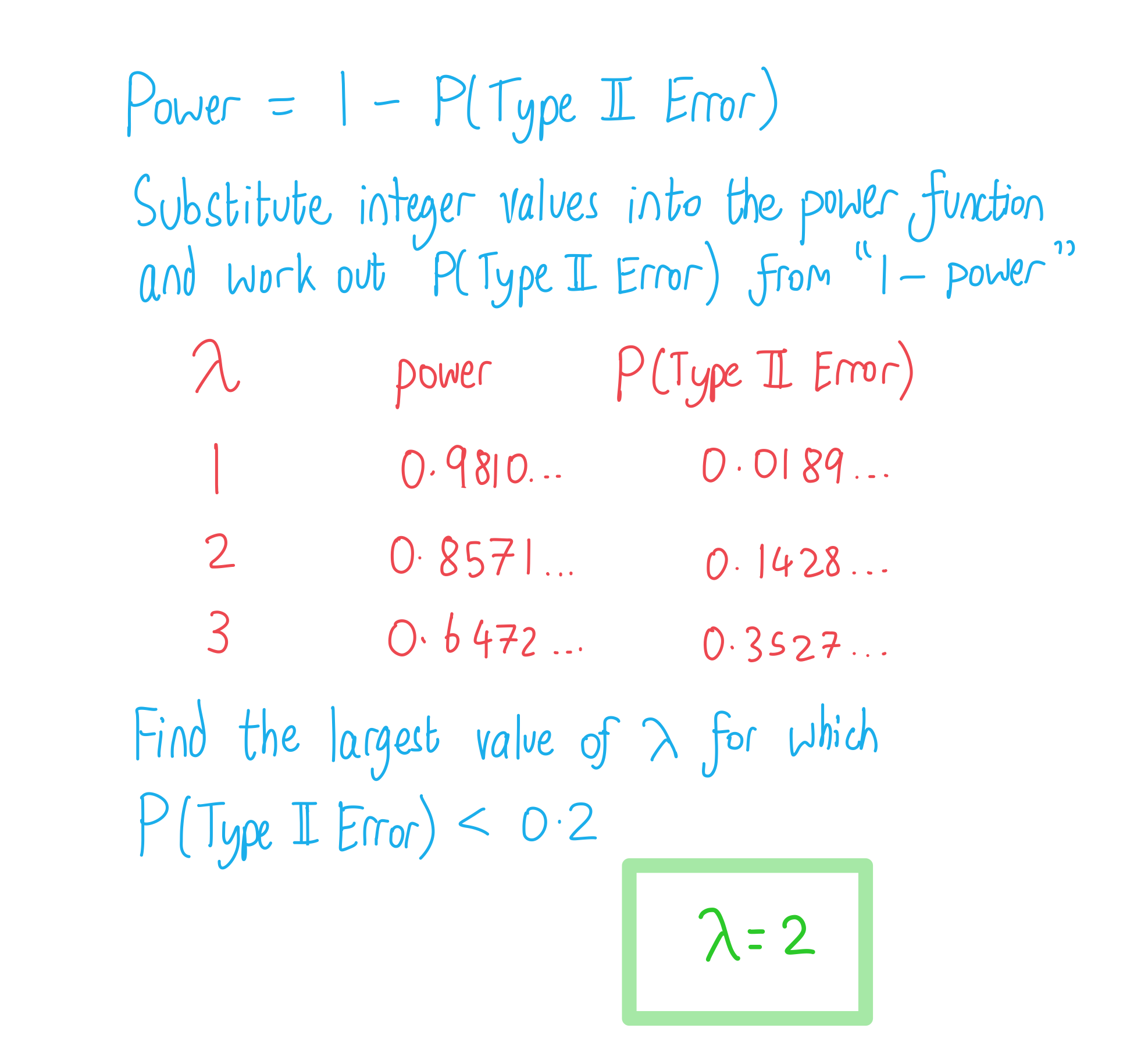
Residents suspect that the number of accidents on a main road has decreased. They test, at a 5% significance level, the hypotheses and .
a) Show that the power function is , where and are integers to be found.
b) Find the largest integer value of for which the probability of a Type II error is less than 20%.

Unlock more, it's free!
Join the 100,000+ Students that ❤️ Save My Exams
the (exam) results speak for themselves:

Was this revision note helpful?
Build on this topic