1
8 marks
(i) Differentiate
(ii) Use the product rule to differentiate
(iii) Use the quotient rule to differentiate
(iv) Use the chain rule to differentiate
Was this exam question helpful?
Exam code: 9709
(i) Differentiate
(ii) Use the product rule to differentiate
(iii) Use the quotient rule to differentiate
(iv) Use the chain rule to differentiate
Was this exam question helpful?
A curve has equation .
Find an expression for .
(i) Find the gradient of the tangent at the point where , giving your answer in the form , where is a positive integer to be found.
(ii) Hence show that the gradient of the normal to the curve at the point where is .
Was this exam question helpful?
Find for
(i)
(ii)
Was this exam question helpful?
The curve with equation passes through the point .
(i) Find an expression for .
(ii) Find the equation of the tangent to the curve at the point .
Was this exam question helpful?
Differentiate with respect to .
Differentiate with respect to .
Was this exam question helpful?
Differentiate with respect to .
Differentiate with respect to .
Was this exam question helpful?
Write down when
(i)
(ii)
Was this exam question helpful?
The function is defined as
Show that the graph of meets the -axis at the points and .
Find .
Find the gradient of the tangent at the point .
Hence find the equation of the tangent at the point , giving your answer in the form , where , and are integers to be found.
Was this exam question helpful?
(i) Differentiate
(ii) Use the product rule to differentiate
(iii) Use the quotient rule to differentiate
(iv) Use the chain rule to differentiate
Was this exam question helpful?
A curve has equation , .
Find the gradient of the normal to the curve at the point , giving your answer correct to 3 decimal places.
Was this exam question helpful?
Find for .
Find for .
Was this exam question helpful?
Find the equation of the tangent to the curve at the point , giving your answer in the form , where , and are integers.
Was this exam question helpful?
Differentiate with respect to , simplifying your answers as far as possible:
Was this exam question helpful?
Differentiate with respect to .
Was this exam question helpful?
Show that if , then
Hence find the gradient of the tangent to the curve at the point with coordinates .
Was this exam question helpful?
The diagram below shows part of the graph of , where is the function defined by

Points , and are the three places where the graph meets the -axis.
Find .
Show that the coordinates of point are .
Find the equation of the tangent to the curve at point .
Was this exam question helpful?
Use an appropriate method to differentiate each of the following.
(i)
(ii)
(iii)
(iv)
Was this exam question helpful?
Find the gradient of the normal to the curve at the point with -coordinate . Give your answer correct to 3 decimal places.
Was this exam question helpful?
Differentiate with respect to , simplifying your answer as far as possible.
Differentiate with respect to , simplifying your answer as far as possible.
Was this exam question helpful?
Use an appropriate method to differentiate each of the following.
(i)
(ii)
(iii)
(iv)
Was this exam question helpful?
A curve has equation , .
Show that the equation of the tangent to the curve at the point with -coordinate is
Was this exam question helpful?
For , where is a real number and is an integer, show that
Was this exam question helpful?
By writing as and then using the product and chain rules, show that
Was this exam question helpful?
Given that , find in terms of .
Hence find in terms of .
Was this exam question helpful?
The diagram below shows part of the graph of , where is the function defined by
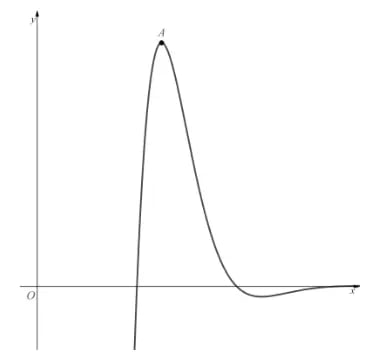
Point is a maximum point on the graph.
Show that the -coordinate of is a solution to the equation
Was this exam question helpful?
A curve has equation .
Show that the gradient of the normal to the curve at the point is
Was this exam question helpful?
Find the derivative of the function , .
Was this exam question helpful?
Show that the derivative of is
Hence find the equation of the tangent to the curve at the point , giving your answer in the form , where and are to be given as exact values.
Was this exam question helpful?
Differentiate with respect to , simplifying your answer where possible.
Differentiate with respect to , simplifying your answer where possible.
Was this exam question helpful?
The diagram below shows the graph of , where is the function defined by
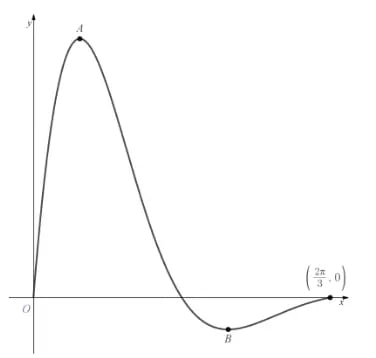
The points and are maximum and minimum points, respectively.
Find the range of , giving your answer correct to 3 decimal places.
Was this exam question helpful?