12 marks
The th term of a number sequence is
Write down the first three terms of the sequence.
Was this exam question helpful?
Exam code: J560
The th term of a number sequence is
Write down the first three terms of the sequence.
Was this exam question helpful?
Write the next term in each of these sequences.
i) 1 1 2 3 5 8
[1]
ii) 2 4 8 16 32 64
[1]
Was this exam question helpful?
Write an expression for theth term of the sequence below.
15 12 9 6
Was this exam question helpful?
A sequence is defined using this term-to-term rule.
If , find
Was this exam question helpful?
This expression can be used to generate a sequence of numbers.
i) Work out the first three terms of this sequence.
[2]
ii) Show that this expression does not only generate prime numbers.
[2]
Was this exam question helpful?
A geometric progression starts 4 16
Work out the next term.
A Fibonacci-type sequence starts 3 –8
The sequence is continued by adding the previous two terms. Work out the next two terms.
Was this exam question helpful?
The first three terms of a geometric progression are
Circle the fourth term.
Was this exam question helpful?
The next term of a sequence is made by adding the previous two terms.
Which of these sequences follows this rule?
Circle your answer.
–9 2 –7 –5 –12 | –3 5 –2 3 1 |
0 –3 –3 0 –3 | –1 –1 –2 –3 1 |
Was this exam question helpful?
Here is a sequence of numbers.
7, 5, 3, 1, – 1, …
Find the next term in this sequence.
Was this exam question helpful?
These are the first five terms in a sequence.
Find the next term.
Was this exam question helpful?
Here are the first four dot patterns in a sequence.
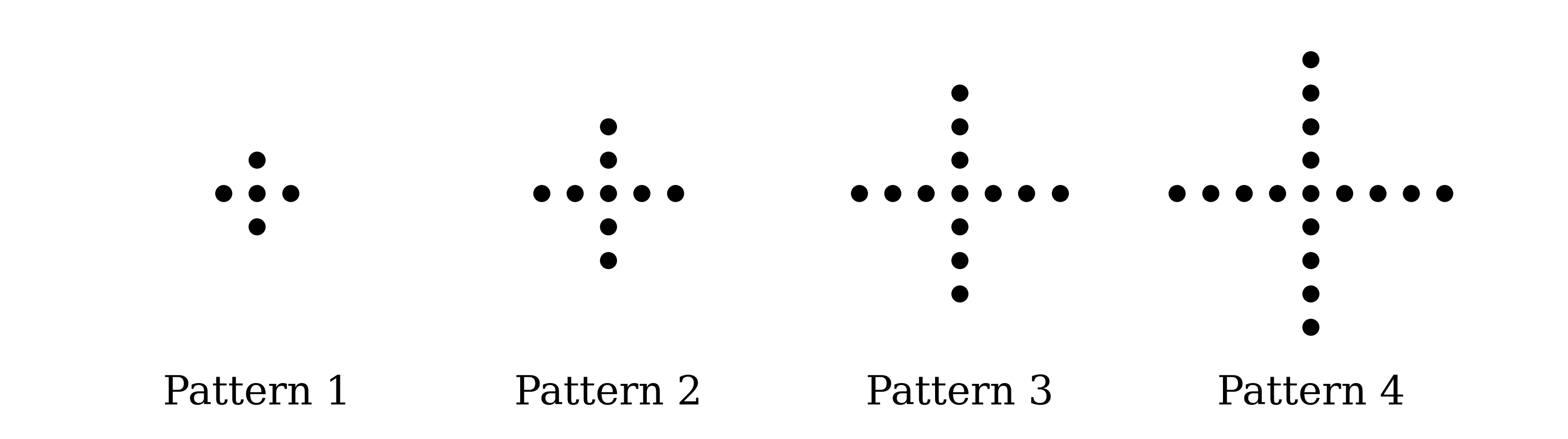
Draw Pattern 5 in the sequence.
Without drawing, work out how many dots are in Pattern 8 of the sequence.
Explain how you worked out your answer.
Was this exam question helpful?
Here are the first 5 terms of an arithmetic sequence.
3 9 15 21 27
Find an expression, in terms of , for the th term of this sequence.
Ben says that 150 is in the sequence.
Is Ben right?
You must explain your answer.
Was this exam question helpful?
Here are the first four terms of an arithmetic sequence.
3 10 17 24
Find, in terms of , an expression for the th term of this arithmetic sequence.
Is 150 a term of this sequence?
You must explain how you get your answer.
Was this exam question helpful?
Here are the first five terms of an arithmetic sequence.
2 6 10 14 18
Write down an expression, in terms of , for the th term of this sequence.
Is 86 a term in the sequence?
You must give a reason for your answer.
Was this exam question helpful?
Here are the first four terms of an arithmetic sequence.
11 17 23 29
Find, in terms of , an expression for the th term of this arithmetic sequence.
Is 121 a term of this arithmetic sequence?
You must explain your answer.
Was this exam question helpful?
Here are the first four terms of an arithmetic sequence.
6 10 14 18
Write an expression, in terms of , for the th term of this sequence.
The th term of a different arithmetic sequence is
Is 108 a term of this sequence?
Show how you get your answer.
Was this exam question helpful?
Here are the first five terms of an arithmetic sequence.
4 9 14 19 24
Find, in terms of , an expression for the th term of this sequence.
Here are the first five terms of a different sequence.
2 2 0 -4 -10
An expression for the th term of this sequence is
Write down, in terms of , an expression for the th term of a sequence whose first five terms are
4 4 0 -8 -20
Was this exam question helpful?
Here are the first six terms of a Fibonacci sequence.
1 1 2 3 5 8
The rule to continue a Fibonacci sequence is,
the next term in the sequence is the sum of the two previous terms.
Find the 9th term of this sequence.
The first three terms of a different Fibonacci sequence are
Show that the th term of this sequence is
Given that the 3rd term is 7 and the 6th term is 29,
find the value of and the value of .
Was this exam question helpful?
Here are the first 5 terms of a quadratic sequence.
1 3 7 13 21
Find an expression, in terms of , for the th term of this quadratic sequence.
Was this exam question helpful?
Find the th term of each of these sequences.
16, 19, 22, 25, 28, ...
1, 3, 9, 27, 81, ...
Was this exam question helpful?
The first five terms of a sequence are 4, 9, 16, 25, 36, .....
Find
the 10th term,
the th term.
Was this exam question helpful?
Here are the first six terms of a quadratic sequence.
-1 5 15 29 47 69
Find an expression, in terms of , for the th term of this sequence.
Was this exam question helpful?
A sunflower grows at a rate of 4 cm each day.
How many days does it take to grow from a height of 80 cm to more than 1.06 m?
If the sunflower grows at a faster rate, how would this affect your answer to part ()?
Was this exam question helpful?
Here are the first four terms of a sequence.
Find the nth term of this sequence.
Was this exam question helpful?
Here are the first four terms of a sequence of fractions.
The numerators of the fractions form the sequence of whole numbers
The denominators of the fractions form the sequence of odd numbers
Write down an expression, in terms of , for the term of this sequence of fractions.
Was this exam question helpful?
Here are the first five terms of a number sequence .
Find an expression, in terms of , for the term of this sequence.
The term of a sequence is given by
There are numbers that are terms in both the sequence and the sequence
Find one of these numbers.
Was this exam question helpful?
Here are the first four terms of an arithmetic sequence.
Find an expression, in terms of , for the term of this sequence.
Write down an expression, in terms of , for the term of this sequence.
Was this exam question helpful?
Here are the first five terms of a number sequence.
7 11 15 19 23
Find an expression, in terms of , for the th term of this sequence.
The th term of a different number sequence is given by
Write down the first 3 terms of this sequence.
Yuen says there are no numbers that are in both of the sequences.
Yuen is correct.
Explain why.
Was this exam question helpful?
The th term of a sequence is .
Write down an expression, in terms of and , for the 3rd term.
The 3rd term of this sequence is 21 and the 6th term is 96.
Find the value of and the value of
You must show all your working.
Was this exam question helpful?
Here are the first five terms of an arithmetic sequence.
2 5 8 11 14
Write down an expression, in terms of , for the th term of this sequence.
Is 299 a term of this sequence?
You must give a reason for your answer.
Write down an expression, in terms of , for the th term of this sequence.
Was this exam question helpful?
Here are the first five terms of a sequence.
4 11 22 37 56
Find an expression, in terms of , for the th term of this sequence.
Was this exam question helpful?
The th term of a sequence is given by where and are integers.
The 2nd term of the sequence is –2
The 4th term of the sequence is 12
Find the 6th term of the sequence.
Here are the first five terms of a different quadratic sequence.
0 2 6 12 20
Find an expression, in terms of , for the th term of this sequence.
Was this exam question helpful?
Find the th term of each sequence.
4, 8, 12, 16, 20, .........
11, 20, 35, 56, 83, ..........
Was this exam question helpful?
is a geometric sequence.
Given that , and are the first three terms of , find the value of . You must show all your working.
Show that the th term of is
Was this exam question helpful?
Louis and Robert are investigating the growth in the population of a type of bacteria.
They have two flasks A and B.
At the start of day 1, there are 1000 bacteria in flask A.
The population of bacteria grows exponentially at the rate of 50% per day.
Show that the population of bacteria in flask A at the start of each day forms a geometric progression.
The population of bacteria in flask A at the start of the 10th day is times the population of bacteria in flask A at the start of the 6th day.
Find the value of .
At the start of day 1 there are 1000 bacteria in flask B.
The population of bacteria in flask B grows exponentially at the rate of 30% per day.
Sketch a graph to compare the size of the population of bacteria in flask A and in flask B.
Was this exam question helpful?
The table shows the first five terms of sequences A, B and C.
Sequence | 1st term | 2nd term | 3rd term | 4th term | 5th term | 6th term |
A | 3 | 4 | 5 | 6 | 7 |
|
B | 0 | 1 | 4 | 9 | 16 |
|
C | -3 | -3 | -1 | 3 | 9 |
|
Complete the table for the 6th term of each sequence.
Write down the th term of sequence A.
i) Find the th term of sequence B.
[1]
ii) Find the value of when the th term of sequence B is 8281.
[3]
i) Find the th term of sequence C in its simplest form.
[2]
ii) Find the 8th term of sequence C.
[1]
The th term of another sequence D is .
Complete the table for the first four terms of sequence D.
Sequence | 1st term | 2nd term | 3rd term | 4th term |
D |
|
|
|
|
Was this exam question helpful?
In all the following sequences, after the first two terms, the rule is to add the previous two terms to find the next term.
Write down the next two terms in this sequence.
1 1 2 3 5 8 13 ........ ........
Write down the first two terms of this sequence.
.......... ........... 3 11 14
i) Find the value of and the value of . 2 10
[3]
ii) Find the value of , the value of and the value of .
-33 18
[5]
Was this exam question helpful?
A sequence is defined using this term-to-term rule,
where and are constants.
Given that , and , find the value of and the value of .
= ................
= .................
Was this exam question helpful?
Here is a sequence.
3 | 15 |
Work out the next term.
Find the th term.
Was this exam question helpful?
A sequence is defined by the rule
If , calculate
i)
=............................[3]
ii)
=............................[3]
Was this exam question helpful?
The first two terms of a quadratic sequence are 10 and 17
Here is some information about the sequence.

Work out an expression for the nth term of the sequence.
Was this exam question helpful?
Theo starts with savings of £18
James starts with no savings.
Each week from now,
Theo will save £4.50 and James will save £4
In how many weeks will Theo and James have savings in the ratio 15 : 8 ?
Was this exam question helpful?
Using
with
find the values of and
Was this exam question helpful?
Use the formula with x1 = 2 to calculate x2 and x3.
Round your answers correct to 4 decimal places.
x2 = ............. and x3 = ................
Was this exam question helpful?
A sequence of numbers is formed by
Work out the values of and
Was this exam question helpful?
A sphere has radius cm
An approximate value of can be found using the formula
The starting value is
Work out the values of and
Continue the iteration to work out the radius to 1 decimal place.
................................................. cm
Was this exam question helpful?
At the start of year , the number of animals in a population is At the start of the following year, the number of animals in the population is , where
At the start of 2017 the number of animals in the population was 4000
At the start of 2019 the number of animals in the population was 3610 Find the value of the constant .
Was this exam question helpful?
The number of rabbits on a farm at the end of month is
The number of rabbits at the end of the next month is given by
At the end of March there are 200 rabbits on the farm.
Work out how many rabbits there will be on the farm at the end of June.
Considering your results in part (a), suggest what will happen to the number of rabbits on the farm after a long time.
Was this exam question helpful?
The number of bees in a beehive at the start of year is .
The number of bees in the beehive at the start of the following year is given by
At the start of 2015 there were 9500 bees in the beehive.
How many bees will there be in the beehive at the start of 2018?
Was this exam question helpful?
The number of slugs in a garden days from now is where
Work out the number of slugs in the garden 3 days from now.
Was this exam question helpful?