11 mark
An aqueous solution of copper chloride is electrolysed using inert electrodes.
What is meant by 'inert'?
Was this exam question helpful?
Exam code: 8465
An aqueous solution of copper chloride is electrolysed using inert electrodes.
What is meant by 'inert'?
Was this exam question helpful?
Zinc reacts with copper sulfate to produce zinc sulfate and copper.
Complete the word equation for the reaction.
zinc + ------ → ------ + ---------
Was this exam question helpful?
Describe the test for hydrogen gas.
Give the result of the test.
Was this exam question helpful?
Describe the test for hydrogen gas.
Give the result of the test.
Was this exam question helpful?
This question is about the electrolysis of copper sulfate solution.
A student investigated the electrolysis of copper sulfate solution.
FIGURE 2 shows the apparatus.
FIGURE 2
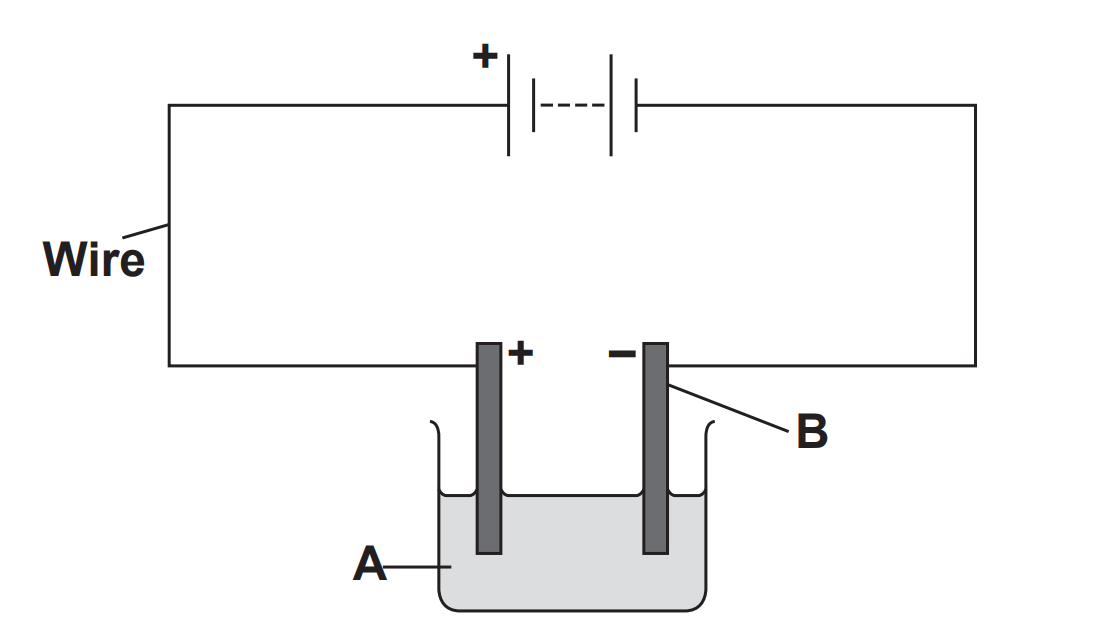
What is the name of the component represented by the circuit symbol shown?
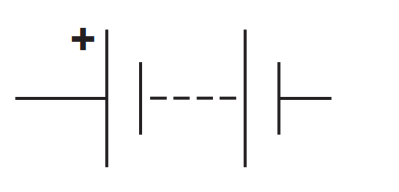
Identify A and B in FIGURE 2.
Which particles in the copper sulfate solution carry the charge during electrolysis?
Atoms
Ions
Molecules
The student measured the mass of copper deposited in 20 minutes.
The student did the test three times.
TABLE 2 shows the results.
Test | Mass of copper deposited in 20 minutes in grams |
1 | 0.52 |
2 | 0.45 |
3 | 0.50 |
Calculate the mass of copper deposited in ONE minute for TEST 1.
Use TABLE 2.
Calculate the mean mass of copper deposited in 20 minutes.
Use TABLE 2.
TABLE 2
Test | Mass of copper deposited in 20 minutes in grams |
1 | 0.52 |
2 | 0.45 |
3 | 0.50 |
FIGURE 3 shows the balance used to make the measurements in TABLE 2.
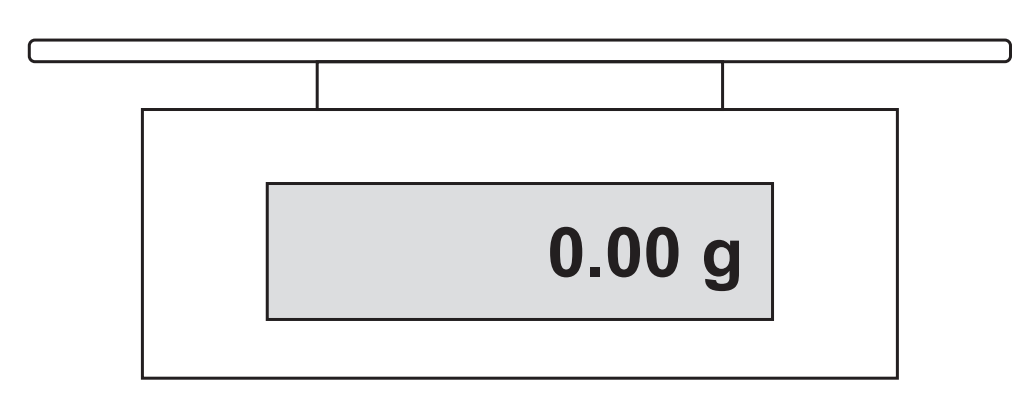
What is the smallest change in mass that can be measured using this balance?
0.001 g
0.01 g
0.1 g
Was this exam question helpful?
What is the result of the test for hydrogen?
A burning splint makes a pop sound
A glowing splint relights
Damp blue litmus paper bleaches
Was this exam question helpful?
This question is about electrolysis.
An aqueous solution of copper sulfate was electrolysed.
0.0400 moles of copper were deposited at the negative electrode.
Calculate the number of copper atoms in 0.0400 moles of copper.
Give your answer to 3 significant figures.
Avogadro constant = 6.02 × 10²³ per mole [3 marks]
Number of copper atoms (3 significant figures) =__________________
An aqueous solution of sodium chloride is electrolysed.
Chlorine is produced at the positive electrode.
Hydrogen is produced at the negative electrode.
Write a half equation for the reaction at the positive electrode. [2 marks]
Explain how hydrogen gas is produced at the negative electrode. [4 marks]
Was this exam question helpful?
Copper sulfate solution contains copper ions and hydrogen ions.
Why is copper produced instead of hydrogen during the electrolysis of copper sulfate solution?
Tick (✓) one box.
Copper is less reactive than hydrogen.
Copper has the same reactivity as hydrogen.
Copper is more reactive than hydrogen.
Was this exam question helpful?
A student investigated the reactivity of four metals with sulfuric acid.
Figure 5 shows the apparatus.
Figure 5
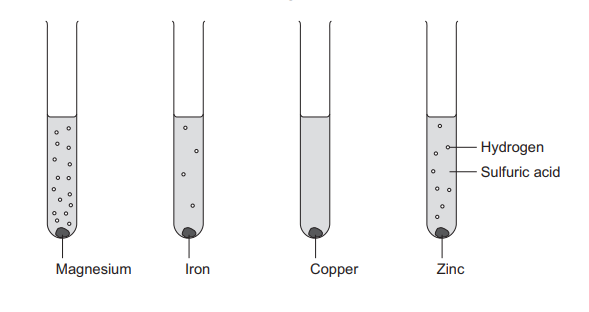
Give two variables the student should control.
Write the order of reactivity from least reactive to most reactive for the four metals.
Use Figure 5.
Least reactive → ........... → ........... → ........... → Most reactive
The gas produced in Figure 5 is hydrogen.
Describe the test for hydrogen gas.
Give the result if hydrogen is present.
The student repeated the investigation using different apparatus to determine the rate of reaction.
Figure 6 shows part of the apparatus.
Figure 6
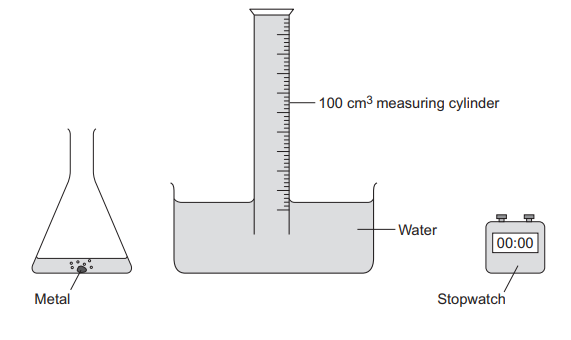
Complete Figure 6 so that the apparatus can be used to determine the rate of reaction.
What is the unit for the rate of reaction determined using the apparatus in Figure 6?
Was this exam question helpful?
This question is about electrolysis.
Figure 9 shows the electrolysis of molten potassium chloride using inert electrodes.
Figure 9
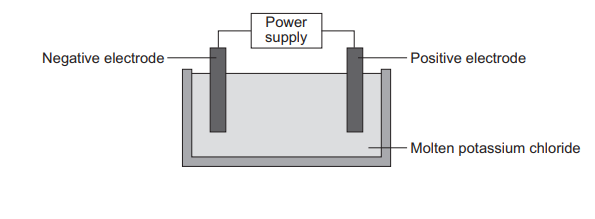
Why must potassium chloride be molten during the electrolysis?
Why are inert electrodes used in electrolysis?
A gas is released during the electrolysis of molten potassium chloride.
Describe the test to identify the gas released.
Give the result if the gas is present.
Test ------------------------
Result -----------------------
What type of reaction occurs at the negative electrode?
An aqueous solution of potassium chloride was electrolysed.
Hydrogen gas was produced at the negative electrode.
Explain why hydrogen gas is produced during the electrolysis of an aqueous solution of potassium chloride.
Was this exam question helpful?
This question is about the reactions of acids.
When dilute hydrochloric acid is reacted with sodium hydroxide solution there is a temperature change.
Explain how the temperature changes.
A student reacted four metals with water and with a dilute acid to work out the order of reactivity of the metals.
Table 1 shows some of the observations.
Table 1
Metal | Reaction with water | Reaction with dilute acid |
|---|---|---|
Calcium | Bubbles of gas | X |
Copper | Y | No bubbles of gas |
Magnesium | Few bubbles of gas | Bubbles of gas |
Zinc | No bubbles of gas | Bubbles of gas |
Write the observations for X and Y.
Observation at X:
Observation at Y:
Write the four metals, calcium, copper, magnesium and zinc, in order of reactivity.
Start with the most reactive metal.
Some gases given off in reactions can be identified by chemical tests.
Draw one line from each chemical test to the name of the gas.
Chemical tests:
Put in a lighted splint. The gas burns with a pop sound.
Put in a glowing splint. The gas relights the splint.
Put into limewater. The gas turns limewater cloudy.
Gases:
Carbon dioxide
Chlorine
Hydrogen
Nitrogen
Oxygen
Was this exam question helpful?
This question is about the electrolysis of two compounds.
Figure 9 shows the electrolysis of molten lead bromide.
Figure 9
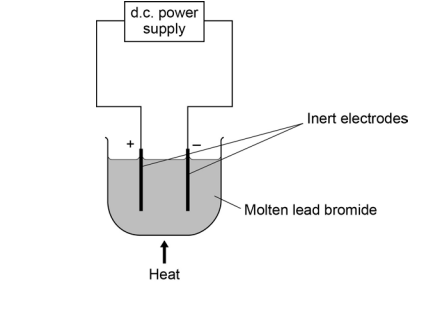
The electrolyte contains lead ions (Pb²⁺) and bromide ions (Br⁻).
Complete the sentences. Use words from the box.
atoms | bromide | bromine | ions | lead | molecules | oxygen |
At the positive electrode the gas produced is --------------.
At the negative electrode lead ---------------- gain electrons and turn into lead -----------------.
A student measured the volumes of each gas produced during the electrolysis of water.
Table 3 shows the student's results.
Table 3
Time in minutes | Volume of hydrogen in cm³ | Volume of oxygen in cm³ |
|---|---|---|
0 | 0 | 0 |
2 | 11.2 | 5.4 |
4 | 20.1 | 11.4 |
6 | 32.5 | 17.6 |
8 | 40.0 | 23.7 |
10 | 60.9 | 30.0 |
The student plotted a graph of the results for oxygen. Figure 10 shows the graph.
The student did not put a scale on the y-axis.
On the graph in Figure 10:
complete the scale for the y-axis
plot the results for hydrogen
include a line of best fit.
Use the graph to calculate the mean volume of oxygen produced per second.
Mean volume of oxygen produced = cm³/s
Was this exam question helpful?
Iron is a metal that has many uses.
Iron is extracted from iron ore. Part of the process involves reduction of the ore with carbon monoxide.
Iron ore contains iron oxide (Fe₂O₃).
Write a balanced equation for the reaction of iron oxide with carbon monoxide.
Was this exam question helpful?
What is the name given to solutions that conduct electricity?
The student electrolyses a solution of potassium chloride.
Figure 1 shows the apparatus she uses (a beaker of potassium chloride solution with two inert electrodes connected to a d.c. power supply; bubbles of gas are produced at each electrode).
When the current is switched on, bubbles of hydrogen gas are given off at the negative electrode.
Explain why hydrogen is produced and not potassium.
The student then compares the relative conductivity of different concentrations of potassium chloride.
Figure 2 shows the apparatus she uses (a beaker of water with two electrodes connected to a conductivity meter; potassium chloride solution is added drop by drop).
This is the method used.
Add potassium chloride solution to the water one drop at a time.
Stir the mixture.
Record the reading on the conductivity meter.
Table 1 shows the student's results.
Table 1
Number of drops of potassium chloride solution | Relative conductivity of solution |
|---|---|
0 | 0 |
1 | 90 |
2 | 180 |
3 | 270 |
4 | 360 |
5 | 450 |
6 | 540 |
When there is no potassium chloride in the beaker no electrical charge flows.
Suggest why pure water does not conduct electricity.
Describe the relationship shown in Table 1.
Was this exam question helpful?