How to get a 9 in GCSE Maths
My top tips and tricks for achieving full marks in your GCSE Maths exam

Written by: Mark Curtis
Reviewed by: Emma Dow
Last updated
Contents
- 1. What Does a Grade 9 Mean in GCSE Maths?
- 2. How Rare Is a Grade 9 in GCSE Maths?
- 3. What Mark Do You Need for a Grade 9 in GCSE Maths?
- 4. Which GCSE Maths Topics Do You Need to Master?
- 5. How to Revise for a Grade 9 in GCSE Maths
- 6. Exam Technique for a Grade 9
- 7. Common Mistakes That Cost Grade 9 Students Marks
- 8. Frequently Asked Questions
- 9. Ready to Start Revising?
A grade 9 in GCSE Maths means having great exam technique and knowing what examiners want. Yes, you need the content knowledge, but you also need the right revision strategies and practice.
Many students revise for hours and still fall short because they're practising the wrong things or making avoidable mistakes under exam pressure.
After graduating from Oxford with a PhD in Mathematics, I spent ten years teaching top sets at both GCSE and A Level, specialising in getting able students from a grade 7 to a grade 9. These high grade boundaries are my comfort zone and in this article I’m going to share my advice for anyone looking to bridge this gap.
Read on to find out how to get a 9 in GCSE Maths.
Key Takeaways
To get a grade 9, you'll need to sit the Higher tier paper - the top grade isn't available on Foundation.
Exam technique - showing working clearly, reading questions carefully, checking answers - is as important as content knowledge.
Mastering Higher-tier only topics (like surds, algebraic proof and circle theorems) is essential.
What Does a Grade 9 Mean in GCSE Maths?
Grade 9 is the highest grade available in the 9–1 GCSE grading system, introduced in England in 2017. It sits above the old A*, designed to stretch and reward the very highest-achieving students.
A grade 4 is the standard pass, while a grade 5 is considered a strong pass. (opens in a new tab)A grade 9 is a step above both. It signals exceptional performance and a deep understanding of the subject.
You can only achieve a grade 9 on the Higher tier paper. If you're on the Foundation tier, the maximum grade available is a 5.
How Rare Is a Grade 9 in GCSE Maths?
Very rare, and that's worth knowing before you start, so you can set realistic expectations.
In 2025, 3.2% of all GCSE Maths entries achieved a grade 9. (opens in a new tab) That means fewer than 1 in 30 students who sit GCSE Maths reach this level. It's achievable, but it demands serious preparation.
What Mark Do You Need for a Grade 9 in GCSE Maths?
Grade boundaries aren't fixed. They're set after each exam series based on how difficult that year's papers were. Each year, exam boards try to ensure papers are no easier or harder than previous years. Grade boundaries shift to reflect that. (opens in a new tab)s. (opens in a new tab)
Here's a comparison of grade 9 boundaries across exam boards for Higher tier in 2025.
Exam board | Grade 9 boundary - marks needed | Total marks |
AQA (opens in a new tab) | 219 | 240 |
Edexcel (opens in a new tab) | 217 | 240 |
OCR (opens in a new tab) | 258 | 300 |
The table shows that you students in 2025 needed between 86% and 91% to achieve a grade 9.
Which GCSE Maths Topics Do You Need to Master?
To get a 9 in GCSE Maths, you need to be solid across all topic areas. However, there are a few that need to be cemented as they appear as higher-level questions.
Number & Algebra
These topics form the backbone of the Higher paper:
Surds - simplifying, rationalising the denominator
Algebraic proof - using algebra to prove results generally
Quadratic equations - factorising, completing the square, the quadratic formula
Functions - composite and inverse functions
Sequences - nth term for arithmetic and quadratic sequences
Geometry & Measures
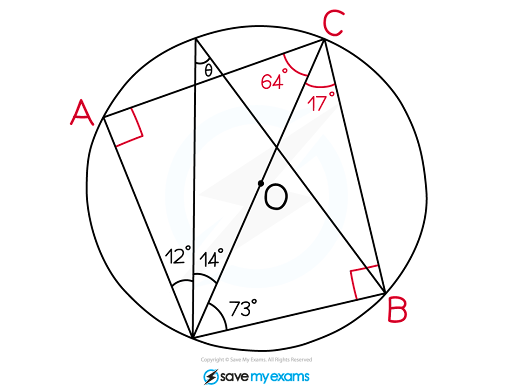
Circle theorems - knowing all 8 theorems and applying them in proofs
Trigonometry - sine rule, cosine rule, 3D trig
Vectors - adding, subtracting, proving geometric results
Transformations - enlargements with fractional and negative scale factors
Statistics & Probability
Conditional probability - using Venn diagrams and tree diagrams
Histograms - drawing and interpreting frequency density
Cumulative frequency and box plots - comparing distributions
The harder problem-solving questions (usually the last two or three on each paper) draw on multiple topics at once. Practising these multi-step questions is essential for a grade 9.
Our GCSE Maths revision notes are organised by exam board and tier, so you can focus solely on Higher paper content.
How to Revise for a Grade 9 in GCSE Maths
1. Use Past Papers as Your Primary Revision Tool
Nothing prepares you for the exam better than doing exam questions. Work through past papers under timed conditions, then mark them carefully against the mark scheme.
Pinpoint why you went wrong. That's how you stop making the same mistake twice.
Access AQA GCSE Maths past papers, Edexcel GCSE Maths past papers, and OCR GCSE Maths past papers on Save My Exams.
2. Target Your Weak Areas First
It's tempting to keep practising what you're already good at. Don't. Use a topic list to identify your weakest areas, then focus your time there.
The AI-powered Smart Mark feature at Save My Exams will mark the topic questions you answer to identify exactly where you're losing marks so you can fix the gaps efficiently.
3. Learn the Mark Scheme
Examiners at grade 9 are looking for clear, logical working. Studying mark schemes teaches you exactly what to write and how much detail to show.
Show your working too. Even if you don’t arrive at the correct answer, you can still pick up method marks.
4. Practise the Hardest Questions
If you want a grade 9, you need to be able to answer the hardest questions on the paper. These are the ones that a lot of students leave blank. Seek these out. Practice them repeatedly until they feel manageable.
Heat to the Higher tier GCSE Maths topic questions and work your way up to the most challenging material.
5. Get Good at Graphs
Graphs will always come up as big questions with lots of marks available, and often with a hard part at the end.
I would expect a grade 9 student to be able to predict the shape of a curve from its equation before even sketching it, knowing details such as positive and negative shapes, x- and y-intercepts and any standard symmetries (especially for the Trigonometric Graphs).

6. Don’t Underestimate the Last Line of Algebra
Some of the hardest questions in algebra are not due to beginnings or middles, but due to their ends.
The hardest part is that last line of algebra and this is where grade 9 students should concentrate.
Some of my favourite grade 9 skills here include simplifying Algebraic Fractions, simplifying expressions under square-root signs, rewriting negative fractional indices as roots and Completing the Square for harder quadratics.

7. Learn off by Heart
If I were to recommend three topics to learn off by heart to get you closer to a grade 9, I would say all the Circle Theorems, all the Graph Transformations and all the Exact Trigonometric Values.
These are relatively straightforward to learn, but are seen as hard topics because most students only learn them a few weeks before the exam!
Exam Technique for a Grade 9
Good technique can be the difference between a grade 8 and a grade 9. Here's what to focus on:
Show all your working.
Even if you get the final answer wrong, you can pick up method marks. An answer with no working gets no method marks if it's incorrect.
Read each question twice.
Many marks are lost by misreading - especially in longer problem-solving questions where key information is easy to miss.
Don't leave blanks.
If you're stuck, write down what you know. Jot down a relevant formula. Attempt the first step. You may still earn a mark.
Check your answers.
If you finish early, go back and check. Use substitution to verify algebraic answers. Sense-check geometric answers against the diagram.
Use diagrams and jottings.
For geometry and statistics questions, drawing out the problem often makes the method clearer.
Manage your time.
Don't spend too long on any one question. If you're stuck, move on and come back. The last question on a paper is often worth as many marks as the first - don't run out of time before you reach it.
Common Mistakes That Cost Grade 9 Students Marks
Even the best-prepared students can drop marks through avoidable errors:
Rounding too early - keep full decimal values in your calculator until the final step.
Misreading bearings or angles - always check whether you've used the right angle in trig questions.
Forgetting to include units - especially in area, volume and speed calculations.
Skipping algebraic proof questions - these are guaranteed to appear, and students often avoid them. Learn the method and practise it.
Not checking if the answer is realistic - a negative length or a probability above 1 are red flags.
Frequently Asked Questions
Is it possible to get a 9 in GCSE Maths without a tutor?
Yes, absolutely. A tutor can help, but it's not a requirement. What matters most is consistent, targeted practice. Using good revision resources, working through past papers and marking them carefully against mark schemes is entirely sufficient - with or without a tutor.
Can I get a grade 9 in GCSE Maths on the Foundation tier?
No. The maximum grade available on the Foundation tier is a 5. To be awarded a grade 9, you must sit the Higher tier paper.
When should I start revising for GCSE Maths?
The earlier the better, but even starting a few months before the exam is enough time to make a significant difference if you're organised and consistent. Use your mock exam results to identify gaps and prioritise accordingly.
Ready to Start Revising?
Getting a 9 in GCSE Maths is challenging - but it's achievable with the right preparation.
Start with your weakest topics, work through past papers regularly, and practise the hardest questions until they feel familiar. Save My Exams GCSE Maths revision resources have everything you need to aim for grade 9.
References
JCQ Exam Results Tables (opens in a new tab)
OCR GCSE grade boundaries June 2025 (opens in a new tab)
Edexcel GCSE grade boundaries June 2025 (opens in a new tab)
AQA GCSE grade boundaries June 2025 (opens in a new tab)
https://www.tiktok.com/@savemyexams/video/7454517012165954849?lang=en
Was this article helpful?
Sign up for articles sent directly to your inbox
Receive news, articles and guides directly from our team of experts.

Share this article





 written revision resources that improve your