Amide Chemistry (Edexcel A Level Chemistry): Revision Note
Exam code: 9CHO

Amide Formation
Amides are organic compounds with an -CONR2 functional group
They can be prepared from the condensation reaction between an acyl chloride and ammonia or amine
In a condensation reaction, two organic molecules join together and in the process eliminate a small molecule
In this case, the acyl chlorides and ammonia or amine join together to form an amide and eliminate an HCl molecule
Condensation reaction
The chlorine atom in acyl chlorides is electronegative and draws electron density from the carbonyl carbon
The carbonyl carbon is therefore electron-deficient and can be attacked by nucleophiles
The nitrogen atom in ammonia and amines has a lone pair of electrons which can act as a nucleophile and attack the carbonyl carbon
As a result, the C-Cl bond is broken and an amide is formed
Whether the product is a substituted amide or not, depends on the nature of the nucleophile
Primary and secondary amines will give a substituted amide
The reaction of acyl chlorides with ammonia will produce a non-substituted amide
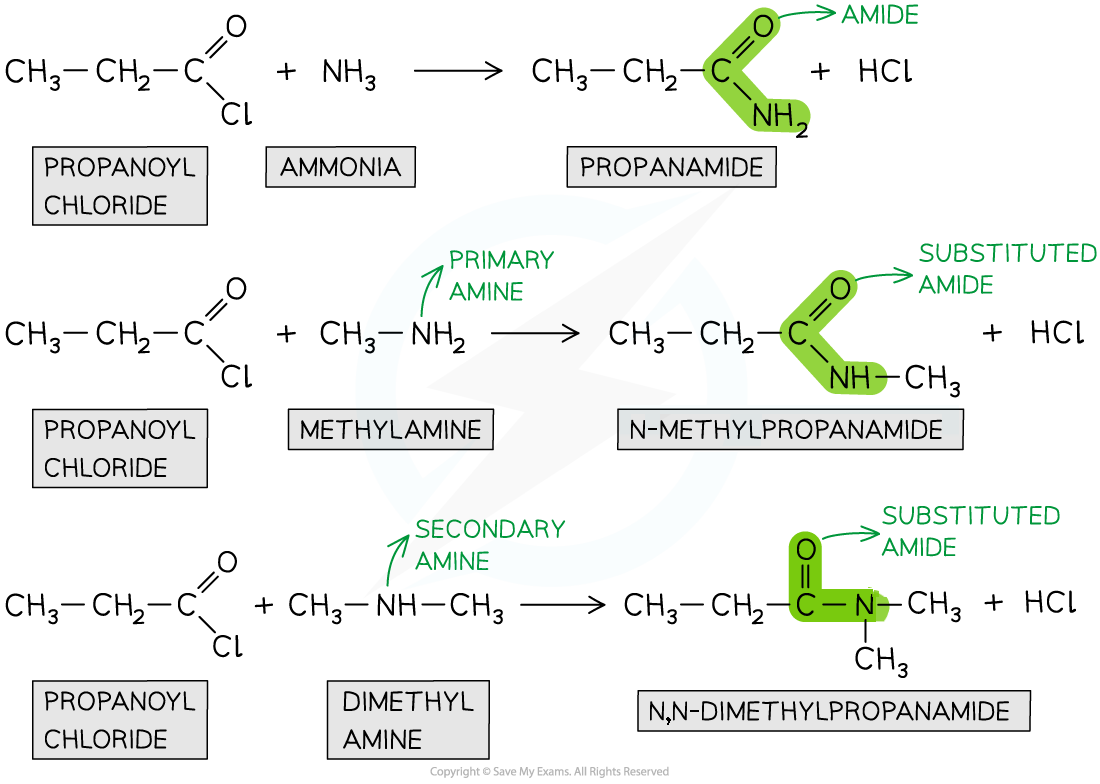
Acyl chlorides undergo condensation reactions with ammonia and amines to form amides
Note that ammonia is basic and the inorganic product is acidic, so there will be a reaction between the two molecules
NH3 + HCl → NH4Cl
We can therefore write the overall equation for the reaction of propanoyl chloride and ammonia as
CH3CH2COCl + 2NH3 → CH3CH2CONH2 + NH4Cl
Polyamide Formation
Amide link
Polyamides are also formed using condensation polymerisation

An amide link - also known as a peptide link - is the key functional group in a polyamide
Monomers
A diamine and a dicarboxylic acid are required to form a polyamide
A diamine contains 2 -NH2 groups
A dicarboxylic acid contains 2 -COOH groups

The monomers for making polyamides
Formation of polyamides

This shows the expulsion of a small molecule as the amide link forms
Nylon 6,6 is a synthetic polyamide
Its monomers are 1,6-diaminohexane and hexane-1,6-dioic acid
The ‘6,6’ part of its name arises from the 6 carbon atoms in each of Nylon 6,6 monomers

Nylon 6,6 is a synthetic polyamide made using diamine and dicarboxylic acid monomers
Kevlar
Kevlar is another example of a polymer formed through condensation polymerisation
The polymer chains are neatly arranged with many hydrogen bonds between them
This results in a strong and flexible polymer material with fire resistance properties
These properties also lend Kevlar to a vital application in bullet-proof vests
The monomers used to make Kevlar
1,4-diaminobenzene
Benzene-1,4-dicarboxylic acid

Kevlar is made using a diamine and dicarboxylic acid monomers

Unlock more, it's free!
Join the 100,000+ Students that ❤️ Save My Exams
the (exam) results speak for themselves:

Was this revision note helpful?
Build on this topic