Preparation of Carboxylic Acids (Edexcel A Level Chemistry): Revision Note
Exam code: 9CHO

Preparation of Carboxylic Acids
Carboxylic acids are compounds with a -COOH functional group
They can be prepared by a series of different reactions
Oxidation of primary alcohols & aldehydes
Carboxylic acids can be formed from the oxidation of primary alcohols and aldehydes by either acidified K2Cr2O7 or acidified KMnO4 and reflux
The oxidising agents themselves get reduced causing the solutions to change colour
In K2Cr2O7 the orange dichromate ions (Cr2O72-) are reduced to green Cr3+ ions
In KMnO4 the purple manganate(VII) ions (MnO4-) are reduced to colourless Mn2+ ions
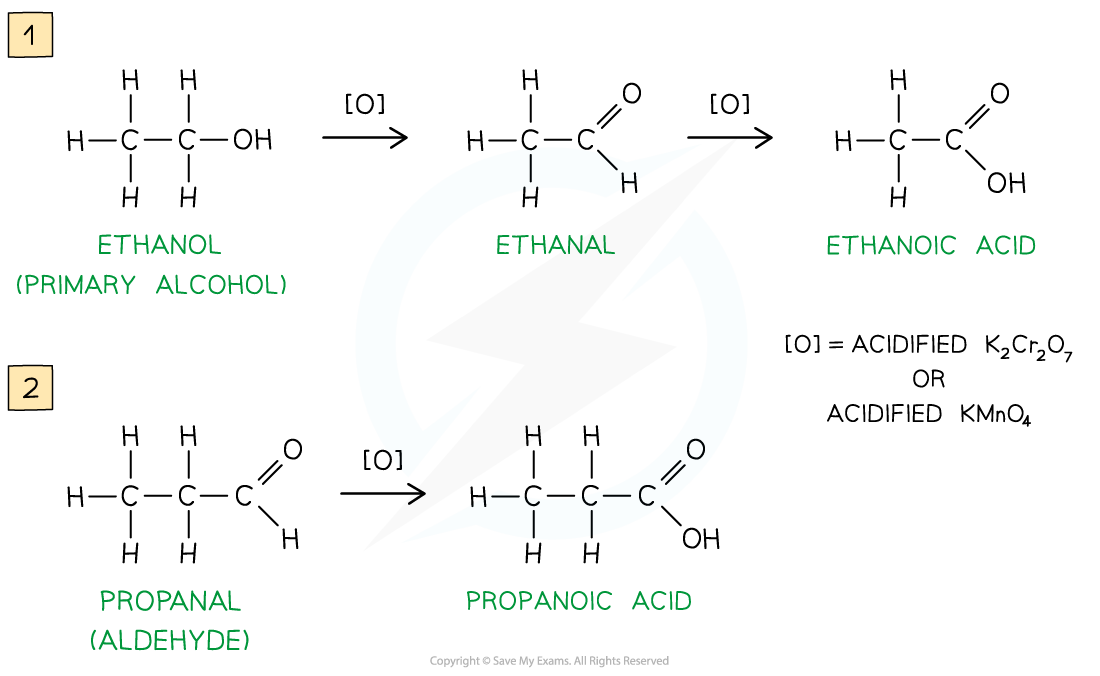
Oxidation of primary alcohols (1) and aldehydes (2) gives carboxylic acids
Examples: (1) ethanol, CH3CH2OH, is oxidised by [O] to ethanal, CH3CHO, and then to ethanoic acid, CH3COOH; (2) propanal, CH3CH2CHO, is oxidised by [O] to propanoic acid, CH3CH2COOH. [O] = acidified K2Cr2O7 or acidified KMnO4.
Hydrolysis of nitriles
Carboxylic acids can also be prepared from the hydrolysis of nitriles using either dilute acid (e.g. hydrochloric acid) or dilute alkali followed by acidification, and heating under reflux
Hydrolysis by dilute acid results in the formation of a carboxylic acid and ammonium salt, e.g.:
CH3CH2CN + HCl + 2H2O → CH3CH2COOH + NH4Cl
Hydrolysis by dilute alkali results in the formation of a sodium carboxylate salt and ammonia, e.g.:
Acidification is required to change the carboxylate ion into a carboxylic acid
CH3CH2CN + NaOH + H2O → CH3CH2COO-Na+ + NH3
Then acidification gives CH3CH2COOH
The -CN group at the end of the hydrocarbon chain is converted to a -COOH group

Hydrolysis of nitriles by either dilute acid (1) or dilute alkali and acidification (2) will form a carboxylic acid

Unlock more, it's free!
Join the 100,000+ Students that ❤️ Save My Exams
the (exam) results speak for themselves:

Was this revision note helpful?
Build on this topic