Data Types & Records (Cambridge (CIE) A Level Computer Science): Exam Questions

Exam code: 9618

57 mins13 questions
1
2 marks

Refer to the insert (opens in a new tab) for the list of pseudocode functions and operators.

A program will calculate the tax payable based on the cost of an item.

Calculations will occur at many places in the program and these involve the use of one of three tax rates.

Tax rate values represent a percentage. For example, a tax rate value of 5.23 represents 5.23%. In this case, the tax payable on an item costing $100 would be $5.23.

Tax rate values are used at several places within the program. One example is given in pseudocode as follows:

HighRate leftwards arrow FALSE
CASE OF ItemCost
<= 50 : TaxRate leftwards arrow 3.75 // tax rate of 3.75%
<= 200 : TaxRate leftwards arrow 5.23 // tax rate of 5.23%
> 200 : TaxRate leftwards arrow 6.25 // tax rate of 6.25%
HighRate leftwards arrow TRUE
ENDCASE
TaxPayable leftwards arrowItemCost * TaxRate // tax payable

Give the appropriate data type for the variables in the following table, as used in the pseudocode:

Variable name

Data type

HighRate

TaxPayable

2
6 marks

The module to perform the checks and calculation will be implemented as a function. The function will need to return both a real and a Boolean value. To achieve this a record type is defined in pseudocode as follows:

TYPE Result
DECLARE Done : BOOLEAN
DECLARE Value : REAL
ENDTYPE

The function Evaluate() will:

  • take two parameters of type string representing the two numeric values

  • return a variable of type Result with the Done field set to FALSE if either of the following applies:

    • at least one of the strings does not represent a valid numeric value

    • the numeric value of the string representing value y is zero

  • otherwise return a variable of type Result with the Done field set to TRUE and the Value field assigned the result of the formula (based on the numeric value of the two parameters).

Write pseudocode for the function Evaluate().

3
3 marks

To solve the error a programmer decides to create a new module.

The design of the new module has been completed and the module is being coded.

The new module referred to in part (c) introduces three new variables.

Complete the following table by giving the appropriate data type for each.

Variable name

Used to store

Data type

Name

A customer name.

Index

An array index.

Result

The result of the division of any two non-zero numbers.

4
7 marks

A program is being developed to implement a game for up to six players.

During the game, each player assembles a team of characters. At the start of the game there are 45 characters available.

Each character has four attributes, as follows:

Attribute

Examples

Comment

Player

0, 1, 3

The player the character is assigned to

Role

Builder, Teacher, Doctor

The job that the character will perform in the game.

Name

Bill, Lee, Farah, Mo

The name of the character. Several characters may perform the same role, but they will each have a unique name.

Level

14, 23, 76

The skill level of the character. An integer in the range 0 to 100 inclusive.

The programmer has defined a record type to define each character.

The record type definition is shown in pseudocode as follows:

TYPE CharacterType
DECLARE Player : INTEGER
DECLARE Role : STRING
DECLARE Name : STRING
DECLARE Level : INTEGER
ENDTYPE

The Player field indicates the player to which the character is assigned (1 to 6). The field value is 0 if the character is not assigned to any player.

The programmer has defined a global array to store the character data as follows:

DECLARE Character : ARRAY[1:45] OF CharacterType

At the start of the game all record fields are initialised, and all Player field values are set to 0

The programmer has defined a program module as follows:

Module

Description

Assign()

  • called with two parameters:

    • an integer representing a player

    • a string representing a character role

  • search the Character array for an unassigned character with the required role

  • If found, assign the character to the given player and output a confirmation message, for example:

    "Bill the Builder has been assigned to player 3"

  • If no unassigned character with the required role is found, output a suitable message.

Write pseudocode for module Assign().

5
3 marks

Complete the table by giving the appropriate data type in each case.

Variable

Example data value

Data type

Available

TRUE

Received

"18/04/2021"

Index

100

6
7 marks

A program is being developed to implement a game for up to six players.

During the game, each player assembles a team of characters. At the start of the game there are 45 characters available.

Each character has four attributes, as follows:

Attribute

Examples

Comment

Player

0, 1, 3

The player the character is assigned to.

Role

Builder, Teacher, Doctor

The job that the character will perform in the game.

Name

Bill, Lee, Farah, Mo

The name of the character. Several characters may perform the same role, but they will each have a unique name.

Skill Level

14, 23, 76

An integer in the range 0 to 100 , inclusive.

The programmer has defined a record type to define each character. The record type definition is shown in pseudocode as follows:

TYPE CharacterType
DECLARE Player : INTEGER
DECLARE Role : STRING
DECLARE Name : STRING
DECLARE SkillLevel : INTEGER
ENDTYPE

The Player field indicates the player to which the character is assigned (1 to 6). The field value is 0 if the character is not assigned to any player.

The programmer has defined a global array to store the character data as follows:

DECLARE Character : ARRAY[1:45] OF CharacterType

At the start of the game all record fields are initialised, and all Player field values are set to 0

The programmer has defined a program module as follows:

Module

Description

Count()

  • called with two parameters:

    • an integer representing a player

    • a string representing a character role

  • searches the Character array for characters with the given role that are assigned to the given player

  • counts the number of assigned characters and sums their total skill level

  • outputs the result of the search if characters with the given role are found, for example:

    "Player 3 has 4 characters with the role of Teacher and the total skill level is 65"

  • if no characters with the given role are found, outputs:

    "No characters with that role are assigned to this player"

Complete the pseudocode for module Count().

PROCEDURE Count(ThisPlayer : INTEGER, ThisRole : STRING)

7a
4 marks

A factory needs a program to help manage its production of items.

Data will be stored about each item.

The data for each item will be held in a record structure of type Component.

The programmer has started to define the fields that will be needed as shown in the table.

Field

Example value

Comment

Item_Num

123478

a numeric value used as an array index

Reject

FALSE

TRUE if this item has been rejected

Stage

'B'

a letter to indicate the stage of production

Limit_1

13.5

any value in the range 0 to 100 inclusive

Limit_2

26.4

any value in the range 0 to 100 inclusive

Write pseudocode to declare the record structure for type Component.

7b
3 marks

State three benefits of using an array of records to store the data for all items.

8
1 mark

A record structure is declared to hold data relating to components being produced in a factory:

TYPE Component
DECLARE Item_ID : STRING
DECLARE Reject : BOOLEAN
DECLARE Weight : REAL
ENDTYPE

The factory normally produces a batch (or set) of 1000 components at a time. A global array is declared to store 1000 records for a batch:

DECLARE Batch : ARRAY [1:1000] OF Component

Two global variables contain the minimum and maximum acceptable weight for each component.
The values represent an inclusive range and are declared as:

DECLARE Min, Max : REAL

When batches of less than 1000 components are processed, it is necessary to indicate that certain elements in the array are unused.

Suggest how an unused array element could be indicated.

9
4 marks

Write pseudocode statements to declare the record data type FootballClub to hold data about football clubs in a league, to include:

  • name of team

  • date team joined the league

  • main telephone number

  • name of the manager

  • number of members

  • current position in the league.

10
3 marks

Refer to the insert (opens in a new tab) for the list of pseudocode functions and operators.

The following pseudocode represents part of the algorithm for a program:

CASE OF ThisValue
< 30 : Level leftwards arrow "Low" // less than 30
Check leftwards arrow 1
< 20 : Level leftwards arrow "Very Low" // less than 20
Check leftwards arrowThisValue / 2
30 TO 40 : Level leftwards arrow "Medium" // between 30 and 40
Check leftwards arrow ThisValue / 3
Data[ThisValue]leftwards arrow Data[ThisValue] + 1
> 40 : Level leftwards arrow "High"
ENDCASE

Give the appropriate data types for the variables ThisValue, Check and Level.

ThisValue ..........................................................................................................

Check ................................................................................................................

Level ...................................................................................................................

11a
4 marks

Refer to the insert (opens in a new tab)for the list of pseudocode functions and operators

A shop sells car accessories. A customer order is created if an item cannot be supplied from current stock. A program is being developed to create and manage the customer orders.

The following identifier table shows some of the data that will be stored for each order.

Complete the identifier table by adding meaningful variable names and appropriate data types.

Example value

Explanation

Variable name

Data type

"Mr Khan"

The name of the customer

3

The number of items in the order

TRUE

To indicate whether this is a new customer

15.75

The deposit paid by the customer

11b
3 marks

The data that needs to be stored for each customer order in part (a) is not all of the same type.

Describe an effective way of storing this data for many customer orders while the program is running.

12
4 marks

Refer to the insert (opens in a new tab) for the list of pseudocode functions and operators.

A program is being developed in pseudocode before being converted into a programming language.

The following table shows four valid pseudocode assignment statements.

Complete the table by giving the data type that should be used to declare the variable underlined in each assignment statement.

Assignment statement

Data type

MyVar1 ← Total1 / Total2

MyVar2 ← 27/10/2023

MyVar3 ← "Sum1 / Sum2"

MyVar4 ← Result1 AND Result2

13
3 marks

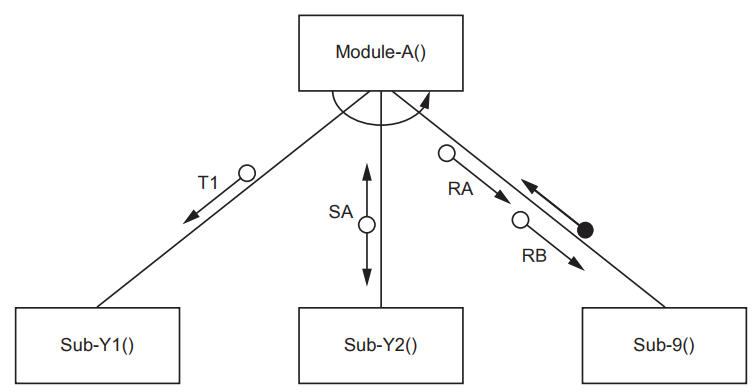
A structure chart shows the modular structure of a program:

Diagram showing Module-A linked to Sub-Y1, Sub-Y2, and Sub-9 with arrows labelled T1, SA, RA, and RB indicating different interactions.

The structure chart shows that Sub-9() is a function.

A Boolean value is returned by Sub-9() for processing by Module-A().

The original parameter RA is of type integer and RB is of type string.

A record type MyType will be defined with three fields to store the values passed between the two modules.

Write pseudocode to define MyType.