Introduction to Abstract Data Types (ADT) (Cambridge (CIE) A Level Computer Science): Exam Questions

Exam code: 9618

2 hours17 questions
1a
3 marks

A program uses a stack to hold up to 60 numeric values.
The stack is implemented using two integer variables and a 1D array.

The array is declared in pseudocode as shown:

DECLARE ThisStack : ARRAY[1:60] OF REAL

The stack operates as follows:

  • Global variable SP acts as a stack pointer that points to the next available stack location. The value of SP represents an array index.

  • Global variable OnStack represents the number of values currently on the stack.

  • The stack grows upwards from array element index 1.

(i) Give the initial values that should be assigned to the two variables.

SP ............................................................................................................

OnStack ...................................................................................................

[1]

(ii) Explain why it is not necessary to initialise the array elements before the stack is used.

[2]

1b
4 marks

A function to add a value to ThisStack is expressed in pseudocode as shown. The function will return a value to indicate whether the operation was successful or not.

Complete the pseudocode by filling in the gaps.

FUNCTION Push(ThisValue : REAL) RETURNS BOOLEAN

DECLARE ReturnValue : BOOLEAN

IF ................................................ THEN

RETURN ................................................ // stack is already full

ENDIF

................................................←ThisValue

SP← ................................................

OnStack← OnStack + 1

RETURN TRUE

ENDFUNCTION

2a
1 mark

The implementation of a linked list uses an integer variable and a 1D array List of type Node.

Record type Node is declared in pseudocode as follows:

TYPE Node
DECLARE Data : STRING
DECLARE Pointer : INTEGER
ENDTYPE

The array List is declared in pseudocode as follows:

DECLARE List : ARRAY[1:200] OF Node

The linked list will operate as follows:

  • Integer variable HeadPointer will store the array index for the first node in the linked list.

  • The Pointer field of a node contains the index value of the next array element (the next node) in the linked list.

  • The value 0 is used as a null pointer.

State why the value 0 has been selected as the null pointer.

2b
4 marks

The array List will be initialised so that each node points to the following node. The last node will contain a null pointer.

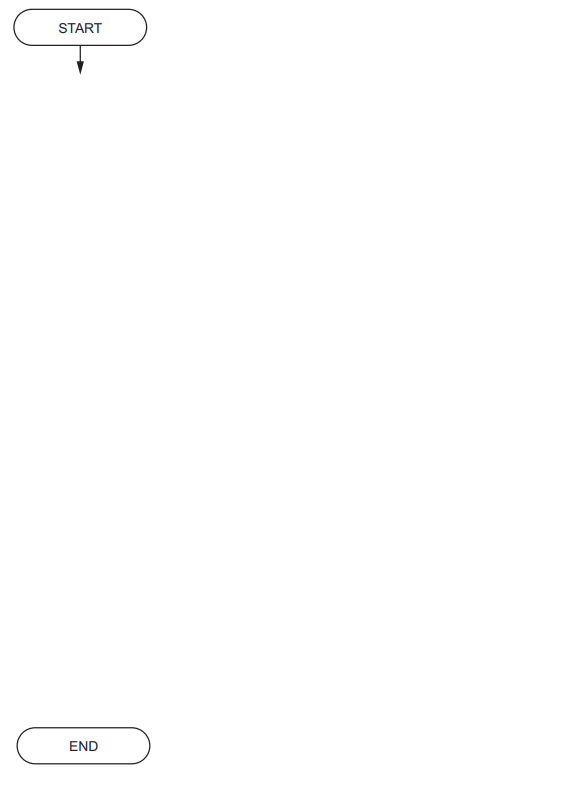
Complete the program flowchart to represent the algorithm for this operation.

Flowchart with a "Start" oval at the top and "End" oval at the bottom, connected by an arrow indicating sequence.
2c
4 marks

An algorithm outputs the Data field from all nodes in the array List. The order the Data is output should be the same order it is stored in the linked list.

Describe the algorithm in four steps.

Do not use pseudocode statements in your answer.

Step 1 ......................................................................................................................

Step 2 .....................................................................................................................

Step 3 .....................................................................................................................

Step 4 .....................................................................................................................

3
3 marks

The diagram shows an Abstract Data Type (ADT) representation of a linked list after data items have been added.

  • PS is the start pointer.

  • PF is the free list pointer.

  • Labels Df, Dc, Db and Dy represent the data items of nodes in the list.

  • Labels Fg, Fh, Fm and Fw represent the data items of nodes in the free list.

  • The symbol Ø represents a null pointer.

Flowchart with two horizontal processes. The top shows PS to Df, Dc, Db, Dy, Ø. The bottom shows PF to Fg, Fh, Fm, Fw, Ø.

Describe the linked list immediately after initialisation, before any data items are added.

4a
3 marks

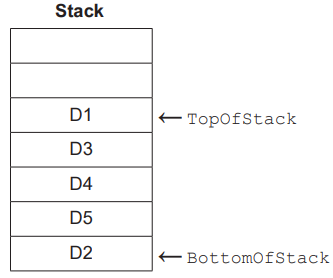
The diagram represents an Abstract Data Type (ADT).

The operation of this stack may be summarised as follows:

  • The TopOfStack pointer points to the last item added to the stack.

  • The BottomOfStack pointer points to the first item on the stack.

Diagram of a stack data structure with five layers labelled D1 to D5, marked "TopOfStack" at D1 and "BottomOfStack" at D2.

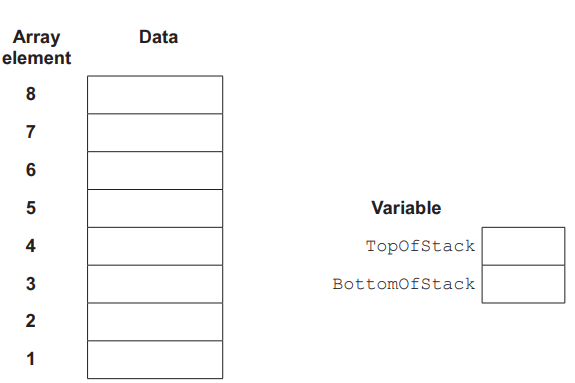
The stack is implemented using two variables and a 1D array of 8 elements as shown.

The variables are used to reference individual elements of the array, in such a way that:

  • the array is filled from the lowest indexed element towards the highest

  • all the elements of the array are available for the stack.

Complete the diagram to represent the state of the stack as shown above.

Diagram of an array with eight elements labelled 1 to 8, empty data cells; variables TopOfStack and BottomOfStack beside with empty boxes.
4b
5 marks

A function Push() will add a value onto the stack by manipulating the array and variables in part (a).

Before adding a value onto the stack, the algorithm will check that space is available.

If the value is added to the stack, the function will return TRUE, otherwise it will return FALSE.

The algorithm is expressed in five steps.

Complete the steps.

  1. If ........................................................ then return FALSE

  2. Otherwise .......................................... TopOfStack

  3. Use TopOfStack as an ................................... to the array.

  4. Set the element at this ...................................... to the .............................. being added.

  5. Return .............................. .

5a
5 marks

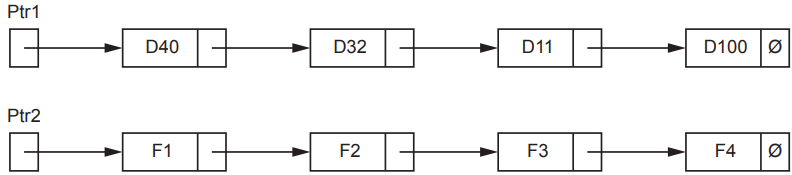
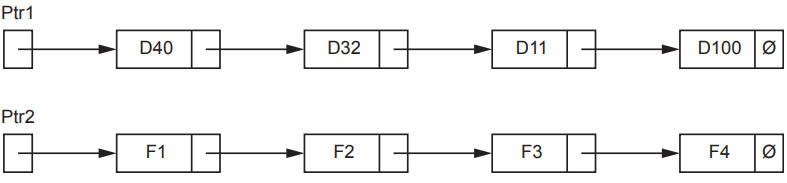
The diagram represents a linked list Abstract Data Type (ADT).

  • Ptr1 is the start pointer. Ptr2 is the free list pointer.

  • Labels D40, D32, D11 and D100 represent the data items of nodes in the list.

  • Labels F1, F2, F3 and F4 represent the data items of nodes in the free list.

  • The symbol Ø represents a null pointer.

Flowchart with two pathways, Ptr1 and Ptr2, showing sequences of nodes: D40, D32, D11, D100, Ø, and F1, F2, F3, F4, Ø respectively.

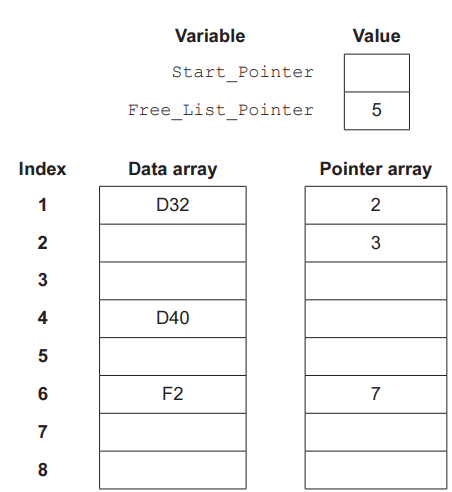
The linked list is implemented using two variables and two 1D arrays as shown.

The pointer variables and the elements of the Pointer array store the indices (index numbers) of elements in the Data array.

Complete the diagram to show how the linked list as shown above may be represented using the variables and arrays.

Diagram showing a variable table with 'Start_Pointer' and 'Free_List_Pointer' set to 5, and two arrays: Data containing 'D32', 'D40', 'F2', and Pointer with values '2', '3', '7'.
5b
4 marks

The original linked list is to be modified. A new node D6 is inserted between nodes D32 and D11.

Two rows of flow diagrams labelled Ptr1 and Ptr2. Ptr1 has nodes D40, D32, D11, D100. Ptr2 includes nodes F1, F2, F3, F4. Both end with null symbols.

The algorithm required is expressed in four steps as shown.

Complete the steps.

  1. Assign the data item .................................. to .................................. .

  2. Set the .................................. of this node to point to .................................. .

  3. Set Ptr2 to point to .................................. .

  4. Set pointer of .................................. to point to .................................. .

6
3 marks

The program contains a module GetFile() which receives text files sent from another computer.

Lines from the file are sent one at a time. Each message contains one line and ProcessMsg() from part (b) adds each message as it is received onto stack 1.

Module GetFile() removes messages from stack 1 and writes the data to a text file.

There is a problem. Under certain circumstances, the received file does not appear as expected.

Assume that while a file is being received ProcessMsg() receives only messages containing lines from the file.

(i) Describe the circumstances and explain the problem.

Circumstances ........................................................................................................

Explanation .............................................................................................................

[3]

(ii) Suggest a more appropriate Abstract Data Type that could be used to store the messages that would not have the same problem.

[1]

7a
3 marks

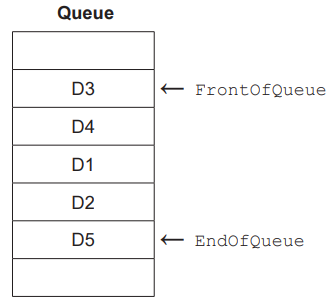
The diagram represents a queue Abstract Data Type (ADT).

The organisation of this queue may be summarised as follows:

  • The FrontOfQueue pointer points to the next data item to be removed.

  • The EndOfQueue pointer points to the last data item added.

Diagram of a queue with five boxes labelled D3, D4, D1, D2, and D5 from top to bottom, with arrows marking FrontOfQueue and EndOfQueue.

The queue is implemented using three variables and a 1D array of eight elements as shown. The variable NumItems stores the number of items in the queue.

The pointer variables store indices (index numbers) of the array.

Complete the diagram to represent the state of the queue as shown above.

Array with 8 indices, all empty. Variables shown: FrontOfQueue, EndOfQueue, NumItems set to 5, indicating the number of items in queue.
7b
6 marks

A module AddTo() will add a value to the queue by manipulating the array and variables in part (a).

The queue implementation is circular. When pointers reach the end of the queue, they will ‘wrap around’ to the beginning.

Before a value can be added to the queue, it is necessary to check the queue is not full.

The algorithm to add a value to the queue is expressed in six steps.

Complete the steps.

  1. If NumItems .............................. then jump to step 6.

  2. Increment ................................... .

  3. If ................................................. then set EndOfQueue to .............................. .

  4. Increment ................................... .

  5. Set the ............................ at the index stored in ........................... to the ............................ being added.

  6. Stop.

8a
7 marks

A stack Abstract Data Type (ADT) is to be implemented using pseudocode, with procedures to initialise it and to push new items onto the stack.

A 1D array Stack stores the contents of the stack.

(i) Study the pseudocode in part (a)(ii) and complete the table of identifiers by writing the missing data types and descriptions.

Identifier

Data type

Description

BasePointer

TopPointer

Stack

REAL

[2]

(ii) Complete the pseudocode.

CONSTANT MaxSize = 40
DECLARE BasePointer : INTEGER
DECLARE TopPointer : INTEGER
DECLARE Stack : ARRAY[1:40] OF REAL

// initialisation of stack
PROCEDURE Initialise()

...................................................................← 1 .

...................................................................← 0
ENDPROCEDURE

// push an item onto the stack
PROCEDURE Push(NewItem : REAL)

..............................................................MaxSize THEN

....................................................................

Stack[TopPointer]←..................................................
ENDIF
ENDPROCEDURE

[5]

8b
2 marks

Justify the use of a linked list instead of an array to implement a stack.

9
2 marks

A program stores the names of cities in a linked list.

The linked list is implemented using a 1D array CityList of record type Node. Each Node has two fields:

  • Data stores one city name

  • Pointer stores the array index of the next node in the linked list

StartPointer stores the array index of the first node in the linked list. The value 0 is used as the null pointer.

The table shows the contents of CityList. StartPointer has the value 2.

Index

Data

Pointer

1

Nairobi

5

2

Cairo

4

3

Perth

0

4

Dhaka

6

5

Oslo

3

6

Lima

1

State the order of the city names in the linked list.

10
4 marks

A library program stores book reference codes in a linked list. The codes are held in ascending order.

The linked list is implemented using a 1D array BookList of record type Node. Each Node has a Data field and a Pointer field. The Pointer field stores the array index of the next node.

  • StartPointer stores the array index of the first node in the linked list.

  • FreeListPointer stores the array index of the first node in the free list.

  • The value 0 is used as the null pointer.

  • A node on the free list has nothing stored in its Data field.

StartPointer has the value 8 and FreeListPointer has the value 4.

Index

Data

Pointer

1

6

2

BK208

7

3

BK115

2

4

1

5

BK340

0

6

0

7

BK297

5

8

BK061

3

The node storing BK208 is deleted from the linked list and returned to the free list. It becomes the first node on the free list.

Complete the table to show the Pointer field of every array element, and the values of StartPointer and FreeListPointer, after this deletion.

Index

Data

Pointer

1

2

BK208

3

BK115

4

5

BK340

6

7

BK297

8

BK061

Variable

Value

StartPointer

FreeListPointer

11
6 marks

An online shop stores product codes in a linked list.

The record type Node and the array Product are declared as follows.

TYPE Node
   DECLARE Data : STRING
   DECLARE Pointer : INTEGER
ENDTYPE

DECLARE Product : ARRAY[1:50] OF Node
DECLARE StartPointer : INTEGER

The linked list works as follows.

  • StartPointer stores the array index of the first node in the linked list.

  • The Pointer field of a node stores the array index of the next node in the linked list.

  • The value 0 is used as the null pointer.

  • StartPointer has the value 0 when the linked list is empty.

The function FindNode() takes a product code as a parameter. It searches the linked list, in order, for that product code.

  • If a node in the linked list stores the product code in its Data field, the function returns the array index of that node.

  • If no node in the linked list stores the product code, the function returns 0.

The function uses a local integer variable ThisPointer to store the array index of the node currently being looked at.

Describe the algorithm for FindNode() in six steps.

Do not use pseudocode statements in your answer.

Step 1 ..............................................................................................

Step 2 ..............................................................................................

Step 3 ..............................................................................................

Step 4 ..............................................................................................

Step 5 ..............................................................................................

Step 6 ..............................................................................................

12
2 marks

A program uses a stack to store the product codes of items as they are scanned at a checkout.

The stack is held in memory locations 700 to 707.

The operation of this stack may be summarised as follows:

  • The TopOfStack pointer points to the last item added to the stack.

  • The BottomOfStack pointer points to the first item on the stack.

  • The stack grows upwards when items are added.

The diagram shows the current state of the stack.

Memory location

Value

Stack pointer

707

706

705

"P51"

TopOfStack

704

"P18"

703

"P77"

702

"P34"

701

"P09"

700

"P62"

BottomOfStack

Complete the following table by writing the answers.

Statement

Answer

The value that will be removed by the next POP operation.

The memory location that TopOfStack will point to after the operations POP, POP and PUSH "P40" have been performed, in that order.

13
4 marks

A text editor uses a stack to store the codes of the edits that a user can undo.

The stack is implemented using a 1D array and one integer variable. The array is declared in pseudocode as DECLARE EditStack : ARRAY[1:6] OF STRING.

The stack operates as follows:

  • TopOfStack holds the index of the array element that contains the last item added to the stack.

  • TopOfStack holds 0 when the stack is empty.

  • The array is filled from the lowest indexed element towards the highest.

The table shows the current state of the stack. TopOfStack currently holds 4.

Array element

Data

6

5

4

"E4"

3

"E3"

2

"E2"

1

"E1"

The following operations are then performed, in this order:

  • POP

  • PUSH "E5"

  • PUSH "E6"

  • POP

  • POP

  • PUSH "E7"

Complete the table to show the state of the array and the value of TopOfStack after all of these operations have been performed.

Leave an array element empty if it no longer holds an item that is part of the stack.

Array element

Data

6

5

4

3

2

1

TopOfStack = ..............................................

14
5 marks

A program uses a stack to store reference codes. The stack is implemented using a 1D array and one integer variable, declared in pseudocode as follows:

DECLARE ItemStack : ARRAY[1:50] OF STRING

DECLARE TopOfStack : INTEGER

The stack operates as follows:

  • TopOfStack holds the index of the array element that contains the last item added to the stack.

  • TopOfStack holds 0 when the stack is empty.

  • The array is filled from the lowest indexed element towards the highest.

A module Pop() will remove the item at the top of the stack and return that item to the calling program.

If there are no items on the stack, Pop() will output an error message and return an empty string.

Describe the algorithm for module Pop() in five steps.

Do not use pseudocode in your answer.

Step 1 ..............................................

Step 2 ..............................................

Step 3 ..............................................

Step 4 ..............................................

Step 5 ..............................................

15
2 marks

A program uses a queue to store the reference numbers of messages waiting to be sent.

The queue is implemented as a circular queue using a 1D array of eight elements, declared in pseudocode as DECLARE MsgQueue : ARRAY[1:8] OF STRING.

The organisation of this queue may be summarised as follows:

  • The FrontOfQueue pointer holds the index of the next data item to be removed.

  • The EndOfQueue pointer holds the index of the last data item added.

  • The variable NumItems holds the number of data items currently in the queue.

  • The queue is circular, so that array elements can be reused. When a pointer moves past element 8 it wraps around to element 1.

The table shows the current state of the queue. All eight elements have been used at least once.

Array element

Data

1

"M7"

2

"M8"

3

4

5

6

"M4"

7

"M5"

8

"M6"

FrontOfQueue = 6

EndOfQueue = 2

(i) State the number of data items currently in the queue.

[1]

(ii) State the index of the array element that will store the next data item added to the queue.

[1]

16
4 marks

A help desk program stores the reference numbers of customers who are waiting to speak to a support agent. The reference numbers are stored in a queue Abstract Data Type (ADT).

The queue is implemented as a circular queue using a 1D array of eight elements, declared in pseudocode as DECLARE CustQueue : ARRAY[1:8] OF STRING.

The queue works as follows.

  • The pointer FrontOfQueue stores the index of the reference number that will be removed next.

  • The pointer EndOfQueue stores the index of the reference number added most recently.

  • The variable NumItems stores how many reference numbers are in the queue.

  • When either pointer moves on from element 8, it goes back to element 1.

When a support agent is free, the procedure TakeNext() removes the next reference number from the queue and outputs it.

Describe the algorithm for TakeNext() in four steps.

Do not use pseudocode statements in your answer.

Step 1 ..............................................................................................

Step 2 ..............................................................................................

Step 3 ..............................................................................................

Step 4 ..............................................................................................

17
5 marks

A program uses a queue to store the reference numbers of parcels waiting to be loaded.

The queue is implemented as a circular queue using a 1D array of six elements, declared in pseudocode as DECLARE ParcelQueue : ARRAY[1:6] OF STRING.

The organisation of this queue may be summarised as follows:

  • The FrontOfQueue pointer holds the index of the next data item to be removed.

  • The EndOfQueue pointer holds the index of the last data item added.

  • The variable NumItems holds the number of data items currently in the queue.

  • The queue is circular. When a pointer moves past element 6 it wraps around to element 1.

The table shows the current state of the queue.

Array element

Data

1

2

3

"R21"

4

"R22"

5

"R23"

6

"R24"

FrontOfQueue = 3

EndOfQueue = 6

NumItems = 4

The following operations are then performed, in this order:

  • Remove one data item

  • Add "R25"

  • Add "R26"

  • Remove one data item

  • Remove one data item

  • Add "R27"

Complete the table to show the state of the array after all of these operations have been performed, and write the final value of each of the three variables.

Leave an array element empty if it no longer holds a data item that is part of the queue.

Array element

Data

1

2

3

4

5

6

FrontOfQueue = ..............................................

EndOfQueue = ..............................................

NumItems = ..............................................