Motivation: Learning & Cognition (DP IB Psychology: HL): Exam Questions

Syllabus Edition

First teaching 2025

First exams 2027

1 hour8 questions
1
3 marks

Source 1

A survey study examined autistic adolescents’ perceptions of how autism spectrum disorder (ASD) relates to their motivation to work hard at school. Participants responded to the statement “My ASD motivated me to work hard at school.”

Responses were given on a Likert scale ranging from strongly agree to strongly disagree. Results were recorded as percentages. Figure 1 shows the percentage of participants selecting each response option.

Figure 1: Percentage of autistic adolescents endorsing different levels of agreement with the statement “My ASD motivated me to work hard at school”
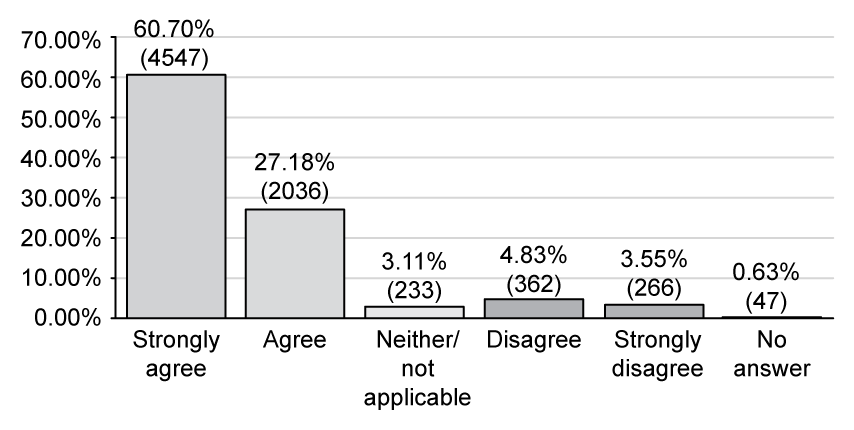
Bar chart showing survey results: 60.7% strongly agree, 27.18% agree, 3.11% neither, 4.83% disagree, 3.55% strongly disagree, 0.63% no answer.

Explain one issue that limits the interpretation of the data in source 1.

2
6 marks

Source 2

A study investigated whether motivation to improve memory influenced engagement with and uptake of memory improvement strategies (e.g. rehearsal, elaboration, use of mnemonics). Participants completed:

  • a Motivation to Learn Scale (1–7)

  • a Memory Strategy Engagement Scale measuring willingness to learn and apply memory strategies (0–100)

Participants were grouped according to their level of motivation, the findings of which are presented in Table 1.

Table 1: Mean engagement with memory improvement strategies by level of motivation

Level of motivation to learn

Mean engagement score (0–100)

Standard deviation

Low motivation

42.6

8.9

Moderate motivation

61.3

9.5

High motivation

78.8

7.6

Analyse the findings from source 2 and state a conclusion linked to the claim that motivation increases engagement with memory improvement strategies.

3
6 marks

Source 3

A qualitative study explored how university students aged 18–21 experienced motivation when deciding whether to study or socialise in the weeks leading up to exams. Four focus group interviews were conducted. Discussions focused on study priorities, social pressures, and emotional factors influencing motivation.

The transcripts were analysed using thematic analysis. The following themes were identified:

  • Students described a conflict between short-term social enjoyment and long-term academic goals

  • Peer influence and fear of missing out affected motivation to revise

  • Motivation increased when exams were seen as important for future outcomes

  • Stress and anxiety influenced decisions about studying versus socialising

  • Individual differences were noted, with some students reporting stronger self-discipline than others

Discuss the extent to which the findings in source 3 are transferable.

4
15 marks

To what extent can we claim that motivation is a key factor in the use of effective learning strategies? In your answer, use your own knowledge and at least three of sources 2-5 (opens in a new tab).

5
3 marks

Source 1

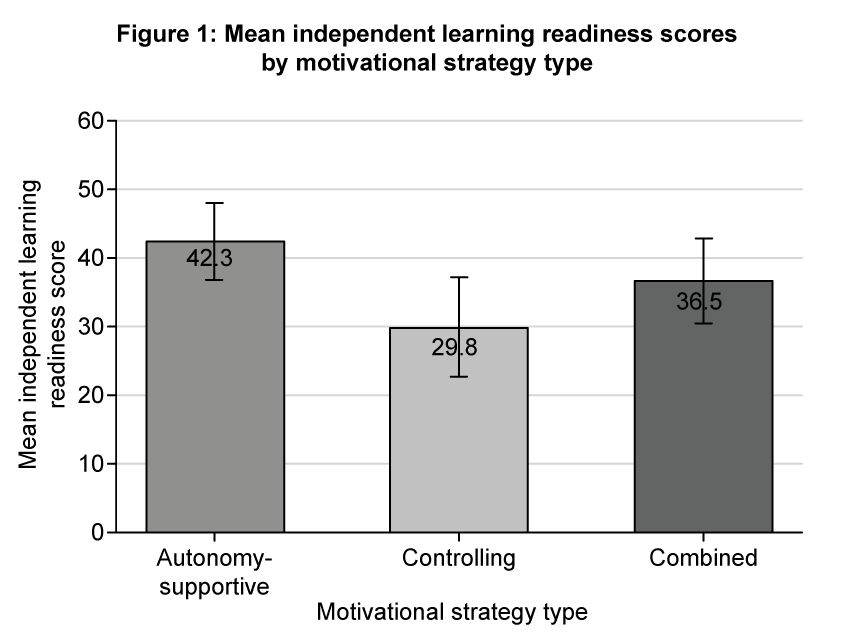
A researcher was interested to see if the type of motivational strategy used by teachers affected students' readiness for independent learning.

Figure 1 shows the findings of this study. Error bars represent one standard deviation above and below the mean.

Bar chart showing mean independent learning readiness scores: autonomy-supportive 42.3, controlling 29.8, combined 36.5, with error bars.

Explain one issue that limits the interpretation of the data in source 1.

6
6 marks

Source 2

A study investigated whether autonomy-supportive teaching improves independent learning more than controlling teaching. 140 students aged 14–16 from two secondary schools were assigned for one academic term to either:

  • an autonomy-supportive condition (choice, self-reflection, minimal external pressure), or

  • a controlling condition (rigid deadlines, performance-contingent rewards, teacher-directed tasks).

Independent learning was measured using the Self-Directed Learning Readiness Scale (0–60), administered pre- and post-programme. Mean change scores and standard deviations for each condition are shown in Table 1.

Table 1: Mean change in independent learning readiness scores by teaching condition

Teaching condition

Mean change score

Standard deviation

Autonomy-supportive

+8.7

4.3

Controlling

+2.1

5.6

Analyse the findings from source 2 and state a conclusion linked to the claim that specific strategies can effectively motivate students to become independent learners.

7
6 marks

Source 3

A qualitative study explored students' perceptions of how different motivational strategies affected their willingness and ability to learn independently. Focus groups were conducted with 24 students aged 15–17 from two secondary schools. Discussions focused on the motivational strategies used by teachers, their effect on learning habits, and students' confidence in learning without direct supervision.

Thematic analysis of the focus group data identified the following key themes:

  • Choice over topics and methods increased interest and willingness to study independently

  • Feedback focused on effort and improvement (rather than grades) boosted confidence and reduced fear of failure

  • Deadlines and rewards kept students on track but did not foster genuine interest in learning or independent study planning

  • Too much choice without clear guidance caused anxiety and reduced productivity, with some students preferring clearer teacher direction

Discuss the extent to which the findings from source 3 may be transferable to other populations or contexts.

8
15 marks

To what extent can we conclude that specific strategies can effectively motivate students to become independent learners? In your answer, use your own knowledge and at least three of sources 2–5 (opens in a new tab).