Technology: Learning & Cognition (DP IB Psychology: HL): Exam Questions

Syllabus Edition

First teaching 2025

First exams 2027

1 hour8 questions
1
3 marks

Source 1

Research was conducted into a possible relationship between regular computer gaming and working memory.

A researcher obtained a purposive sample of regular computer gamers and asked them to log the number of hours spent gaming per week. She also gave the participants a standardised test of working memory. The results are shown in Figure 1.

Scatter plot showing a positive correlation between hours spent gaming weekly and working memory scores, ranging from 50 to 75.

Explain one issue that limits the interpretation of the data in source 1.

2
6 marks

Source 2

A study investigated whether smartphone multitasking during a lecture affects students’ recall. The sample consisted of UK college students.

During a lecture, one group listened while being encouraged to use their smartphones for unrelated activities (e.g., scrolling or checking emails). The other group listened with their smartphones kept out of reach. After the lecture, all students completed a 20-question recall test on the lecture content.

Two months later, the procedure was repeated, with students switching conditions. Scores were converted into percentages.

Table 1 shows the mean recall scores and standard deviations for each condition.

Table 1: Mean and standard deviation scores of recall per condition

Condition

Mean recall score

Standard deviation

Smartphone

36.5%

4.6

No smartphone

68.2%

1.4

Analyse the findings from source 2 and state a conclusion linked to the claim that technology has an effect on memory.

3
6 marks

Source 3

A researcher conducted narrative interviews with older adults to explore how technology may act as a source of stress in everyday life. 20 participants aged 65–80, who regularly used digital technologies such as smartphones, online banking, or healthcare apps, took part in the study.

A thematic analysis identified the following themes:

  • Participants described feelings of overwhelm and frustration when using unfamiliar technologies

  • Some reported fear of making irreversible mistakes, such as deleting important information

  • Many expressed anxiety about keeping up with rapid technological change

Discuss how the researcher could improve the credibility of the findings in source 3.

4
15 marks

To what extent can we conclude that technology affects cognitive processes? In your answer, use your own knowledge and at least three of sources 2–5 (opens in a new tab).

5
3 marks

Source 1

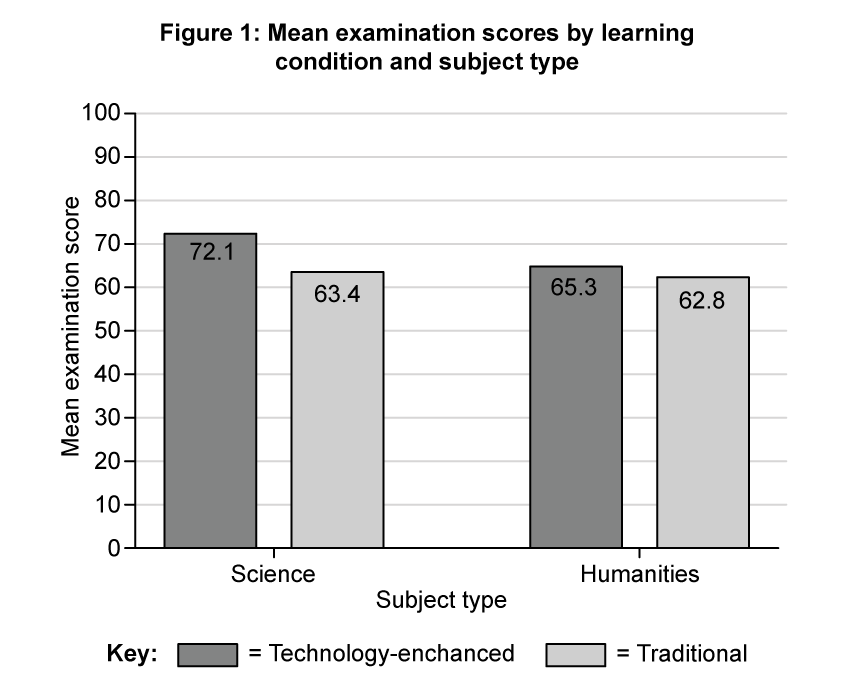
A researcher was interested to see if the type of learning condition (technology-enhanced or traditional) and the subject type (science or humanities) affected students' examination scores.

Bar chart titled "Mean examination scores by learning condition and subject type." Science scores: 72.1 (tech), 63.4 (trad). Humanities: 65.3 (tech), 62.8 (trad).

Explain one issue that limits the interpretation of the data in source 1.

6
6 marks

Source 2

A study was conducted to investigate whether the use of technology-enhanced learning tools improves academic performance compared with traditional teaching methods. 163 students aged 15–16 at two secondary schools were assigned to one of two conditions: a technology-enhanced condition (using interactive simulations, online quizzes, and video-based instruction alongside classroom teaching) or a traditional condition (classroom teaching with textbooks and written exercises only).

Academic performance was measured using a standardised end-of-unit assessment scored from 0 to 100.

Table 1 shows the mean scores and standard deviations for each condition.

Table 1: Mean academic performance scores by learning condition

Learning condition

Mean score

Standard deviation

Technology-enhanced

68.4

12.3

Traditional

61.7

14.1

Analyse the findings from source 2 and state a conclusion linked to the claim that the integration of technology into learning environments improves academic outcomes for students.

7
6 marks

Source 3

A researcher conducted semi-structured interviews with students to explore how technology-enhanced learning may affect engagement and understanding. 20 participants aged 15–17, drawn from three schools that had introduced interactive learning platforms, took part in the study.

Thematic analysis identified the following themes:

  • Participants described interactive simulations and visual tools as helping them grasp abstract concepts they had struggled when using textbooks

  • Some reported that online quizzes with immediate feedback exposed gaps in their knowledge and motivated them to revisit topics

  • Many found technology distracting, particularly notifications from social media and messaging apps on personal devices

  • Several felt overwhelmed by the sheer volume of digital resources and struggled to distinguish essential from supplementary content

Discuss how the researcher could avoid bias in source 3.

8
15 marks

To what extent can we conclude that the integration of technology into learning environments improves academic outcomes for students? In your answer, use your own knowledge and at least three of sources 2–5 (opens in a new tab).