Problem Solving with Volumes (WJEC GCSE Maths & Numeracy (Double Award)): Revision Note
Exam code: 3320

Problem-solving with volumes
What is problem-solving?
Problem-solving, usually has two key features:
A question is given as a real-life scenario
eg. The volume of water in a swimming pool...
There is usually more than one topic of maths you will need in order to answer the question
eg. Volume and money
What are common problems that involve volume?
Volume is a commonly used topic of 'real-world' maths
For example, a carton of juice in the shape of a cuboid, a cylindrical tin and a triangular prism chocolate box all involve volume
Typically, the 'real-world' scenarios also have a cost
A lot of volume problems also involve calculations with money
How do I solve problems involving volume?
Often the 3D object in a question will not be a standard cuboid, cone, sphere, etc.
It will likely either be:
A prism (3D shape with the same cross-section running through it)
A portion or fraction of a standard shape (half a cylinder for example)
A compound object (an object made up of two or more standard 3D objects)
If the object is a prism, recall that the volume of a prism is the cross-sectional area × its length
The cross-sectional area may be a compound 2D shape
For example, an L-shape, or a combination of a rectangle and a triangle
If the object is a fraction of a standard shape, consider the "full" version of the object and find the appropriate fraction of it
E.g. if a cylinder is cut in half, across the circular face's diameter, its volume is half of the full cylinder
If the object is a compound object, find the volumes of the individual standard 3D objects and add them together
Problem solving questions could appear on either a non-calculator paper or a calculator paper
Examiner Tips and Tricks
Before you start calculating, make a quick note of your plan to tackle the question.
For example, "Find the area of the triangle and the rectangle, add together, multiply by the length".
Worked Example
The diagram shows a prism.
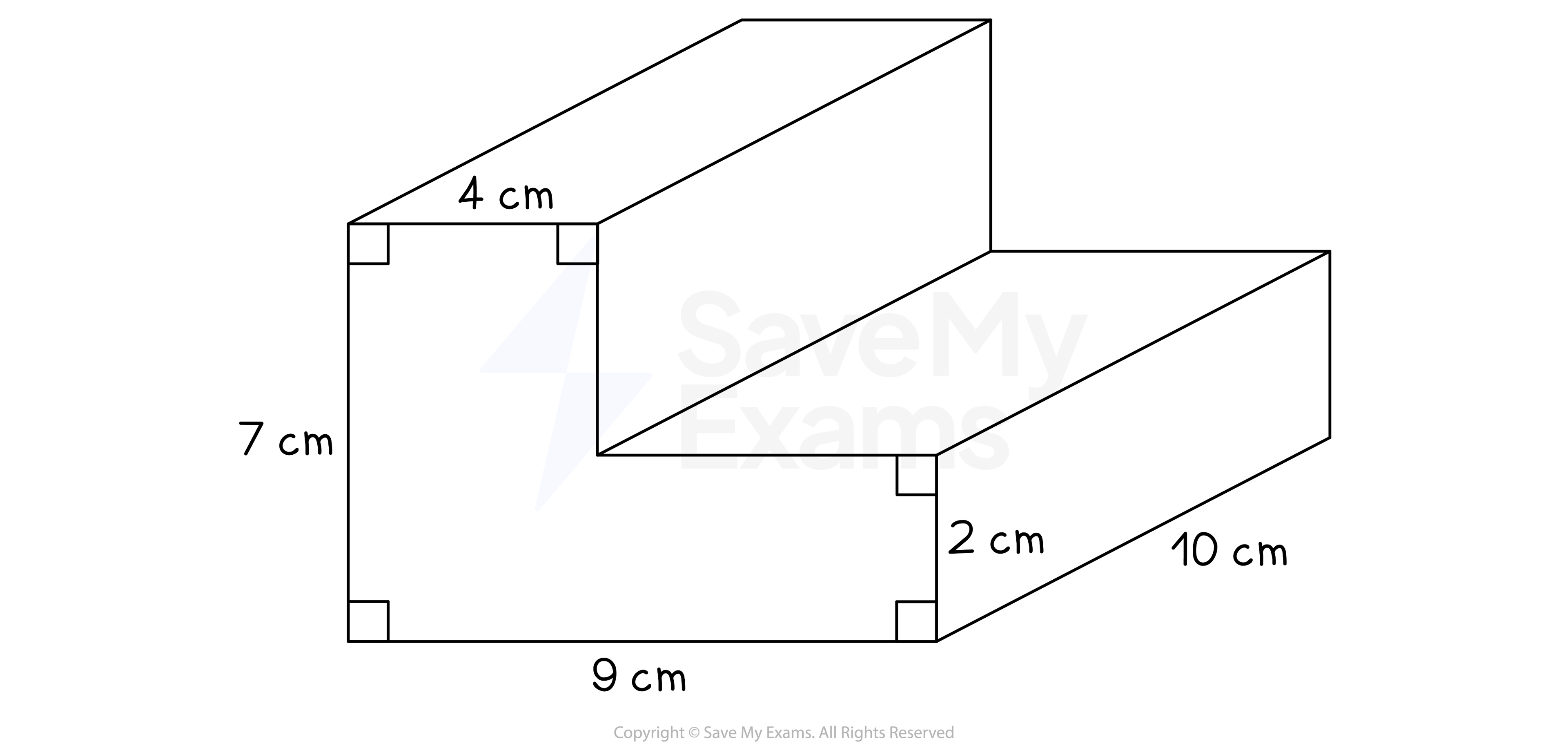
Work out the volume of the prism.
Answer:
The volume is the area of the cross section × length (10 cm)
Find the area by splitting into a 7 × 4 and a (9 - 4) × 2 rectangle (or a 9 × 2 and a (7 - 2) × 4 rectangle)
7 × 4 + (9 - 4) × 2 = 38 cm2
Find the volume (by multiplying 38 by 10)
38 × 10
380 cm3

Unlock more, it's free!
Join the 100,000+ Students that ❤️ Save My Exams
the (exam) results speak for themselves:

Was this revision note helpful?