Angles in Polygons (WJEC GCSE Maths & Numeracy (Double Award): Foundation): Revision Note
Exam code: 3320

Angles in polygons
What is a polygon?
A polygon is a 2D shape with straight sides
A triangle is a polygon with 3 sides
A quadrilateral is a polygon with 4 sides
A pentagon is a polygon with 5 sides
In a regular polygon all the sides are the same length and all the angles are the same size
A regular polygon with 3 sides is an equilateral triangle
A regular polygon with 4 sides is a square
What are the interior angles and the exterior angles of a polygon?
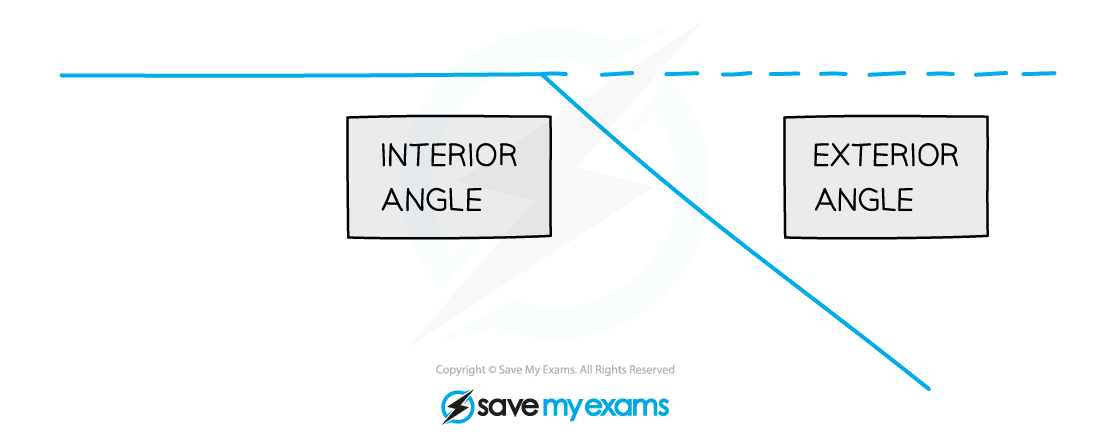
Interior angles are the angles inside a polygon at the corners
The exterior angle at a corner is the angle needed to make a straight line with the interior angles
It is not the angle that forms a full turn at the corner
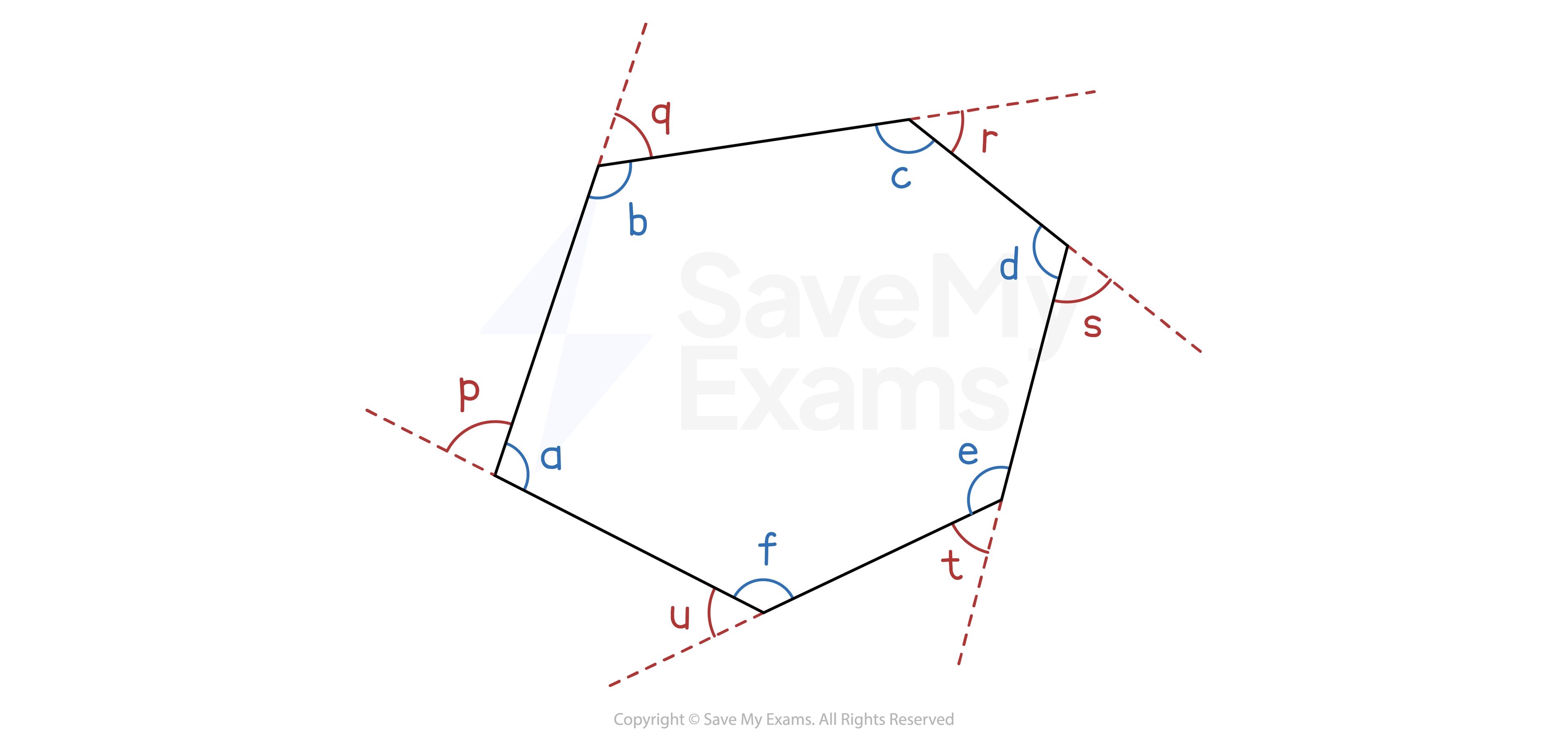
The interior angle and exterior angle add up to 180° at each corner
What is the sum of the interior angles in a polygon?
To find the sum of the interior angles in a polygon of sides, use the rule
Sum of interior angles =
This formula comes from the fact that -sided polygons can be split into triangles
Remember the sums for these polygons
The interior angles of a triangle add up to 180°
The interior angles of a quadrilateral add up to 360°
The interior angles of a pentagon add up to 540°
What is the sum of the exterior angles in a polygon?
The exterior angles in any polygon always sum to 360°
How do I find the size of an interior or exterior angle in a regular polygon?
To find the size of an interior angle in a regular polygon:
Method 1
Find the sum of the interior anglesFor a pentagon:
Divide by the number of sides ()
For a pentagon:
Method 2
Use the formula which calculates the interior angle directlyTo find the size of an exterior angle in a regular polygon:
either divide 360° by the number of sides ()
For a pentagon:
or use the formula
The interior angle and exterior angle add to 180°
Subtract the exterior angle from 180° to find the interior angle
Subtract the interior angle from 180° to find the exterior angle
Regular Polygon | Number of Sides | Sum of Interior Angles | Size of Interior Angle | Size of Exterior Angle |
|---|---|---|---|---|
Equilateral Triangle | 3 | 180° | 60° | 120° |
Square | 4 | 360° | 90° | 90° |
Regular Pentagon | 5 | 540° | 108° | 72° |
Regular Hexagon | 6 | 720° | 120° | 60° |
Regular Octagon | 8 | 1080° | 135° | 45° |
Regular Decagon | 10 | 1440° | 144° | 36° |
How do I find a missing angle in a polygon?
To find a missing angle in a polygon:
Use the formula to work out the sum of the interior angles
Subtract the other interior angles in the polygon
How do I find the number of sides in a regular polygon?
If you are given the interior angle of a regular polygon
set the angle equal to
then solve the equation to find
Examiner Tips and Tricks
Make sure you identify whether you are dealing with a regular or irregular polygon before you start a question.
Finding the sum of the interior angles using can often be a good starting point for finding missing angles.
Worked Example
The exterior angle of a regular polygon is 45°.
Write down the name of the polygon.
Answer:
The formula for the exterior angle of a regular polygon is
Substitute the 45 for the exterior angle
Solve by rearranging
Write down the name of a shape with 8 sides
Regular octagon

Unlock more, it's free!
Join the 100,000+ Students that ❤️ Save My Exams
the (exam) results speak for themselves:

Was this revision note helpful?
