Basic Angle Properties (WJEC GCSE Maths & Numeracy (Double Award): Foundation): Revision Note
Exam code: 3320

Basic angle properties
What are the basic angle properties?
Angles around a point add up to 360°
Angles that form a straight line add up to 180°
Vertically opposite angles are equal
Vertically opposite angles occur when two lines intersect, as in the diagram below

Worked Example
The diagram below shows three straight lines intersecting at a point.

Find the values of and .
Answer:
Vertically opposite angles between two intersecting lines are equal
Angles that meet on a straight line add up to 180°
Solve to find
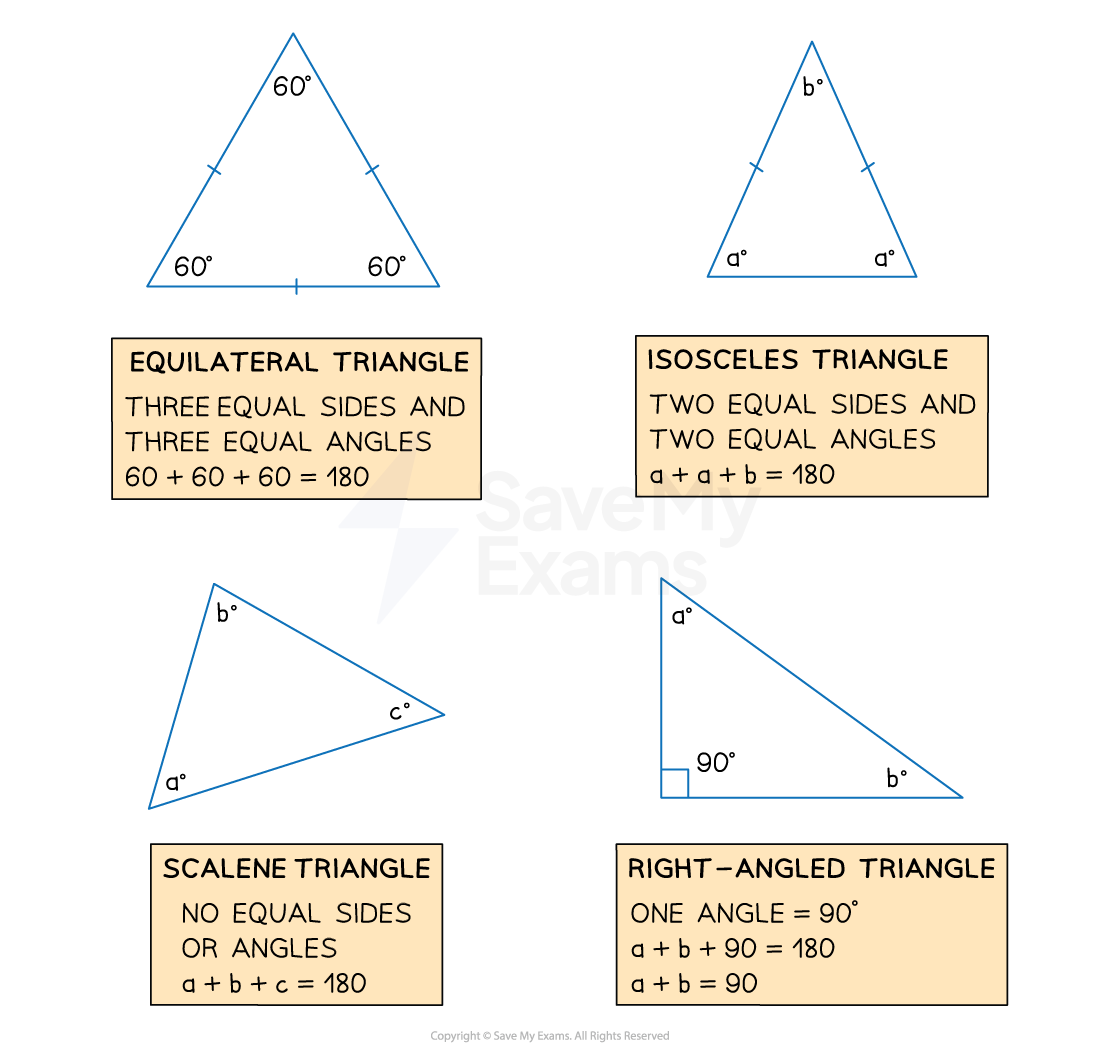
What are the angle properties of triangles?
The three interior angles inside any triangle add up to 180°
If the triangle is isosceles then two angles will be equal
These will be the two angles opposite the two sides of equal length
If the triangle is equilateral then all three angles will be equal
Each angle will equal 60°
A right-angled triangle has one 90° angle
The exterior angle of a triangle (180-the interior angle) is equal to the sum of the other two interior angles
You can remember this result, but it is also straight forward to work out
In the diagram below, angle c is (180-a-b) as angles in a triangle sum to 180
The exterior angle is (180-c) as angles on a straight line sum to 180
Therefore the exterior angle at c is (180-(180-a-b)) = a+b

Examiner Tips and Tricks
Find all the missing angles that you can using the angles that are given to you in a question
They might not seem to help you straight away but having more angles will lead you to find the angle you need
Worked Example
The diagram below is formed using three straight lines.
Find the value of .

Answer:
Label the other missing angles inside the triangle

Vertically opposite angles between two intersecting lines are equal
Angles that meet on a straight line add up to 180°
Interior angles in a triangle add up to 180°
What are the angle properties of quadrilaterals?
The four interior angles inside any quadrilateral add up to 360°
If the quadrilateral is a square or a rectangle then all the angles are equal to 90°
You can use any symmetries of the quadrilateral to identify other equal angles
For a parallelogram (or rhombus), opposite angles are equal
For a kite, one pair of opposite angles are equal

Worked Example
The diagram below shows an irregular quadrilateral.
Find the value of .

Answer:
Find the missing angle inside the quadrilateral using the rule 'angles in a quadrilateral add up to 360°'
First, add together the three given angles
Subtract the answer from 360°
Add this to the diagram

Angles on a straight line add up to 180°, so subtract the answer from 180°

Unlock more, it's free!
Join the 100,000+ Students that ❤️ Save My Exams
the (exam) results speak for themselves:

Was this revision note helpful?