Surface Area (WJEC GCSE Maths & Numeracy (Double Award)): Revision Note
Exam code: 3320

Surface area
What is surface area?
The surface area of a 3D object is the sum of the areas of all the faces that make up the shape
Area is a 2D idea being applied into a 3D situation
A face is one of the flat or curved surfaces that make up a 3D object
How do I find the surface area of cubes, cuboids, and prisms?
In cubes, cuboids, and polygonal-based prisms (ie. prisms whose bases have straight sides), all the faces are flat
The surface area is found by
calculating the area of each individual flat face
adding these areas together
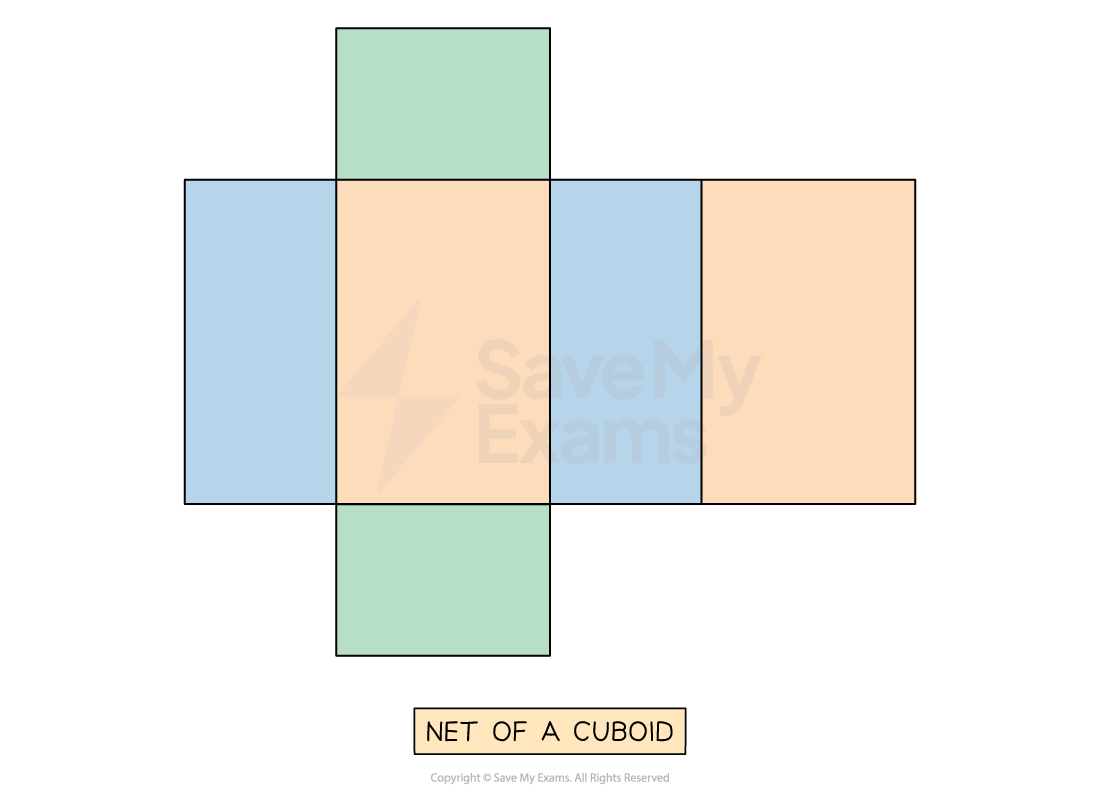
When calculating surface area, it can be helpful to draw a 2D net for the 3D shape in question
For example, consider a cuboid
Its net will consist of six faces (three pairs of rectangles)
Calculate the area of each rectangle then add them together
Examiner Tips and Tricks
Read the question carefully, sometimes surfaces may or may not be included. E.g. A box with or without a lid.
Make you are confident in calculating the areas of rectangles, circles and triangles.
Worked Example
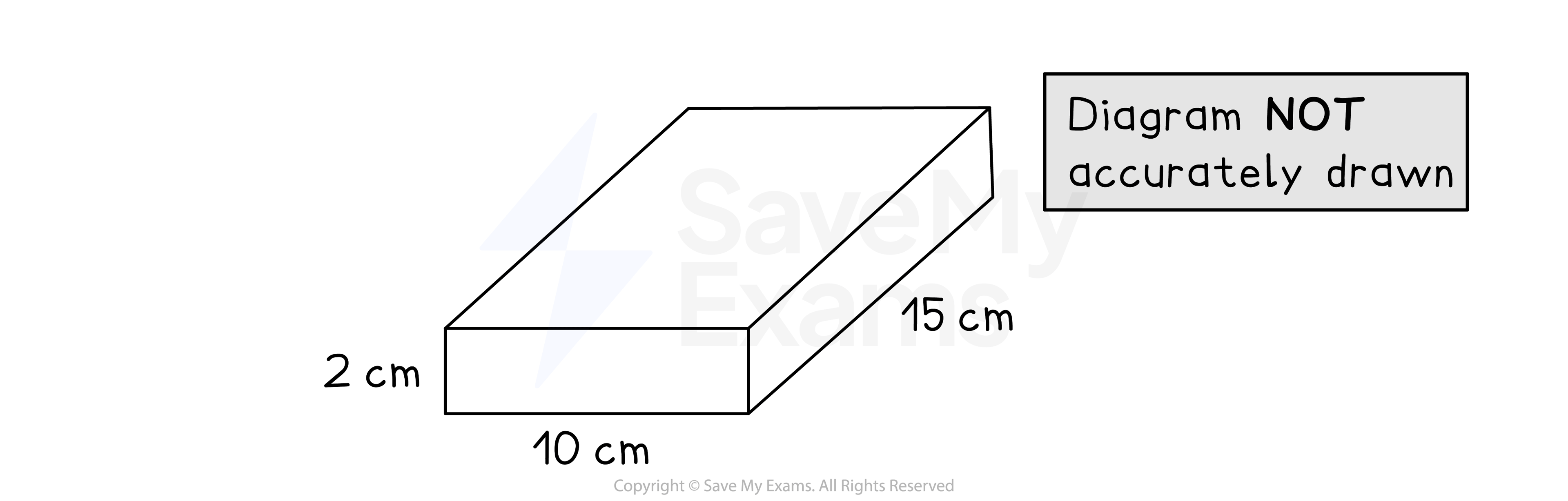
Find the surface area of the cuboid shown below.
Answer:
Find the area of the face at the front
2 cm × 10 cm = 20 cm2
Find the area of the face at the side
2 cm × 15 cm = 30 cm2
Find the area of the face at the top
10 cm × 15 cm = 150 cm2
There are two of each face
Add together the areas of all 6 faces
20 + 20 + 30 + 30 + 150 + 150 = 400
400 cm2

Unlock more, it's free!
Join the 100,000+ Students that ❤️ Save My Exams
the (exam) results speak for themselves:

Was this revision note helpful?