Genotype - GCSE Biology Definition
Reviewed by: Dr Natalie Lawrence
Last updated
Key Takeaways
A genotype is the combination of alleles an organism has for a particular characteristic.
Genotypes are written as letters, with a capital letter for a dominant allele and a lower-case letter for a recessive allele.
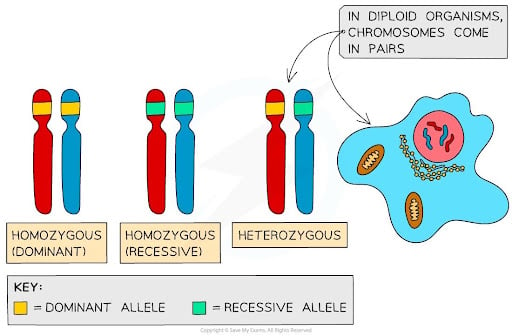
For a gene with two alleles in a diploid organism, there are three possible genotypes: homozygous dominant (TT), heterozygous (Tt) and homozygous recessive (tt).
The phenotype is the observable characteristic, and it can be affected by the environment as well as the genotype.
Two different genotypes can give the same phenotype, so you can't always tell a genotype just by looking.
What is a genotype?
A genotype is the combination of alleles an organism has at a gene or across its genes. These alleles help determine an organism’s observable characteristics, such as blood group or height.
A gene is a short length of DNA on a chromosome. Each gene codes for a particular sequence of amino acids, which makes a specific protein. Alleles are different versions of the same gene.
Most genes in ordinary human body cells have two copies, one inherited from each parent. These may be the same allele or different alleles, which determine the genotype for that gene.
Genotype definition in biology
A genotype is the combination of alleles an organism has for a particular gene or set of genes. It's written using letters, one for each allele.
Dominant alleles get capital letters. Recessive alleles get letters in lower case. In pea plants, for example, the allele for tall stems might be T and the allele for short stems is t. A plant with one of each has the genotype Tt.
Write the dominant allele first. It also helps to pick a letter that looks different as a capital and in lower case, such as Aa rather than Cc.
Types of genotype
The types of genotype depend on whether the two alleles are the same or different. "Homo" means “the same” and "hetero" means “different”.
Type of genotype | Alleles | Example | Pea plant phenotype |
Homozygous dominant | Two dominant alleles | TT | Tall |
Heterozygous | Two different alleles | Tt | Tall |
Homozygous recessive | Two recessive alleles | tt | Short |
A dominant allele is always expressed, even if only one copy is present. A recessive allele is only expressed if two copies are present. That's why the heterozygous plant is tall.
Heterozygous genotypes matter for inherited disorders caused by a recessive allele. A person with the genotype Ff for cystic fibrosis doesn't have the disorder but is a carrier. They can pass the recessive allele on to their children.
“Understanding the difference between genes and alleles can be confusing. I tell my students to think of genes as like the instructions for the different parts of a car motor that are needed to make it function. But then different motors are made up of parts with different specifications - these are the alleles. All motors need the same set of parts, but they all have different versions of these parts, which makes them function differently.”
– Natalie Lawrence, Biology Tutor
Genotype vs phenotype
Genotype and phenotype are different but interacting aspects of an organism. The genotype is the alleles an organism has at one or more particular genes. The phenotype is its observable characteristics, either seen just by looking, like eye colour, or found by testing, like blood type.
Genotype | Phenotype | |
What it describes | The combination of alleles at a gene or set of genes | The observable characteristic or characteristics |
How it's shown | Letters, e.g. Tt | A description, e.g. tall |
Affected by the environment? | No | Often, yes |
The same phenotype can come from more than one genotype. TT and Tt pea plants are both tall, because one dominant allele is enough. Only the tt genotype gives a short plant.
In this simple inheritance model, a short plant has the genotype tt. A tall plant could be TT or Tt, and you'd need more information, such as the results of a genetic cross, to know which.
How genotype and phenotype are linked
Genotype and phenotype are closely linked–but genes aren't the whole story. A phenotype can be caused by genes alone, by the environment alone, or by a combination of both.
Height is a clear example. Tall parents pass on genes for height, so their children have the genetic potential to be tall. If the children have a poor diet, though, they won't grow as well. Their genotype sets the potential and their environment affects how it develops.
Most characteristics are controlled by several genes rather than one. Eye colour is an example, which is why eyes can be green or hazel as well as brown or blue.
Genotype examples
These genotype examples show how different alleles combine to affect phenotype.
Characteristic | Alleles | Genotype and phenotype |
Pea plant height | T (tall, dominant), t (short, recessive) | TT or Tt = tall; tt = short |
Cystic fibrosis | F (dominant), f (recessive, causes the disorder) | FF = unaffected; Ff = unaffected carrier; ff = has cystic fibrosis |
Polydactyly (extra fingers or toes) | D (dominant, causes the condition), d (recessive) | DD or Dd = polydactyly; dd = unaffected |
ABO blood group | Iᴬ, Iᴮ, Iᴼ | IᴬIᴬ or IᴬIᴼ = A; IᴮIᴮ or IᴮIᴼ = B; IᴬIᴮ = AB; IᴼIᴼ = O |
Blood group is an unusual example because the gene has three alleles instead of two. Alleles Iᴬ and Iᴮ are codominant, meaning both are expressed in the phenotype when present. Both are dominant to Iᴼ, so the only way to have blood group O is the genotype IᴼIᴼ.
In humans, sex is usually determined by the sex chromosomes: XX in females and XY in males, rather than by the alleles of one gene.
Working out genotypes with a Punnett square
A Punnett square is a genetic diagram that shows the possible combinations of alleles in the offspring of two parents. It lets you predict offspring genotypes and the ratios between them.
Start with the parent genotypes. Each gamete (sex cell) carries only one allele from a parent's pair, so a Tt parent makes T gametes and t gametes. Put one parent's gametes along the top and the other’s down the side, then fill in each box.
Crossing two heterozygous pea plants (Tt × Tt) gives this square.
T | t | |
T | TT | Tt |
t | Tt | tt |
The offspring genotypes are 1 TT : 2 Tt : 1 tt. Since TT and Tt are both tall, the phenotype ratio is 3 tall : 1 short. Each offspring has a 25% chance of being short.
Check out our specification-tailored genetic inheritance revision notes to consolidate what you've learned here, for example AQA GCSE Genetic Inheritance Revision Notes. They're written by experienced examiners and cover key terms, Punnett squares and family trees.
Frequently Asked Questions
What does AA genotype mean?
AA means an organism has two copies of the same dominant allele, A, for a gene. This genotype is homozygous dominant. The organism shows the dominant characteristic, and every gamete it produces carries the A allele.
Can you tell someone's genotype just by looking at them?
Not always. A dominant phenotype can come from a homozygous dominant or a heterozygous genotype, and the two look the same. A recessive phenotype can only come from a homozygous recessive genotype, so that one is easier to work out.
What is the difference between a genotype and a genome?
A genotype describes the alleles an organism has at a particular gene or set of genes. A genome is its entire set of genetic material.
How can a person's genotype be tested?
A person's genes can be analysed from a sample of their cells. In embryo screening, one or more cells are taken from an IVF embryo before it's implanted. Its genes are then analysed to detect genetic disorders such as cystic fibrosis. Screening like this raises economic, social and ethical issues.
What are 5 examples of genotypes?
Five examples are TT (a tall pea plant), tt (a short pea plant) and Ff (a cystic fibrosis carrier). Dd (polydactyly) and IᴬIᴮ (blood group AB) are two more. Each one shows the two alleles an organism has for a single characteristic.
Put your understanding of genotypes into practice with exam questions tailored to your specification, for example AQA GCSE Inheritance, Variation & Evolution Exam Questions. They're written by experienced examiners and cover genetic crosses, inherited disorders and variation.
Examiner-written GCSE Biology revision resources that improve your grades 2x
- Written by expert teachers and examiners
- Aligned to exam specifications
- Everything you need to know, and nothing you don’t
Was this glossary entry helpful?


Share this article
 written revision resources that improve your