Energy & Feeding Relationships (Cambridge (CIE) IGCSE Biology): Exam Questions

Exam code: 0610 & 0970

4 hours50 questions

Smart practice available on this topic

Answer questions with adaptive difficulty and personalised feedback

Start practising
1a
5 marks

A student wanted to investigate a garden ecosystem.

She counted the number of insects caught in spider webs in one small section of the garden.

She found six spider webs in the small section of the garden sampled.

Diagrams of the spider webs are shown in Fig. 1 Each black dot represents one insect caught in a spider web.

AjHlQI19_spider-webs

Fig. 1

(i)

Use Fig. 1 to complete Table 1

Table 1

Spider web

Number of insects caught in each web

A


B


C


D


E


F


Total


[2]

(ii)

Calculate the average number of insects per web in the small section of the garden, using the information in Fig.1 and Table 1.

[1]

(iii)

The student counted the total number of spider webs in the whole garden and found that there were a total of 102 spider webs.

Use this information and your answer to part (a)(ii) to estimate the total number of insects caught in webs in the whole garden. 

[1]

(iv)

Suggest one reason why the estimated total number of insects caught in webs in the whole garden may not be accurate.

[1]

1b
8 marks

Fig. 2 is a photograph of a spider.

A spider’s body has two main parts. The legs are all attached to the cephalothorax which is the upper part of the body and starts at label X on Fig. 2. The lower part of the body is called the abdomen and is nearest to label Y on Fig. 2. 

spider-length

Fig. 2

(i)

Make a large drawing of the spider in Fig. 2 to show its outline, including its legs.

Label the abdomen.

[5]

(ii)

Measure the length of the spider between points X and Y in Fig. 2 Include the units. A ruler, graduated in cm, has been added to Fig. 2 for this purpose. 

Draw a line in the same position on your drawing and measure the length of your drawing.

Calculate the magnification of your drawing using your measurements and the following equation:

magnification space equals space fraction numerator length space of space line space bold XY space on space your space drawing over denominator length space of space line bold space bold XY space on space Fig.2 end fraction

[3]

1c
5 marks

Table 2 contains some other data collected by the student from the garden ecosystem.

Table 2

Type of organism

Number found in the garden ecosystem

Trees

2

Bushes

5

Other plants

37

Herbivores

118

Carnivores

14

(i)

Plot a bar chart of the data in Table 2.

cie-igcse-2018-series-1-p6-q2c-graph-paper

[3]

(ii)

Herbivores and carnivores are animals.

Use the data in Table 2 to calculate the ratio of animals to plants.

Show your working and give your answer in its simplest form.

[2]

2a
2 marks

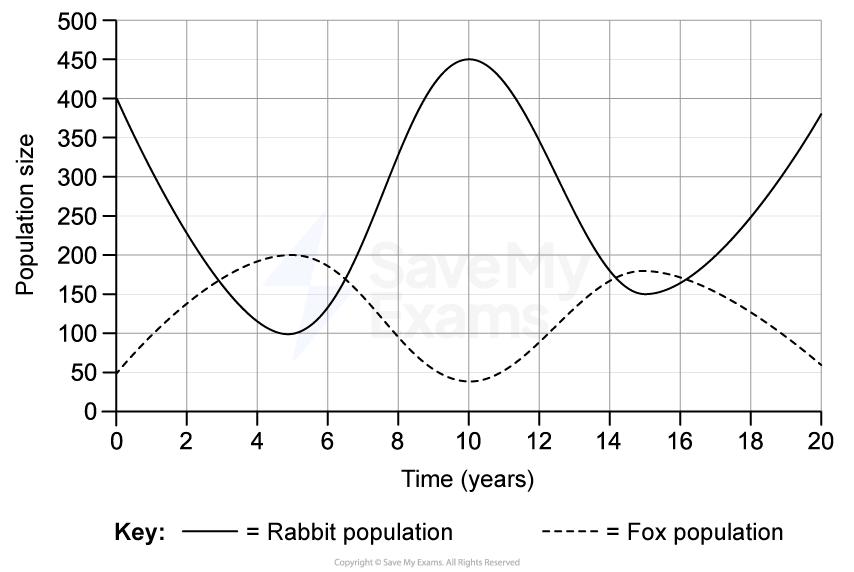
A researcher investigated the populations of rabbits and foxes in a woodland area over 20 years.

Fig. 2 shows the estimated populations over this time period.

Fig. 2

Graph showing population size of rabbits and foxes over 20 years. Rabbit population peaks around 10 and 20 years, while foxes peak around 5 and 15 years.

(i) Using Fig. 2, state the rabbit population at year 0.

[1]

(ii) Using Fig. 2, state the fox population at year 10.

[1]

2b
2 marks

Using Fig. 2, determine the fox population at year 12. Show on your graph how you obtained your answer

2c
2 marks

Describe the trend in the rabbit population over the 20 years shown in Fig. 2.

2d
1 mark

Describe the relationship between the rabbit and fox populations shown in Fig. 2.

2e
Sme Calculator
3 marks

Calculate the percentage decrease in the fox population between year 15 and year 20.

Give your answer to one decimal place. Show your working

2f
2 marks

In year 10, the student estimated the rabbit population by counting the number of rabbits seen in four different sectors of the woodland. The results are shown in Table 2.

Table 2

Sector 1

Sector 2

Sector 3

Sector 4

Mean

Number of rabbits

112

115

42

118

115

(i) Identify the anomalous result in Table 2.

[1]

(ii) Explain how the student calculated the mean shown in Table 2.

[1]

2g
1 mark

Suggest one source of error when trying to estimate a population of mobile animals, such as rabbits, by counting them by eye.

2h
1 mark

Suggest one limitation of the data shown in Fig. 2.

2i
2 marks

Suggest two ways the student could improve their method for estimating the animal populations to increase confidence in the results.