Human Diet & Digestion (Cambridge (CIE) IGCSE Biology): Exam Questions

Exam code: 0610 & 0970

5 hours60 questions

Smart practice available on this topic

Answer questions with adaptive difficulty and personalised feedback

Start practising
1
1 mark

Extended only

Which of the following is a correct function of bile?

  • To emulsify proteins

  • To neutralise the alkaline conditions of food entering the duodenum

  • To provide enzymes for the digestion of lipids

  • To increase the surface area of lipids for digestion

2
1 mark

The diagram below shows part of the human digestive system. 

In which structure is most of the water from food absorbed?

picture1
    3
    1 mark

    The diagram below shows four different types of human teeth. 

    7-q13-teeth

    Which teeth would be used to grind and chew food?

    • 1 and 2

    • 1 and 3

    • 2 only

    • 2, 3 and 4

    4
    1 mark

    Which of the following best describes the function of vitamin D in a human?

    • Vitamin D forms an essential part of collagen protein which is the main component of skin, hair and nails.

    • Vitamin D is needed for strong ligaments and a deficiency may cause ligament tears.

    • Vitamin D assists with the absorption of calcium and is therefore needed to build strong bones and teeth.

    • Vitamin D is an important component of haemoglobin which is needed for the transport of oxygen to the cells.

    5
    1 mark

    Which of the following is not an example of physical digestion?

    • Breaking food up into smaller pieces by chewing it.

    • Starch being broken down into glucose molecules.

    • Food being churned when the muscles in the stomach lining contracts.

    • Bile breaking large fat droplets up into smaller ones during emulsification.

    6
    1 mark

    In which part of the body of a mammal does physical digestion occur?

    • Gall bladder

    • Liver

    • Mouth

    • Pancreas

    7
    1 mark

    Which disease can be caused by a lack of vitamin C?

    • AIDS

    • Coronary heart disease

    • Rickets

    • Scurvy

    8
    1 mark

    In humans, where does most of the absorption of digested food take place?

    • colon

    • kidney

    • liver

    • small intestine

    9
    1 mark

    What are the products when proteins are broken down? 

    •  amino acids 

    •  fatty acids 

    • glycerol

    • simple sugars

    10
    1 mark

    Where does most of the absorption of water take place in the alimentary canal?

    • colon

    • oesophagus

    • small intestine

    • stomach

    11
    1 mark

    What is the dietary importance of fibre in humans?

    • For growth and repair of cells

    • To help food move through the alimentary canal

    • To maintain strong bones and teeth

    • To provide energy

    12
    1 mark

    How does physical digestion help chemical digestion?

    • It changes large insoluble molecules into small soluble molecules.

    • It increases the surface area of food.

    • It provides the acidic conditions needed.

    • It absorbs digested nutrients directly into the blood.

    13
    1 mark

    Amylase is a digestive enzyme.

    Which of the following correctly identifies the product(s) of amylase digestion.

    • amino acids

    • fatty acids and glycerol

    • simple reducing sugars

    • starch

    1
    1 mark

    Extended only

    The diagram below shows the organs of the digestive system.

    7-q1-human


    In which organs does the digestion of proteins take place?

    • W and Y

    • W and Z

    • Z only

    • W and X

    2
    1 mark

    Which of the following is a correct cause and effect?


    deficiency

    cause

    effect

    A

    iron

    diet deficient in red meat, leafy green vegetables and liver

    brittle bones (rickets)

    B

    iron

    lack of sunlight, fish and eggs

    anaemia - tiredness and weakness due to not enough oxygen being delivered to tissues

    C

    vitamin D

    lack of sunlight

    brittle bones (rickets)

    D

    vitamin D

    diet deficient in red meat, leafy green vegetables and liver

    anaemia - tiredness and weakness due to not enough oxygen being delivered to tissues

      3
      1 mark

      Which of the following descriptions are correctly matched to the different stages of food breakdown?


      absorption

      assimilation

      egestion

      A

      small soluble food molecules move into the bloodstream

      small soluble food molecules cross the cell membrane of cells

      excretion of undigested or unabsorbed food through the anus

      B

      small soluble food molecules move into the bloodstream

      small soluble food molecules cross the cell membrane of cells

      passing out of undigested or unabsorbed food through the anus

      C

      small soluble food molecules cross the cell membrane of cells

      small soluble food molecules move into the bloodstream

      passing out of undigested or unabsorbed food through the anus

      D

      small soluble food molecules cross the cell membrane of cells

      small soluble food molecules move into the bloodstream

      excretion of undigested or unabsorbed food through the anus

        4
        1 mark

        Extended only

        Which of the following could be the correct effect and explanation of a disease that results in a reduced number of villi in the small intestine?


        effect

        explanation

        A

        weight gain

        reduced absorption of digested food molecules

        B

        weight gain

        reduced digestion of maltose to glucose, less glucose absorbed

        C

        weight loss

        reduced lipid digestion and absorption

        D

        weight loss

        reduced absorption of digested food molecules

          5
          1 mark

          Extended only

          The diagram below shows a villus.

          7-q10-villus

          In which vessel would the concentration of fatty acids be highest? 

            6
            1 mark

            The diagram shows part of the human digestive system.

            Which structure produces lipase?

            7-1-image-mq6
              7
              1 mark

              In which part of the alimentary canal does ingestion take place? 

              • Anus

              • Liver

              • Mouth 

              • Stomach

              8
              1 mark

              The diagram shows the human alimentary canal, with a string marked in metres beside it.

              Diagram of the human digestive tract with a string marked in metres from 0 at the oesophagus to 9 at the anus, illustrating the length of the tract.

              How long is the small intestine? 

              • 2 m

              • 6 m 

              • 8 m 

              • 9 m

              9
              1 mark

              A new smoothie that claims to provide a balanced diet contains the following ingredients:

              Ingredients

              Soya protein

              Iron

              Fibre

              Low-fat milk

              Water

              What ingredients are missing from the smoothie for it to be a balanced diet product?

              • calcium, carbohydrates, vitamins (C and D), fats and oils

              • carbohydrates, vitamins (C and D), fats and oils

              • vitamins (C and D) and mineral ions

              • vitamins (C and D) and calcium

              10
              1 mark

              Which of the following describe prevention methods for rickets?

              • vitamin D supplementation, adequate intake of protein, adequate intake of iron.

              • vitamin D supplementation, adequate intake of calcium, avoid exposure to sunlight

              • vitamin D supplementation, adequate intake of calcium, exposure to sunlight

              • foods that are high in vitamin D, vitamin A supplementation, adequate intake of fibre

              11
              1 mark

              Which row correctly matches the enzyme to what it breaks down?

              enzyme

              what it breaks down

              A

              amylase

              fats

              B

              maltase

              starch

              C

              pepsin

              starch

              D

              trypsin

              protein

                12
                1 mark

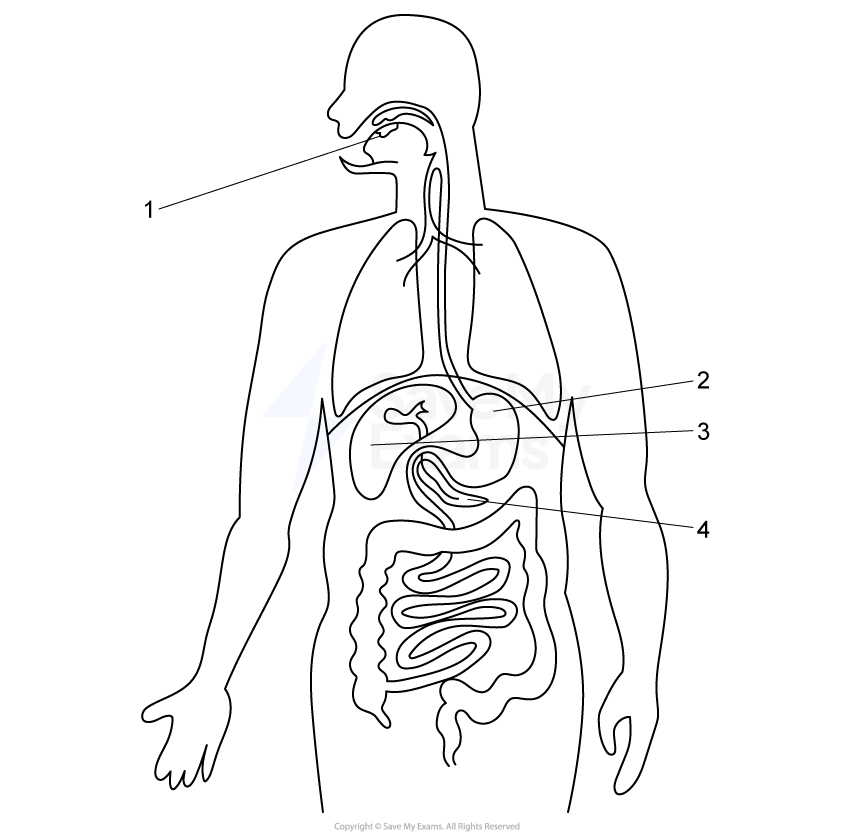
                Below is a diagram of the digestive system

                picture5

                Which row correctly identifies the labelled organs?

                Organ 1

                Organ 2

                Organ 3

                Organ 4

                A

                Teeth

                Stomach

                Gall bladder

                Liver

                B

                Salivary glands

                Stomach

                Liver

                Pancreas

                C

                Mouth

                Liver

                Stomach

                Pancreas

                D

                Mouth

                Liver

                Gall bladder

                Small intestine

                  13
                  1 mark

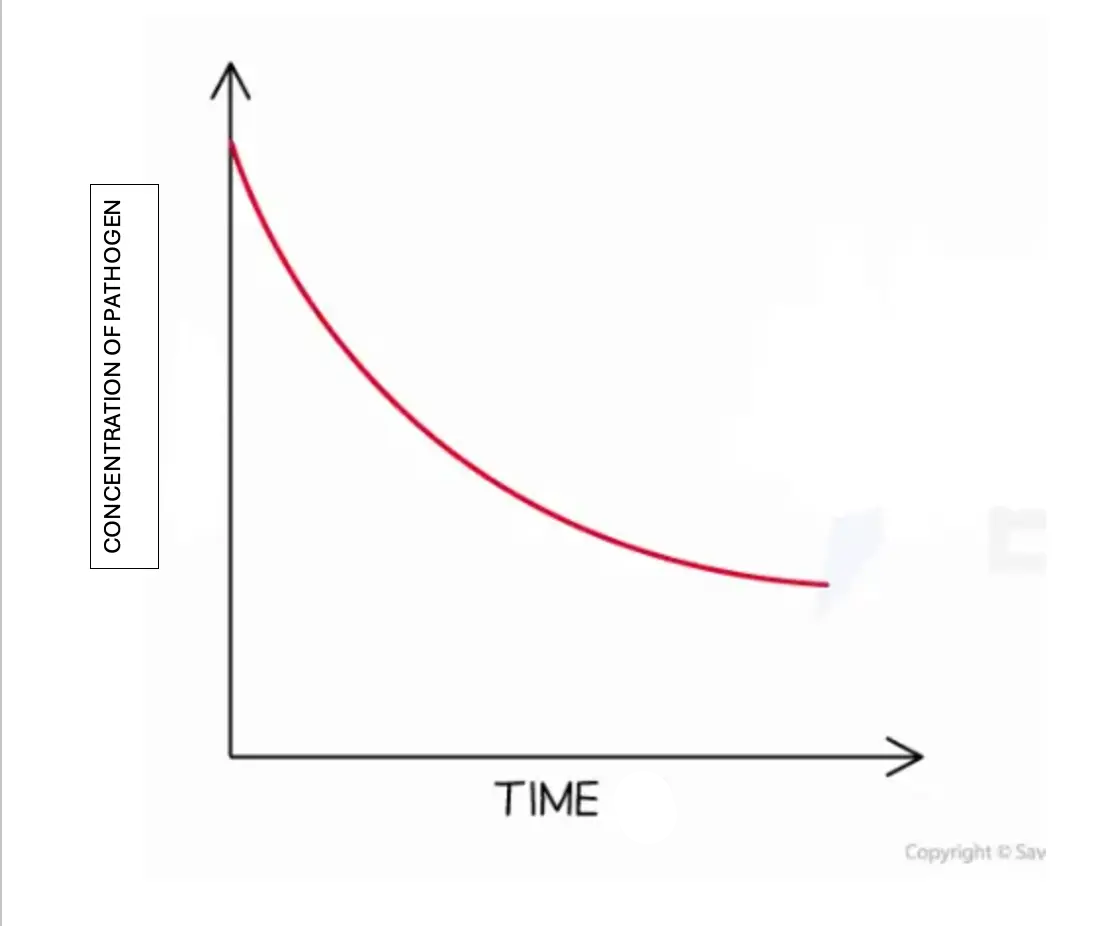
                  The graph below shows the change in concentration of pathogens as food passes through the stomach.

                  Graph showing a downward curve; y-axis labelled "Concentration of Pathogen" and x-axis labelled "Time," indicating a decrease over time.

                  Which of the following is the main factor that explains the shape of the curve?

                  • alkaline conditions

                  • protease enzymes

                  • acidic conditions

                  • churning activity

                  14
                  1 mark

                  Below are diagrams of human teeth.

                  Diagram of four teeth types, labelled 1 to 4: molar, premolar, canine, incisor, each showing crown and root structure.

                  Which row correctly identifies the teeth shown?

                  1

                  2

                  3

                  4

                  A

                  Premolar

                  Molar

                  Canine

                  Canine

                  B

                  Molar

                  Premolar

                  Incisor

                  Canine

                  C

                  Premolar

                  Molar

                  Incisor

                  Canine

                  D

                  Incisor

                  Molar

                  Premolar

                  Incisor

                    1
                    1 mark

                    A student ate a meal which contained a type of biomolecule, X.

                    The digestion of biomolecule X started in the mouth, and finished in the duodenum.

                    What is the product of the digestion of biomolecule X?

                    • Amino acids

                    • Protein

                    • Glucose

                    • Starch

                    2
                    1 mark

                    Below is a list of chemical reactions that occur during digestion.

                    1. Protein → amino acids

                    2. Starch → maltose

                    3. Lipids → fatty acids + glycerol

                    4. Maltose → glucose

                    Which of the chemical reactions above might occur in the duodenum?

                    • 1, 3 and 4

                    • 4 only

                    • 2, 3 and 4

                    • All 4

                    3
                    1 mark

                    Which of the following shows the correct role of a substance made during digestion?


                    substance

                    made by

                    effect

                    A

                    trypsin

                    stomach

                    digests proteins into amino acids

                    B

                    bile

                    gallbladder

                    neutralising acidic mixture of food entering the duodenum from the stomach

                    C

                    gastric juice

                    stomach

                    denaturing enzymes in harmful microorganisms and optimising pH for pepsin activity

                    D

                    bile

                     liver

                    neutralising alkaline mixture of food entering the duodenum from the stomach

                      4
                      1 mark

                      Extended only

                      The diagram below shows the activity of salivary amylase on a starch molecule.

                      7-q12-starch


                      Which of the following is not a function of salivary amylase?

                      • Increasing the rate of breakdown of starch molecules

                      • Increasing the rate of starch breakdown into maltose molecules

                      • Breaking a large insoluble molecule into smaller soluble molecules

                      • Increasing the rate of starch breakdown into glucose molecules

                      5
                      1 mark

                      The diagram below shows the organs of the digestive system, including the alimentary canal and accessory organs.

                      picture5

                      Where are most of the digestive lipase enzymes made in the body?

                      • 2 only

                      • 4 only

                      • 3 and 4

                      • 1 and 4

                      6
                      1 mark

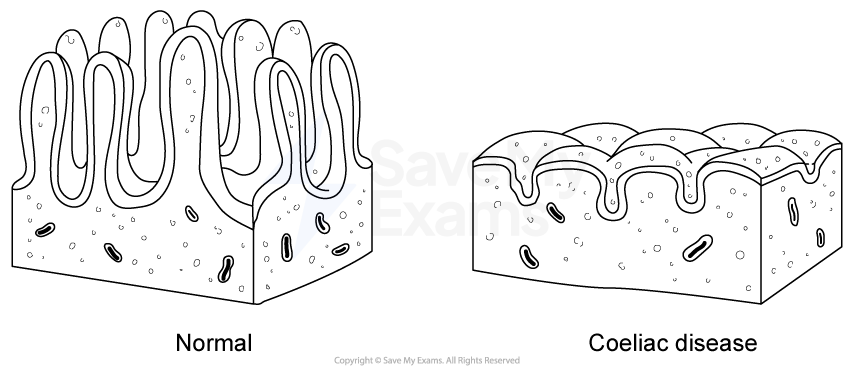
                      The diagram shows villi in a healthy small intestine and in a person with coeliac disease.

                      Comparison of intestinal villi: normal villi on the left, tall and dense; coeliac disease on the right, shorter and less dense.

                      A person with coeliac disease may become undernourished even if they eat enough food.

                      Which is the best explanation?

                      • The surface area exposed to food is reduced, which stops chemical digestion from taking place in the small intestine.

                      • The damaged villi prevent enough digestive enzymes from being secreted into the small intestine.

                      • The surface area of the small intestine is reduced so fewer digested nutrients are absorbed into the blood.

                      • The damaged villi cause food to move through the intestine too slowly to be digested.