Transport in Plants (Cambridge (CIE) IGCSE Biology): Exam Questions

Exam code: 0610 & 0970

5 hours52 questions

Smart practice available on this topic

Answer questions with adaptive difficulty and personalised feedback

Start practising
1
1 mark

The diagram below shows a potted plant and the same plant 48 hours later.

8-q1-wilting

What has caused the plant’s appearance to change?

  • Water loss by translocation is greater than water uptake.

  • Water evaporating from the leaves by translocation.

  • Water loss by transpiration is greater than water uptake.

  • Water loss from the leaves by osmosis.

2
1 mark

Which order below is correct in describing the pathway of water as it travels from the roots through a plant?

  • Root hair cell → xylem → mesophyll cells → air spaces → stomata

  • Root hair cell → xylem → air spaces → mesophyll cells → stomata

  • Root hair cell → mesophyll cells → phloem → stomata

  • Root hair cell → mesophyll cells → xylem → stomata

3
1 mark

Extended only

Which of the following is a correct explanation of the process of translocation in a plant?

  • The movement of mineral ions through the xylem of a plant.

  • The movement of sucrose and amino acids through the phloem from a source to a sink.

  • The one-way movement of sucrose and amino acids through the phloem.

  • The movement of sucrose and amino acids through the phloem from a sink to a source.

4
1 mark

The diagram shows a simplified water cycle.

q11-organisms-and-their-environment-mcq-booklet-1-cie-igcse-biology

Which of the processes listed below would be involved in the loss of water from the tree?

  • Respiration

  • Translocation

  • Photosynthesis

  • Evaporation

5
1 mark

A potometer can be used to measure the rate that a piece of plant transpires under various conditions. 

Part of a potometer is shown in the diagram below. 

potometer

Which statement, relating to how a potometer works, is false?

  • A potometer uses the transpiration stream to produce movement of an air bubble that can be measured. 

  • In a potometer, an air bubble moves away from the piece of plant tissue that is under investigation. 

  • In order to determine the rate of transpiration, the movement of the bubble must be measured alongside the time taken. 

  • The leaves of the plant in the potometer must be dry during the experiment. 

6
1 mark

The diagram shows part of a cross-section of a root.

Diagram of a plant cell's cross-section, showcasing labelled parts: 1 represents a trichome, 2 indicates an epidermal cell, and 3 shows a guard cell.

What are cells 1, 2 and 3?

1

2

3

A

root cortex cell 

root hair cell 

mesophyll cell  

B

root hair cell 

root cortex cell 

xylem

C

root hair cell 

root cortex cell 

mesophyll cell  

D

root cortex cell 

root hair cell 

xylem

    7
    1 mark

    Which sequence correctly shows the pathway of water through a plant?

    • xylem → root hair cell → root cortex cell → mesophyll

    • root hair cell → root cortex cell → xylem → mesophyll

    • root cortex cell → mesophyll → xylem → root hair cell

    • root hair cell → xylem → root cortex cell → mesophyll

    1
    1 mark

    Extended only

    A dicot plant is placed into a bowl of water coloured with red dye. 

    After 1 hour, a cross section of one of the roots is cut. 

    After 4 hours, a cross section is cut from the stem. 

    8--q4-root-and-stem

    Which labelled regions would be stained red in each case? 

    • 1 and 3

    • 1 and 4

    • 2 and 4

    • 2 and 3

    2
    1 mark

    Which of the following is a correct explanation of the effect of root hairs on absorption?

    • Provide a large surface area, maximising the rate of absorption of water and ions by osmosis.

    • Provide a large surface area, maximising the rate of absorption of water by osmosis and ions by active transport.

    • Increase the surface area, maximising the uptake of water by osmosis and ions by diffusion.

    • Provide a surface area, increasing the rate of absorption of water and ions by active transport.

    3
    1 mark

    Which of the following processes is/are involved in the loss of water from the leaves of plants?

    1. diffusion

    2. osmosis

    3. condensation

    4. evaporation

    • 1 and 3

    • 1 only

    • 4 only

    • 1 and 4

    4
    1 mark

    Extended only

    A student collected some of the solution from the phloem in the stem of a plant. 

    Which of the following would be present in the liquid?

    • Glucose

    • Starch

    • Amino acids

    • Cellulose

    5
    1 mark

    A decrease in which of the following factors would normally cause the transpiration rate to increase?

    • Stomatal density

    • Light intensity

    • Temperature

    • Humidity

    6
    1 mark

    Extended only

    Which environmental factor is most likely to be responsible for a plant to wilt?

    • A decrease in light intensity.

    • An increase in humidity.

    • A decrease in the amount of available water.

    • A decrease in wind speed.

    7
    1 mark

    A plant shoot is placed in a solution of dye. 

    The dye moves up the stem. 

    Under which conditions will the dye move most slowly? 

    temperature

    humidity  

    A

    high

    high

    B

    high

    low

    C

    low

    high

    D

    low

    low

      8
      1 mark

      Which environmental condition would most reduce transpiration?

      temperature

      humidity

      A

      low

      high

      B

      high

      low

      C

      low

      low

      D

      high

      high

        9
        1 mark

        Which of the following statements about the process of transpiration is correct?

        • water moves upwards from the roots

        • increasing wind speed decreases the rate of transpiration

        • water evaporates directly from the stomata

        • water vapour is lost from the leaves by diffusion

        1
        1 mark

        Extended only

        The xylem has specific adaptations to allow it to transport water and mineral ions from the roots of a plant to the leaves as a result of transpiration.

        Which processes produce the adaptations in xylem vessels to allow the continuous flow of water?


        cell walls break down between adjacent cells 

        cytoplasm and organelles removed from each cell

        A

        B

        C

        D

          2
          1 mark

          Extended only

          Which of the following graphs correctly shows the relationship between the rate of transpiration and atmospheric humidity?

          8--q9--rate-and-humidity
            3
            1 mark

            Extended only

            The diagram below shows two shoots at the start of an experiment set up by a group of students. Shoot A is on the left, while Shoot B is on the right.

            8--q11--transpiration-

            What are the most likely readings on the spring balances after four days?


            Spring balance readings / g

            shoot A

            shoot B

            A

            40

            40

            B

            40

            34

            C

            34

            40

            D

            34

            34

              4
              1 mark

              The table below shows some characteristics of four different plants. 

              The plants are growing in the same environmental conditions. 

              Which plant will have the lowest rate of transpiration?


              number of leaves on plant

              average surface area of one leaf / cm2

              average density of stomata on leaves / stomata per mm2

              average diameter of one stoma / µm

              A

              36

              53

              276

              19

              B

              21

              51

              247

              18

              C

              24

              45

              249

              15

              D

              17

              40

              151

              16

                5
                1 mark

                Extended only

                Which row of the table below shows substances transported through the phloem and xylem, and the direction of transport, correctly?


                phloem

                direction of transport

                xylem

                direction of transport

                A

                sucrose

                bi-directional (up and down)

                water and mineral ions

                bi-directional (up and down)

                B

                sucrose

                unidirectional (up)

                water and mineral ions

                bi-directional (up and down)

                C

                sucrose and amino acids

                bi-directional (up and down)

                water 

                unidirectional (up)

                D

                sucrose and amino acids

                unidirectional (up)

                water 

                unidirectional (up)

                  6
                  1 mark

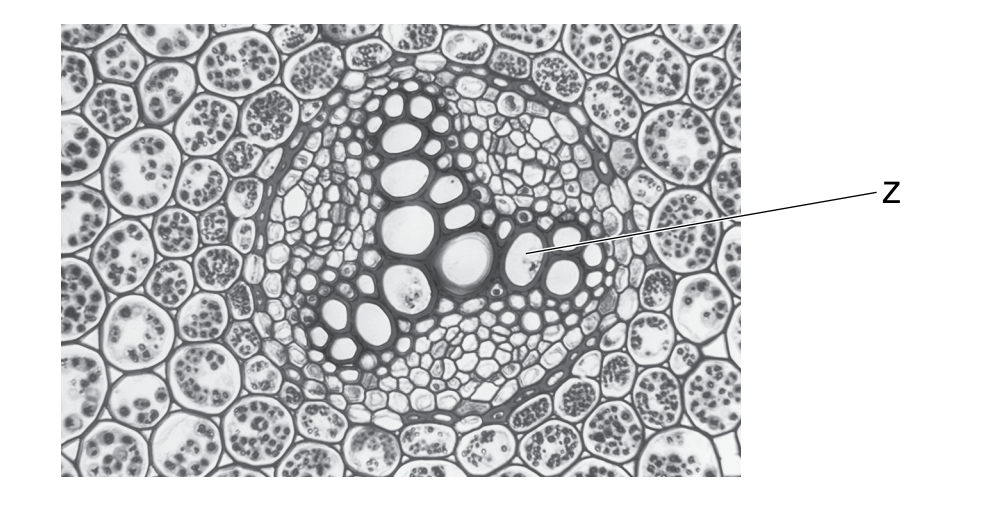
                  The photomicrograph shows a cross-section through the root of a buttercup plant.

                  8-1-image-hq6

                  What is the main function of the tissue labelled Z?

                  • Photosynthesis

                  • Respiration

                  • Transport of sugars

                  • Transport of water

                  7
                  1 mark

                  The diagram shows two shoots at the start of an experiment on transpiration.

                  8-1-image-hq7

                  What are the likely readings on the spring balances after three days?

                  shoot X/g

                  shoot Y/g

                  A

                  25

                  30

                  B

                  25

                  25

                  C

                  30

                  25

                  D

                  30

                  30

                    8
                    1 mark

                    Roots and leaves both act as sources and sinks for sucrose and amino acids at different times during the year.

                    At which point in the year are the roots most active as a source?

                    8-1-image-hq8
                      9
                      1 mark

                      A non-woody plant stem is placed in water containing a red dye. It is left for one day and then a section of the stem is examined using a microscope. 

                      Which tissue is stained red?

                      Diagram of a cross-section of a plant stem, showing a circular arrangement of five labelled vascular bundles: A, B, C, and D inside a circle.
                        10
                        1 mark

                         The diagram shows a cross-section through a leaf.

                        From which cell will most water evaporate during transpiration?

                        Diagram of a dicot leaf's cross-section with labelled structures: A. palisade mesophyll, B. xylem, C. phloem, D. spongy mesophyll, showing cellular details.
                          11
                          1 mark

                          The graph shows daily carbon dioxide uptake and transpiration by the plant Agave americana. 

                          The plant is adapted to live in very dry conditions. 

                          Graph showing CO2 uptake and transpiration rates over 24 hours. CO2 uptake peaks at 0 and 24 hours, while transpiration remains steady with slight midday dip.

                          What can be concluded from this graph?

                          • More stomata are closed during dark periods. 

                          • More stomata are closed during light periods.

                          • There is no carbon dioxide uptake during dark periods.

                          • There is no water uptake during light periods

                          12
                          1 mark

                          The diagram shows an onion plant that has been grown from a seed. Each onion plant takes two years to flower and produce more seeds.

                          Life cycle of a bulb plant showing stages from seed to developing leaves, bulb formation, flowering, and mature plant over two years.

                          What is the onion bulb acting as in stage 3 and in stage 6?

                          stage 3 

                          stage 6

                          A

                          sink

                          sink

                          B

                          sink

                          source

                          C

                          source

                          sink

                          D

                          source

                          source

                            13
                            1 mark

                            A potometer is used to measure the rate of transpiration. The table below shows the results.

                            Distance travelled by bubble (mm)

                            Time (mins)

                            0

                            0

                            17

                            30

                            29

                            60 

                            35

                            90

                            44

                            120

                            51

                            150

                            Calculate the rate of transpiration between 30 and 120 minutes.

                            • 0.37 mm / min

                            • 0.3 mm / min

                            • 3.3 mm / min

                            • 0.3 mm / s