1
1 mark
The image below shows a house mouse, whose scientific name is Mus musculus.

Which genus does it belong to?
Mammal
musculus
Mus
Vertebrate
Was this exam question helpful?
Exam code: 0610 & 0970
The image below shows a house mouse, whose scientific name is Mus musculus.
Which genus does it belong to?
Mammal
musculus
Mus
Vertebrate
Was this exam question helpful?
Which of the following would not be a characteristic seen in all living organisms?
Reproduction
Respiration
Excretion
Photosynthesis
Was this exam question helpful?
Which name can be given to a group of organisms that have similar morphological features and can reproduce successfully to produce fertile offspring?
Kingdom
Genus
Family
Species
Was this exam question helpful?
A yeast (Saccharomyces cerevisiae), glucose and water are mixed in a test tube.
The diagrams show the test tube at the start and after one hour.

Which process causes this change?
Reproduction
Respiration
Growth
Sensitivity
Was this exam question helpful?
Which class of vertebrate typically gives birth to live young?
Mammals
Birds
Amphibians
Reptiles
Was this exam question helpful?
The diagram shows a plant.

Which characteristic of living organisms is shown by the plant in the diagram?
Excretion
Reproduction
Respiration
Sensitivity
Was this exam question helpful?
Humans have the scientific name Homo sapiens.
What do the two parts of this name refer to?
Genus and species
Group and genus
Kingdom and genus
Kingdom and species
Was this exam question helpful?
All living organisms release energy from nutrient molecules within their cells.
What is the name of this characteristic?
Growth
Nutrition
Respiration
Sensitivity
Was this exam question helpful?
What is a characteristic of all living organisms?
breathing
circulation
egestion
sensitivity
Was this exam question helpful?
The scientific names of some animals are listed.
Camelus dromedarius
Camelus ferus
Equus ferus
Struthio camelus
Which animals are in the same genus?
1, 2 and 3
1, 2 and 4
1 and 2 only
2 and 3 only
Was this exam question helpful?
Scientists discover a new species of animal.
It has a segmented body with two pairs of legs on each segment.
To which group of animals does this new species belong?
arachnids
crustaceans
insects
myriapods
Was this exam question helpful?
A scientist observes four events in an organism:
It takes in glucose.
It releases carbon dioxide produced in cells.
It moves away from a harmful chemical.
It increases in biomass over time.
Which row correctly matches the events to characteristics?
1 | 2 | 3 | 4 | |
|---|---|---|---|---|
A | respiration | excretion | sensitivity | growth |
B | nutrition | excretion | sensitivity | growth |
C | nutrition | respiration | movement | reproduction |
D | excretion | nutrition | sensitivity | growth |
Was this exam question helpful?
The diagram shows an organism.
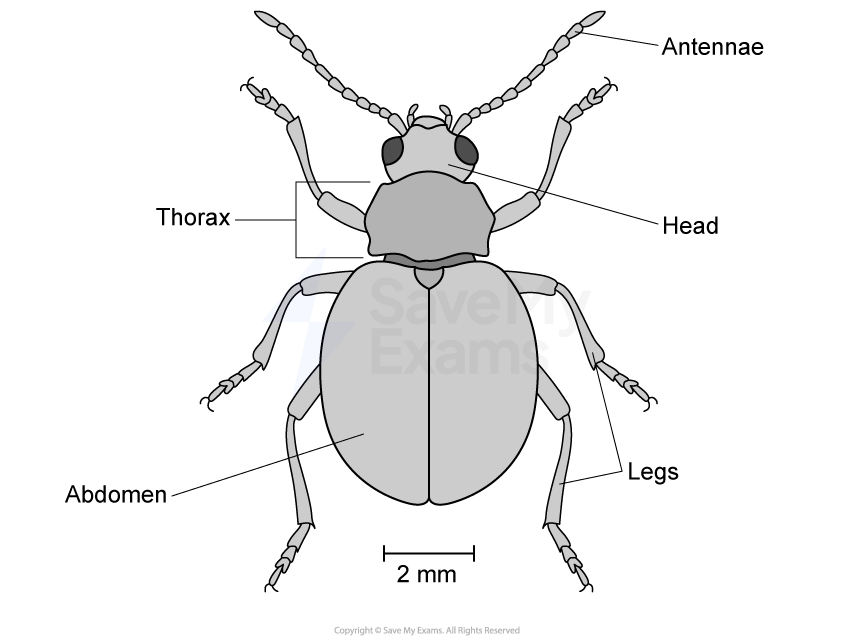
Which arthropod group does the organism belong to?
arachnid
crustacean
insect
myriapod
Was this exam question helpful?
Which characteristic allows an organism to detect or sense stimuli in the internal or external environment and to make appropriate responses?
movement
excretion
sensitivity
nutrition
Was this exam question helpful?
The image below shows what occurs in a seed during and after germination, the seed has been planted in well-watered soil.

Which characteristics of living things are demonstrated by this sequence?
Nutrition and reproduction
Reproduction and growth
Nutrition and sensitivity
Sensitivity and growth
Was this exam question helpful?
Some of the processes carried out by living organisms are illustrated in the diagram below.

Which row of the following table correctly describes the characteristics shown by living organisms in the diagram above?
| W | X | Y |
A | respiration | photosynthesis | respiration |
B | respiration | respiration | nutrition |
C | photosynthesis | respiration | excretion |
D | photosynthesis | excretion | nutrition |
Was this exam question helpful?
The list below shows the binomial names for eight animals.
Canis lupus
Cygnus buccinator
Dasypus novemcinctus
Dasyurus maculatus
Equus burchelli
Eumetopias jubatus
Felis chaus
Felis lybica
Which two animals are most closely related?
Dasypus novemcinctus & Dasyurus maculatus
Felis chaus & Felis lybica
Cygnus buccinator & Dasyurus maculatus
Equus burchelli & Eumetopias jubatus
Was this exam question helpful?
What are the characteristics of birds?
| skin covered in feathers | maintain a constant body temperature | jelly-covered eggs | external ears present |
A | ✔ | ✘ | ✔ | ✘ |
B | ✘ | ✘ | ✘ | ✔ |
C | ✔ | ✔ | ✘ | ✘ |
D | ✘ | ✔ | ✔ | ✔ |
Was this exam question helpful?
The equation below represents a chemical process that occurs in the cells of living organisms.
glucose + oxygen → carbon dioxide + water
Which characteristics of living organisms would this equation be associated with?
| nutrition | respiration |
A | ✔ | ✔ |
B | X | ✔ |
C | X | X |
D | ✔ | X |
Was this exam question helpful?
Lichens are formed from two different organisms living together.
Organism X and organism Y are found in most lichens.
The table shows some of the characteristics of organism X and organism Y.
X | Y |
|---|---|
made of strands called hyphae | single-celled |
hyphae have cell walls and many nuclei | cell contains a nucleus and chloroplasts |
Which kingdoms do X and Y belong to?
X | Y | |
|---|---|---|
A | fungus | prokaryote |
B | fungus | protoctist |
C | protoctist | fungus |
D | protoctist | plant |
Was this exam question helpful?
The horse, Equus ferus, and the donkey, Equus asinus, are able to interbreed. The offspring they produce is called a mule.
Which statement is correct?
The horse and the donkey are the same genus; the mule is infertile.
The horse and the donkey are the same species; the mule is infertile.
The horse and the donkey are the same genus; the mule is fertile.
The horse and the donkey are the same species; the mule is fertile.
Was this exam question helpful?
The table shows a section of DNA taken from four different organisms.

Which two organisms are the most distantly related to each other?
W and X
W and Z
X and Y
X and Z
Was this exam question helpful?
Which diagram shows a flower from a monocotyledon?

Was this exam question helpful?
A hare and a rabbit are unable to reproduce to produce fertile offspring.
Which statement explains why?
they are different species
they belong to different kingdoms
they have different habitats
their DNA base sequences are different
Was this exam question helpful?
Identify the arthropods shown using the key below.

1. | Three pairs of legs... | Class W |
Four pairs of legs or more... | Go to 2 | |
2. | Body plan consists of a head and a many-segmented body... | Class X |
Head and thorax are fused to form a cephalothorax... | Go to 3 | |
3. | No antennae present... | Class Y |
Antennae present... | Class Z |
| Arthropod 1 class | Arthropod 2 class |
A | Y | X |
B | X | Z |
C | Z | W |
D | Z | X |
Was this exam question helpful?
The image below shows a leaf from a plant.

Identify the plant to which the leaf belongs using the dichotomous key below.

Was this exam question helpful?
Use the key to identify the group to which fish belong.
1. | Fur absent... Fur present... | go to 2 mammals |
2. | Eggs do not have hard shells... Eggs have hard shells... | go to 3 group A |
3. | Reproduction occurs in water... Reproduction occurs on land... | go to 4 group B |
4. | Scaly skin... Smooth skin... | group C group D |
Was this exam question helpful?
The diagram shows an organism.

Which type of arthropod is this organism?
Myriapod
Insect
Crustacean
Arachnid
Was this exam question helpful?