Organisation of Cells (Cambridge (CIE) IGCSE Biology): Revision Note
Exam code: 0610 & 0970

Producing new cells
The cells in the body need to divide so that the body can grow and repair (opens in a new tab) itself
Cells grow and divide over and over again
New cells are produced by the division of existing cells
Specialised cells
Specialised cells in animals and plants
Specialised cells are those which have developed certain characteristics in order to perform particular functions. These differences are controlled by genes in the nucleus
Cells specialise by undergoing differentiation: this is a process by which cells develop the structure and characteristics needed to be able to carry out their functions
Specialised cells in animals table
Cell | Function | Adaptations |
|---|---|---|
Ciliated cell | Movement of mucus in the trachea and bronchi |
|
Nerve cell | Conduction of impulses |
|
Red blood cell | Transport of oxygen |
|
Sperm cell | Reproduction |
|
Egg cell (ovum) | Reproduction |
|
Diagrams of specialised cells in animals


Specialised cells in plants table
Cell | Function | Adaptations |
|---|---|---|
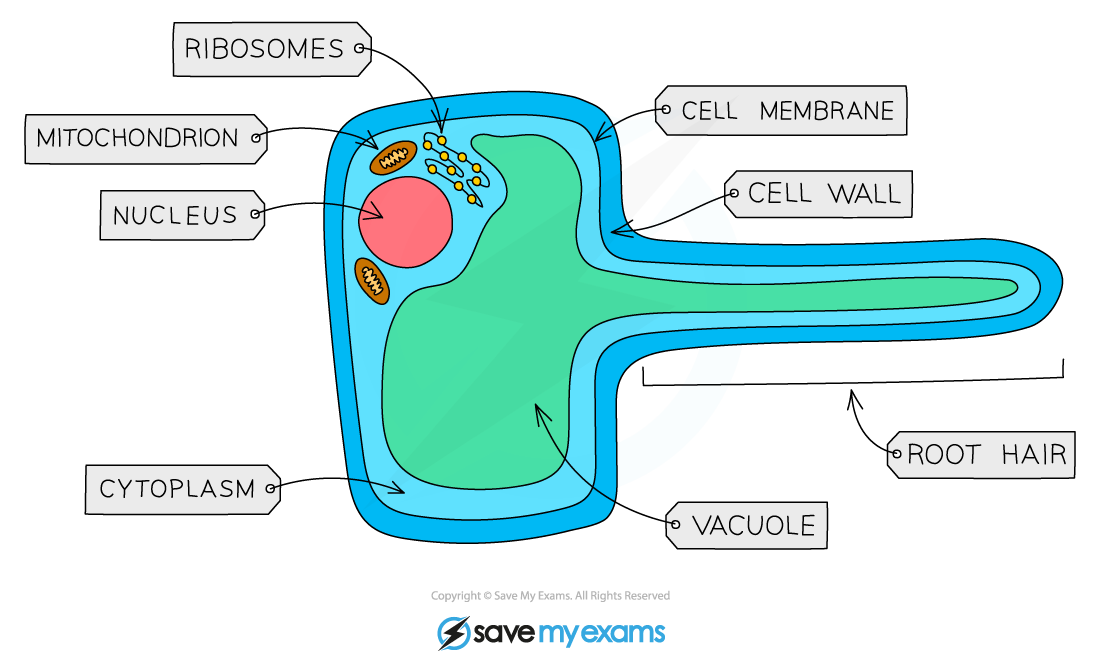
Root hair cell | Absorption of water and mineral ions from soil |
|
Xylem vessel | Conduction of water through the plant, support of the plant |
|
Palisade mesophyll cell | Photosynthesis |
|
Diagrams of specialised cells in plants


Levels of organisation in an organism
Level | Description |
|---|---|
Cells | Basic functional and structural units of all living organisms |
Tissues | Groups of cells of similar structure working together to perform the same function |
Organs | Made from different tissues working together to perform specific functions |
Organ systems | Groups of organs with related functions, working together to perform body functions |

Examples of systems in animals and plants
System | Organs | Tissue examples |
|---|---|---|
Digestive system |
|
|
Circulatory system |
|
|
Immune system |
|
|
Respiratory system |
|
|
Excretory system |
|
|
Nervous system |
| Nerve |
Reproductive system |
|
|
Shoot system |
|
|
Root system |
|
|
Examiner Tips and Tricks
Your syllabus states that you should be able to identify the different levels of organisation in drawings, diagrams and images of familiar material
An example of this is shown in the exam question below:

The answer is B
The correct answer is B, because a leaf is an organ (arrow 1), arrow 2 is pointing to a palisade mesophyll cell, and arrow 3 is pointing to the layer of spongy mesophyll cells (which is a tissue)
Most incorrect answers here come from not being able to identify a tissue, so it’s worth making sure you understand and remember that tissues are always made up of only one type of cell.

Unlock more, it's free!
Join the 100,000+ Students that ❤️ Save My Exams
the (exam) results speak for themselves:

Was this revision note helpful?
Build on this topic