Investigating the Rate of Photosynthesis (Cambridge (CIE) IGCSE Biology): Revision Note
Exam code: 0610 & 0970

Investigating the rate of photosynthesis
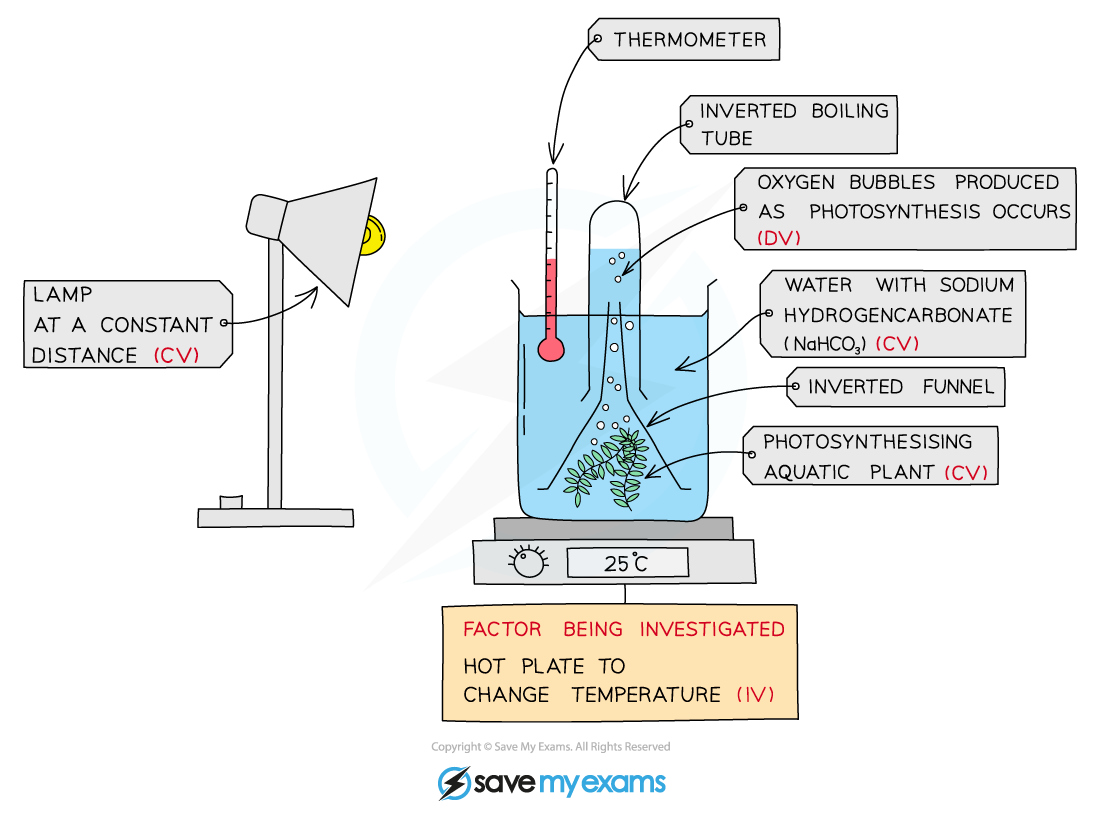
The plants usually used in photosynthesis experiments are aquatic pondweed plants (e.g. types of Elodea)
As photosynthesis occurs, oxygen gas produced is released
As the plant is in water, the oxygen released can be seen as bubbles leaving the cut end of the pondweed
The number of bubbles produced over a minute can be counted to record the rate
The more bubbles produced per minute, the faster the rate of photosynthesis
A more accurate version of this experiment is to collect the oxygen released in a test tube inverted over the top of the pondweed over a longer period of time and then measure the volume of oxygen collected
This practical can be used in the following ways:
Investigating the effect of changing light intensity
This can be done by moving a lamp different distances away from the beaker containing the pondweed

Investigating the effect of changing temperature
This can be done by changing the temperature of the water in the beaker
Investigating the effect of changing carbon dioxide concentration
This can be done by dissolving different amounts of sodium hydrogen carbonate in the water in the beaker

Care must be taken when investigating a condition to keep all other variables constant in order to ensure a fair test
For example, when investigating changing light intensity, a glass tank should be placed in between the lamp and the beaker to absorb heat from the lamp and so avoid changing the temperature of the water as well as the light intensity
Examiner Tips and Tricks
Alternative ways of measuring the gas (oxygen) given off in these experiments would be to:
measure the volume of gas produced using an inverted measuring cylinder with graduations filled with water that readings can be taken from as the water is displaced by the gas
or by using a syringe attached by a delivery tube to the funnel

Unlock more, it's free!
Join the 100,000+ Students that ❤️ Save My Exams
the (exam) results speak for themselves:

Was this revision note helpful?
Build on this topic