Homeostasis: Temperature Control (Cambridge (CIE) IGCSE Biology): Revision Note

Exam code: 0610 & 0970

Lára Marie McIvor

Written by: Lára Marie McIvor

Reviewed by: Jenna Quinn

Updated on

The skin & homeostasis: extended

  • Control of body temperature is a homeostatic mechanism

    • Homeostasis is the maintenance of a constant internal environment

    • This means that internal conditions within the body (such as temperature, blood pressure, water concentration and glucose concentration) need to be kept within set limits in order to ensure that reactions in body cells can function

  • The human body maintains the temperature at which enzymes work best: around 37 ℃

  • If body temperature increases too far above this, enzymes will denature and become less effective at catalysing reactions

The skin and temperature regulation

  • The skin plays an important role in the control of body temperature

  • Structures in the skin that are involved with temperature regulation include:

    • sweat glands

    • temperature receptors

    • capillaries

    • hairs

    • hair erector muscles

    • insulating fatty tissue

Diagram of human skin layers with hair, sweat glands, nerves, blood vessels, muscles, fatty tissue, and labels for each component.
The skin plays an important role in the control of body temperature
  • When skin temperature changes, temperature receptors in the skin send nerve impulses to the brain via sensory neurones

  • The brain responds to this information by sending nerve impulses to effectors in the skin that act to maintain normal body temperature

  • The responses to an increase in body temperature are:

    • sweat glands produce sweat which cools the skin by evaporation

    • blood vessels that supply the skin capillaries dilate

    • hairs on the skin surface lie flat

  • The responses to a decrease in body temperature are:

    • sweat gland stop producing sweat

    • blood vessels that supply the skin capillaries constrict

    • hairs on the skin stand up to trap an insulating layer of air

    • shivering generates heat in the muscles
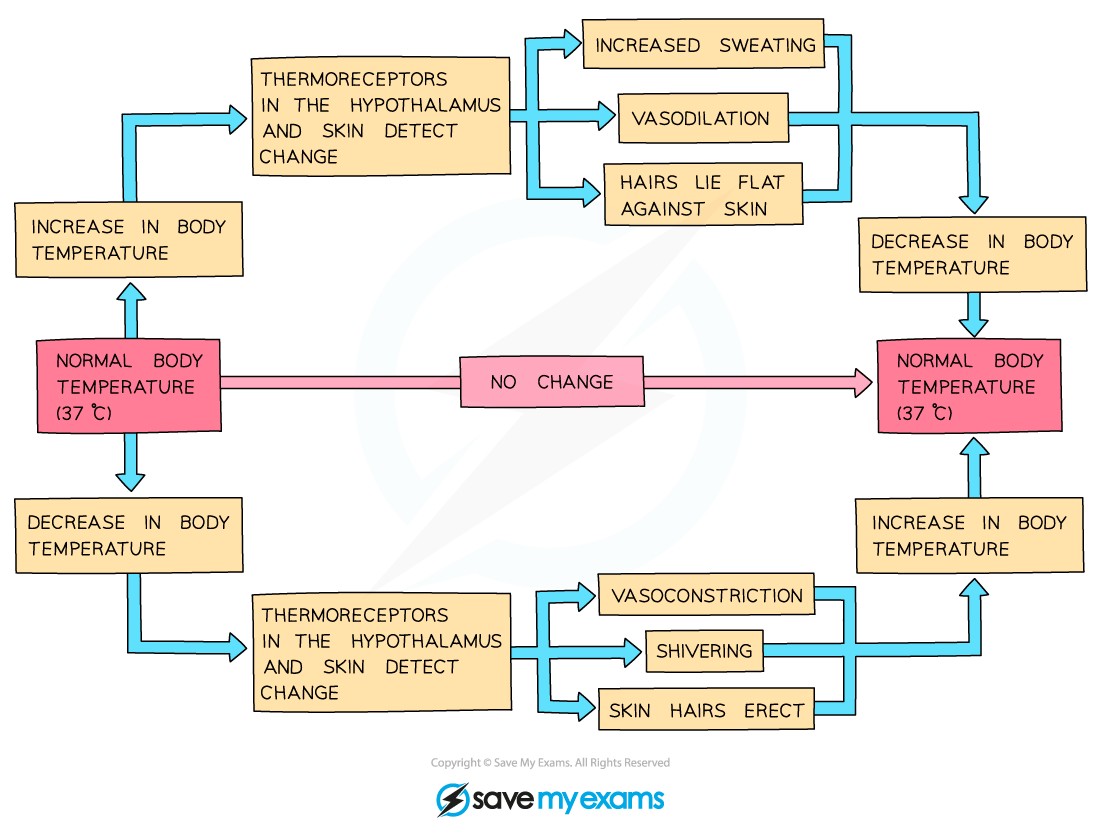
Flowchart of thermoregulation showing hypothalamus responses to increase in temperature (sweating, vasodilation and skin hairs lie flat) and decrease in temperature (vasoconstriction, shivering, skin hairs erect).
Regulating body temperature

Table comparing responses when body temperature is too high or low

When the body detects an increase in body temperature

When the body detects a decrease in body temperature

Sweat is secreted by sweat glands. This cools skin by evaporation. Heat energy from the body is lost as liquid water in sweat becomes water vapour (a state change).

Skeletal muscles contract rapidly (the body shivers). These involuntary muscle contractions require energy from respiration, and some of this is released as heat.

Hairs lie flat against the skin, allowing air to freely circulate. This increases heat transfer to the environment by radiation.

Erect hairs trap a layer of air around the skin, which acts as an insulator, preventing heat loss by radiation.

Vasoconstriction & vasodilation: Extended

  • The blood vessels in and below the skin aid temperature regulation by vasoconstriction and vasodilation

Vasoconstriction

  • When the body detects a decrease in body temperature, the blood vessels that supply capillaries in the skin constrict, or get narrower; this is known as vasoconstriction

  • Vasoconstriction reduces blood flow to the skin, and so reduces the heat lost from blood by radiation at the skin surface

Diagram showing vasoconstriction; labels include epidermis, dermis, artery, arteriole, vein, venule, capillary, and shunt vessel with reduced blood flow.
Vasoconstriction reduces blood flow to the skin, and so reduces the heat lost from blood by radiation

Vasodilation

  • When the body detects an increase in body temperature, the blood vessels that supply capillaries in the skin dilate, or get wider; this is known as vasodilation

  • Vasodilation increases blood flow to the skin surface, and so increases heat lost at the skin by radiation

Vasodilation and vasoconstriction 1, downloadable AS & A Level Biology revision notes
Vasodilation increases blood flow to the skin surface, and so increases heat lost at the skin by radiation

Unlock more, it's free!

Join the 100,000+ Students that ❤️ Save My Exams

the (exam) results speak for themselves:

Build on this topic

Lára Marie McIvor

Author: Lára Marie McIvor

Expertise: Content Creator

Lára graduated from Oxford University in Biological Sciences and has now been a science tutor working in the UK for several years. Lára has a particular interest in the area of infectious disease and epidemiology, and enjoys creating original educational materials that develop confidence and facilitate learning.

Jenna Quinn

Reviewer: Jenna Quinn

Expertise: Content Creator

Jenna studied at Cardiff University before training to become a science teacher at the University of Bath specialising in Biology (although she loves teaching all three sciences at GCSE level!). Teaching is her passion, and with 10 years experience teaching across a wide range of specifications – from GCSE and A Level Biology in the UK to IGCSE and IB Biology internationally – she knows what is required to pass those Biology exams.