Maths Skills in Biology (Cambridge (CIE) IGCSE Biology): Revision Note
Exam code: 0610 & 0970
How to calculate magnification
The magnification of an object, e.g. when viewed under a microscope, can be calculated as follows:
magnification = image size ÷ actual size
The image size is the size of the drawing or photograph, as measured with a ruler
The actual size is the real size of the specimen
When using the formula in exam questions, it is essential that you convert any units so that they match, e.g. if the actual size of a cell is given in μm, you need to convert the image size into μm as well
This can be achieved by measuring the image size in millimetres and then multiplying this value by 1000 (there are 1000 μm in a mm)
Remember that magnification has no unit, and is usually expressed as, e.g. ×400
The magnification formula can be rearranged to find the actual size or the image size:
actual size = image size ÷ magnification
image size = magnification × actual size
Examiner reports show that students lose marks by:
not converting the lengths to the same unit before dividing
measuring in centimetres when the question asks for millimetres
not rounding the answer to the number of significant figures asked for
Worked Example
In the plant cell image below, line XY measures 4.2 cm. The actual length of this plant cell is 28 μm.
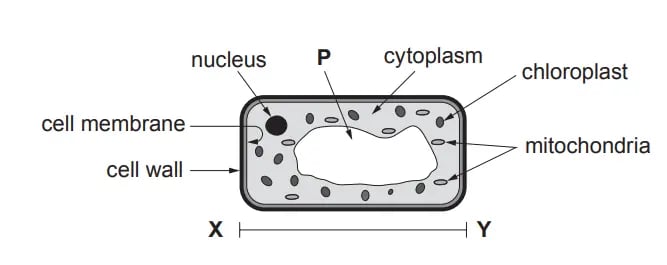
Calculate the magnification at which this cell has been drawn.
[2]
Zero-mark answer:
magnification = image size ÷ actual size
= 4.2 ÷ 28
= ×0.15
Full-mark answer:
4.2 cm = 42 mm = 42 000 μm
magnification = 42 000 ÷ 28 [1 mark]
= ×1500 [1 mark]
Examiner Tips and Tricks
The zero-mark answer uses the correct equation, but it divides a length in centimetres by a length in micrometres; a magnification calculation only works if both lengths are in the same unit, so the answer of ×0.15 has no meaning.
The full-mark answer converts the image length from centimetres into micrometres first (4.2 cm = 42 mm = 42 000 µm), then divides by the actual size.
After you calculate, check that your answer is sensible: for a drawing or micrograph of a cell, the magnification should be greater than ×1.
Calculating mean, range & percentage change
In investigations, it is common to repeat a measurement several times; this makes it possible to check for anomalous results
It is also possible to use a set of results to calculate values such as:
mean
range
percentage change
Mean
The mean gives a single value that represents the whole set of results
Calculating a mean of repeat results reduces the effect of random errors, so it is a better estimate than any single result
To calculate the mean, add up all the values and divide by the number of values:
mean = total of the values ÷ number of values
Leave out any anomalous results before calculating the mean
If the question tells you which values to use, use only those
Give your calculated mean value to the same precision as the measured data points
Range
The range shows how spread out a set of results is
To calculate the range, subtract the lowest value from the highest value:
range = highest value − lowest value
Percentage change
The percentage change shows how much a value has changed compared with where it started
It lets you compare changes fairly when the starting values are different, e.g. potato cylinders with different starting masses
To calculate a percentage change, divide the change by the original value and multiply by 100:
percentage change = (change ÷ original value) × 100
If a value has gone down, show this with a minus sign, or say that it is a percentage decrease
Examiner reports show that students lose marks by:
including values in a mean that the question did not ask them to use
rounding values incorrectly
dividing by the final value, not the original value, in a percentage change
Worked Example
The mass of a potato cylinder increases from 2 g to 2.5 g in an osmosis experiment.
Calculate the percentage change in mass of this cylinder.
[2]
Zero-mark answer:
change in mass = 2.5 − 2 = 0.5 g
percentage change = (0.5 ÷ 2.5) × 100
= 20 %
Full-mark answer:
percentage change = (0.5 ÷ 2) × 100 [1 mark]
= 25 % [1 mark]
Examiner Tips and Tricks
The zero-mark answer finds the change in mass correctly (0.5 g), but then divides it by the final mass (2.5 g). Percentage change compares the change with where the value started, so it must always be divided by the original value.
The full-mark answer divides the change by the original mass of 2 g, giving a percentage change of 25 %. The cylinder gained a quarter of its original mass.
Rates, gradients & surface area to volume ratio
Rates
A rate is how much something changes in a set period of time
E.g. the volume of oxygen produced per minute during photosynthesis
To calculate a rate, divide the change by the time taken:
rate = change ÷ time
The unit of a rate includes a quantity and time
E.g. for rate of photosynthesis the unit might be cm3 per min:
quantity = volume of oxygen (cm3)
time = per minute (min)
Some investigations measure the time taken for a fixed change to happen, e.g. the time for a colour change; a shorter time means a faster rate
If the change is the same each time, you can compare rates using 1 ÷ time
The unit is per second or per minute
Gradients and rate
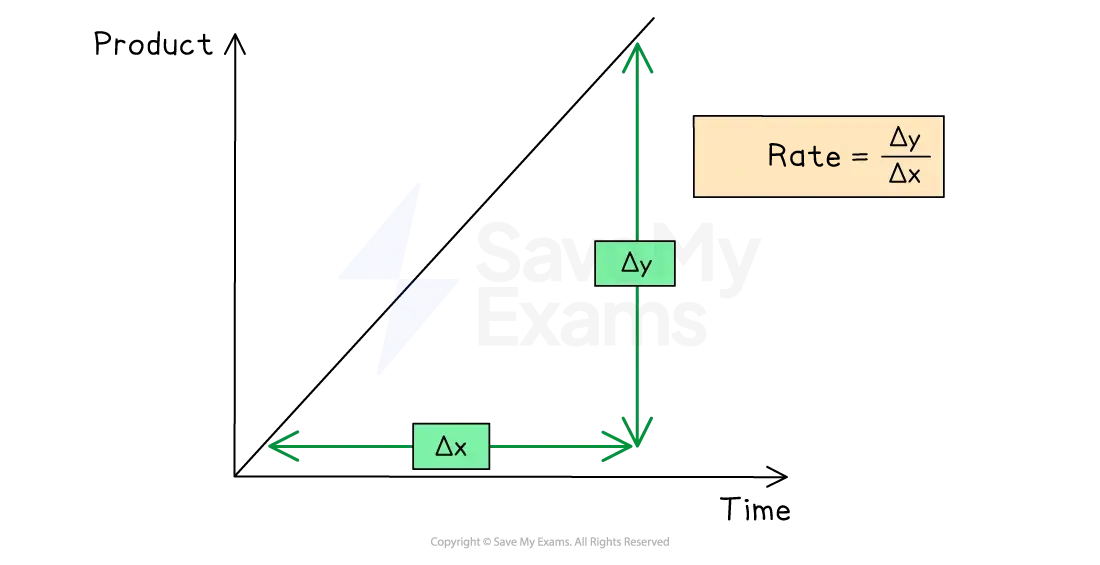
On a graph with time on the x-axis, the gradient of the line is the rate at which the quantity on the y-axis is changing
A steeper line means a faster rate
For a straight line, calculate the gradient using a large triangle drawn on the line:
gradient = change in y ÷ change in x
The unit of the gradient is taken from the unit of y and the unit of x
E.g. if y is volume in cm³ and x is time in min, then the unit is cm³ per min
Surface area to volume ratio
A ratio compares two quantities
For surface area to volume ratio, write the surface area first, then the volume
surface area : volume
To calculate the surface area to volume ratio of a cube:
surface area = area of one face × 6 = l x l x 6
Where 6 = number of faces and l = length of one side
volume = l × l × l
For a cuboid, the faces are not all the same, so work out the area of all six faces (there are 3 pairs of matching faces) and add them together
To make ratios easy to compare, divide both numbers by the volume so that the ratio is written as … : 1
E.g. a cube with sides of 2 cm has a surface area of 6 × 2 × 2 = 24 cm² and a volume of 2 × 2 × 2 = 8 cm³
The ratio is 24 : 8, which simplifies to 3 : 1 (24 ÷ 8 = 3 and 8 ÷ 8 = 1)
Worked Example
Cubes of agar jelly stained with an indicator can be used as model cells to investigate diffusion. When an agar cube is placed into acid, the acid diffuses into the cube and the indicator changes colour.
A student cuts an agar cube with a side length of 3 cm.
Calculate the surface area to volume ratio of this cube.
[2]
Zero-mark answer:
surface area = l x l
SA = 3 x 3
SA = 9 cm2
volume = l x l x l
V = 3 x 3 x 3
V = 27 cm3
ratio = 27 : 9
ratio = :
ratio = 3 : 1
Full-mark answer:
surface area = l x l x 6
SA = 3 x 3 x 6
SA = 54 cm2
volume = l x l x l
V = 3 x 3 x 3
V = 27 cm3
ratio = 54 : 27 [1 mark]
ratio = :
ratio = 2 : 1 [1 mark]
Examiner Tips and Tricks
The zero-mark answer makes two errors. First, it finds the area of only one face of the cube (3 × 3 = 9 cm2); the area of one face must be multiplied by 6 to give 54 cm2. Second, it writes the ratio the wrong way round, as volume : surface area. A surface area to volume ratio always has the surface area first.
The full-mark answer multiplies by 6 to get a surface area of 54 cm², then writes the ratio as surface area : volume, with the surface area first. It divides both numbers by the volume so that the ratio ends in 1.
Unit conversions, significant figures & decimal places
Unit conversions
Calculations often involve sets of numbers that have different units; in order to determine the correct answer you need to convert units so that they match
Convert values to the same unit before you calculate, not afterwards
This reduces the risk of forgetting to convert one of the values
Common conversions include:
Conversion | Calculation |
|---|---|
Millimetres (mm) to micrometres (μm) | × 1000 |
Micrometres (μm) to millimetres (mm) | ÷ 1000 |
Centimetres (cm) to millimetres (mm) | × 10 |
Millimetres (mm) to centimetres (cm) | ÷ 10 |
Cubic decimetres (dm3) to cubic centimetres (cm3) | × 1000 |
Cubic centimetres (cm3) to cubic decimetres (dm3) | ÷ 1000 |
Kilograms (kg) to grams (g) | × 1000 |
Milligrams (mg) to grams (g) | ÷ 1000 |
Significant figures and decimal places
Significant figures and decimal places are not the same thing, so check which one the question asks for
Significant figures count from the first digit that is not zero
E.g. 0.0487 to two significant figures is 0.049
Zeros after the first digit do count, e.g. 0.0450 has three significant figures
Decimal places count the digits after the decimal point
E.g. 0.0487 to two decimal places is 0.05
Give a value to no more decimal places than the scale you read it from allows
When you measure, record the value to the precision of the instrument
E.g. a ruler marked in millimetres can only be read to the nearest millimetre
When you calculate, do not give more figures than your data support, even if your calculator shows many digits
E.g. if the lengths 12 mm, 13 mm and 13 mm give a mean of 12.6666..., give 13 mm (the same precision as the measured instrument)
Examiner reports show that students lose marks by:
confusing significant figures with decimal places
not rounding to the number of significant figures or decimal places asked for
Examiner Tips and Tricks
When a question asks for a set number of significant figures or decimal places, underline it.
Round your final answer only, and check it once more against the instruction before you move on.
Checking your answer
Before you move on from calculation questions in exams, it is a good idea to carry out some checks, for example:
size
Think about the sizes of different organisms, or parts of organisms, in relation to each other, e.g. a cell should be far smaller than a leaf
The magnification for an enlarged image should be greater than ×1, e.g. an answer of ×0.15 suggests that a unit conversion has been missed
If an answer looks far too big or far too small, check first that you converted every value into the same unit
direction
If something decreased, the percentage change should be negative, or described as a decrease
percentages
A percentage change can be over 100 %, e.g. a mass that more than doubles
A percentage of a whole group, e.g. the percentage of people who have been vaccinated, cannot be over 100 %
units
Units should be included, unless the answer is a magnification or a ratio
Check that the units are correct, e.g. don't mix up cm2 and cm3, and use min for minutes, not m (m is the symbol for metres)
rounding
Ensure that the answer has been rounded correctly, and given to the correct number of decimal places or significant figures
Show your working, so you can gain marks for correct steps even if the final answer is wrong

Unlock more, it's free!
Join the 100,000+ Students that ❤️ Save My Exams
the (exam) results speak for themselves:

Was this revision note helpful?