Planning an Investigation (Cambridge (CIE) IGCSE Biology): Revision Note
Exam code: 0610 & 0970

How to write a method
A planning question asks you to describe how you would carry out a specific investigation, using a sequence of instructions that someone else could follow
Write your method as a set of steps, in the order you would do them
A good method includes:
how to set up and use the apparatus
the quantities to use, with units, e.g. 25 cm³ of water
how to change the independent variable, and the range of values to use
how and when to measure the dependent variable, and which apparatus to use
which variables to keep constant, and how
how many times to repeat each reading
Examiner reports show that students lose marks by:
listing apparatus without describing how it is used
not giving enough detail in their method
Worked Example
A student wanted to investigate the effect of light intensity on the rate of photosynthesis in pond weed.
Plan an investigation to find out how light intensity affects the rate of photosynthesis.
[6]
Zero-mark answer:
Independent variable: light intensity
Dependent variable: rate of photosynthesis
Apparatus: lamp, ruler, beaker, pond weed, stopwatch
Full-mark answer:
Place a 5 cm piece of pondweed in a beaker of sodium hydrogencarbonate solution [1 mark]
Place a lamp 10 cm from the beaker, measured with a ruler [1 mark]
Leave for 2 minutes, then use a stopwatch to count the number of bubbles released in 1 minute [1 mark]
Repeat with the lamp at 20, 30, 40 and 50 cm from the beaker [1 mark]
Keep the temperature constant by placing the beaker in a water-bath [1 mark]
Repeat the count two more times at each distance and calculate a mean [1 mark]
Examiner Tips and Tricks
The zero-mark answer is a list of headings and equipment, not a method. It repeats "light intensity" and "rate of photosynthesis" from the question without saying how light intensity will be changed or exactly what will be measured.
The full-mark answer is a sequence of steps in the order you would carry them out, which another student could follow. It gives the actual distances, says what is counted and for how long, how the temperature is kept constant and how many repeats are done.
Choosing & justifying apparatus
When describing apparatus choices in practical questions, you should name the specific piece of apparatus
E.g. a measuring cylinder, not "something to measure volume"
Common apparatus items for measuring different variables include:
volume: measuring cylinder, gas syringe or pipette
mass: electronic balance
length / short distances: ruler
time: stopwatch
temperature: thermometer
Choose apparatus that is precise enough for the variable being measured, e.g. for measuring 2 cm3, a 5 cm3 syringe will be more appropriate than a 100 cm3 measuring cylinder
When a question asks you to justify your choice, give a reason linked to the experiment, e.g.:
use a gas syringe to measure oxygen production rather than counting bubbles; this is because bubbles vary in size, while a gas syringe measures the volume of gas produced, improving precision
use a temperature-controlled water-bath rather than a beaker of hot water; this is because a beaker of hot water cools down over time, while a water-bath maintains a constant temperature, so this control variable won't affect the results
Taking readings to the correct precision
When it comes to reading results and recording measurements correctly, you need to consider:
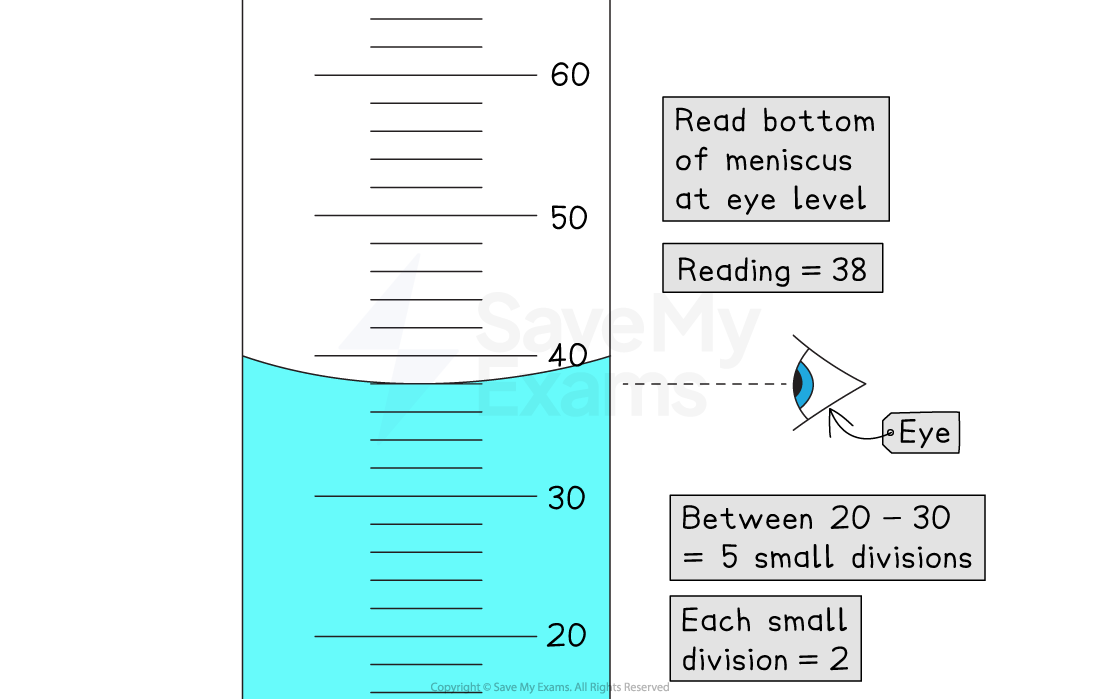
how to determine the size of a single small division on a scale
Sometimes you may not know the size of a single small division on a scale, e.g. in a diagram within an exam question
In order to determine the size of a single division you need to:
Pick two labelled points next to each other on the scale (e.g. 20 and 30); determine the difference between the two numbers, i.e. 30 - 20 = 10
Count the number of spaces between those numbers (e.g. 5)
Divide the difference by the number of spaces: 10 ÷ 5 = 2
Each small division = 2
how to read a scale to the correct level of precision
Once you know what one small division is worth, you can read to the nearest line or half-division
E.g. on a thermometer marked every 1 °C, you can read to the nearest 0.5 °C; so for a reading that falls in between 68 and 69 °C, you could record 68.5 °C, but it would not be reasonable to record 68.3 °C
how to take readings with a ruler, and from a liquid
Always take ruler measurements in mm, e.g. 42 mm, rather than in cm, when measuring for magnification calculations
When reading liquid volumes
ensure that you are at eye level with the liquid to avoid parallax error
read from the bottom of the meniscus
how to record readings from digital instruments
Write down every digit shown on the display, e.g. do not write 5.0 g as 5 g; the trailing zero (.0) shows the precision of the balance
how to record values in a results table
All readings from the same instrument down a column must have the same number of decimal places
Put units in the header, never in the body of the table
If a digital stop-clock shows minutes and seconds, convert values to match the units in the header, e.g. seconds, before entering them into a table
Examiner reports show that students lose marks by:
recording readings to different numbers of decimal places
not giving a unit
Examiner Tips and Tricks
Look at the smallest division on the scale before you take a reading. This tells you how many decimal places every reading from that instrument should have.
Repeats, sample size & random sampling
Repeating an experiment
Repeating an experiment lets you spot anomalous results and calculate a mean
Carrying out at least three trials in total for each value of the independent variable allows anomalous results to be spotted
These anomalies can then be excluded from the mean
The more repeats are carried out, the less impact each individual result has on the mean
Calculating a mean reduces the impact of random error on the results
Sampling
Testing a large sample size, e.g. 100 leaves or 50 seeds, increases the likelihood that your data is representative of the whole population
Choose samples at random, so that you do not pick unusual ones without meaning to
Give a reason that is specific to the experiment, not a general phrase such as "to make it more reliable"
Examiner reports show that students lose marks by:
suggesting only one repeat, instead of at least two more
giving general reasons, e.g. "to improve reliability or accuracy", instead of a reason linked to the experiment
Examiner Tips and Tricks
Writing 'to improve accuracy' or 'to make it reliable' on its own will not score marks. Instead, say what the repeats let you do, e.g. spot anomalous results and calculate a mean.
Making a prediction
A prediction says what you expect to happen, before you do the experiment
A good prediction gives a reason, using the biology you know
E.g. as temperature increases up to 40 °C, the rate of enzyme activity will increase, because molecules will have more kinetic energy.
A prediction is not a conclusion: a conclusion describes what your results show after the end of an experiment
The results show that as temperature increased from 20 °C to 40 °C, the rate of enzyme activity increased from 1.2 to 4.8 cm³/min, because higher kinetic energy increased the rate of successful collisions
Examiner Tips and Tricks
Be careful not to confuse predictions and conclusions; if a question asks for a conclusion, you should refer to an existing set of results, not write about what you expect to happen.

Unlock more, it's free!
Join the 100,000+ Students that ❤️ Save My Exams
the (exam) results speak for themselves:

Was this revision note helpful?