The Life Cycle of Solar Mass Stars (Edexcel IGCSE Science (Double Award) (Modular): Physics Unit 2): Revision Note
Exam code: 4XSD1

The life cycle of solar mass stars
All stars, including the Sun, began as a cloud of dust and gas
Once a star has formed, it will spend its life going through a sequence of evolutionary stages, known as the life cycle of a star
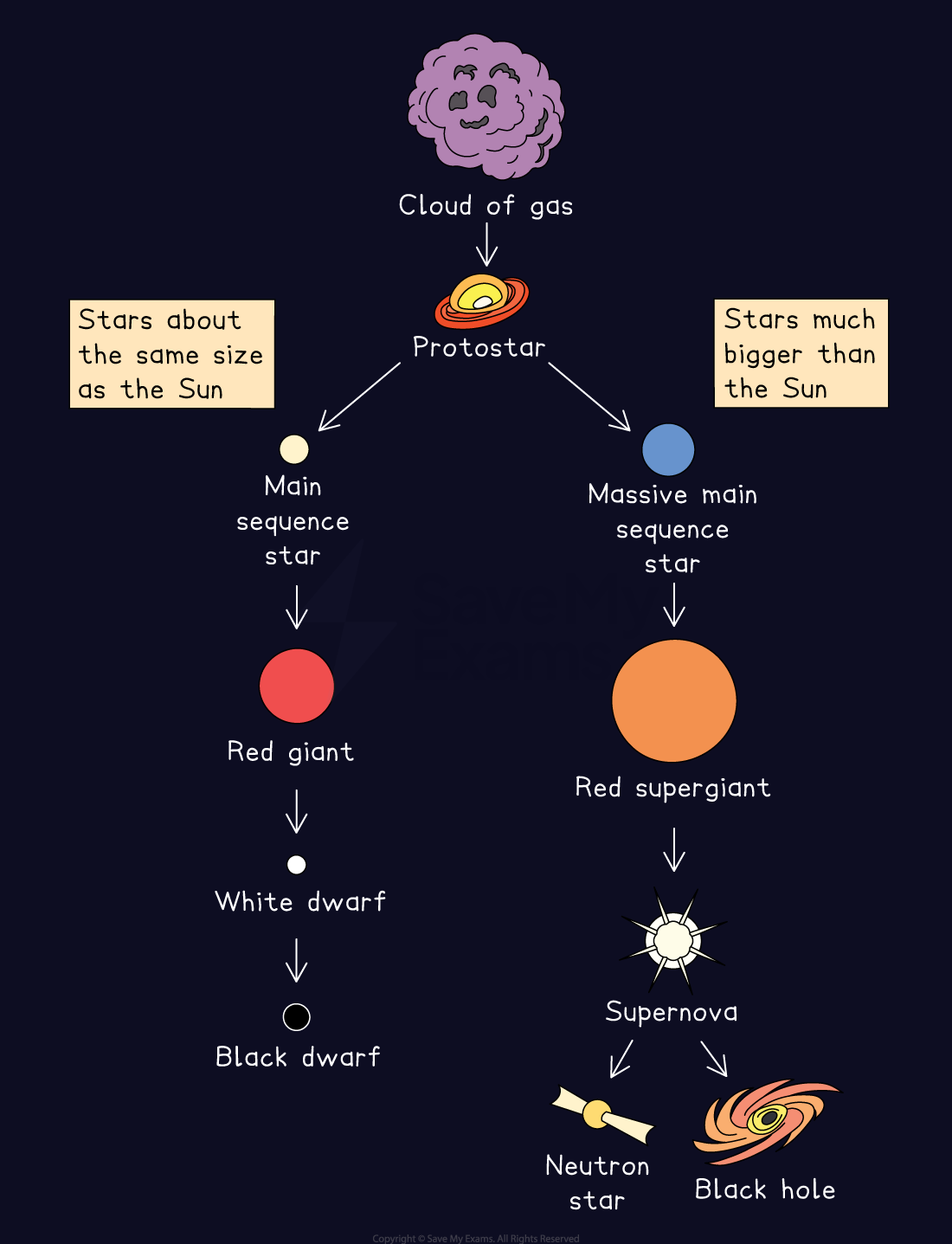
Summary of the life cycles of stars
Star formation
All stars follow the same initial stages:
nebula → protostar → main sequence star
Nebula
Stars form from a giant interstellar cloud of gas and dust called a nebula
Protostar
The force of gravity within a nebula pulls the particles closer together until a hot ball of gas forms, known as a protostar
As the particles are pulled closer together the density of the protostar will increase
This results in more frequent collisions between the particles which causes the temperature to increase
Main sequence star
Once the protostar becomes hot enough, nuclear fusion reactions occur within its core
Once a star initiates fusion, it is known as a main sequence star
During the main sequence, the star is in equilibrium and said to be stable
Evolution of a solar mass star
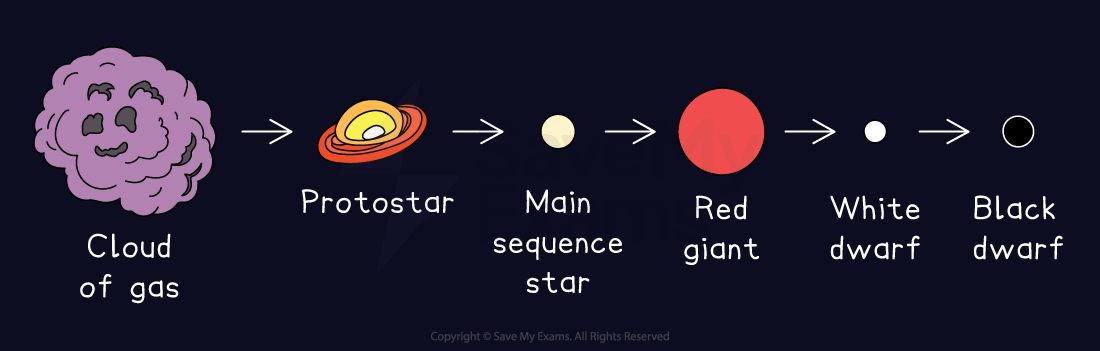
After the main sequence, stars which are similar in size to the Sun go through the following evolutionary stages:
main sequence → red giant → white dwarf
Red giant
After several billion years, the hydrogen causing the fusion reactions in the star will begin to run out
Once this happens, the fusion reactions in the core will start to die down
The star will begin to fuse helium which causes the outer part of the star to expand
As the star expands, its surface cools and it becomes a red giant
White dwarf
Once the helium fusion reactions have finished, the star collapses and becomes a white dwarf
The white dwarf cools down over time and as a result, the amount of energy it emits decreases
Once the star has lost a significant amount of energy and no longer emits light, it becomes a black dwarf
Examiner Tips and Tricks
Make sure you remember the life cycle for a solar mass star and ensure you can describe the sequence in a logically structured manner in case a 6 marker comes up in the exam!
Ensure you can remember the end stages for a solar mass star clearly (red giant, then white dwarf), as this is different for a star that is much larger than our Sun!

Unlock more, it's free!
Join the 100,000+ Students that ❤️ Save My Exams
the (exam) results speak for themselves:

Was this revision note helpful?