Temperature (Edexcel IGCSE Science (Double Award) (Modular): Physics Unit 2): Revision Note
Exam code: 4XSD1

Temperature & speed
Imagine molecules of gas that are free to move around in a box
The molecules in the gas move around randomly at high speeds, colliding with surfaces and exerting pressure upon them
The temperature of a gas is a measure of the average speed of the molecules:
The higher the temperature of the gas, the faster the molecules move
This is because they have a greater average speed

Gas molecules move about randomly at high speeds
Temperature & kinetic energy
The temperature of a substance is related to the average kinetic energy of its molecules
The higher the temperature, the higher the average kinetic energy of the molecules, and vice versa
This means they move faster at higher temperatures
This applies to all states of matter, although the motion of particles in a solid is different from that of particles in a gas
For a gas, the internal energy can be taken as the sum of the kinetic energies of all the molecules
In a gas, the intermolecular forces are negligible, so the contribution from potential energy can be taken as zero
This is different from a solid or liquid, where the internal energy includes contributions from both kinetic and potential energy
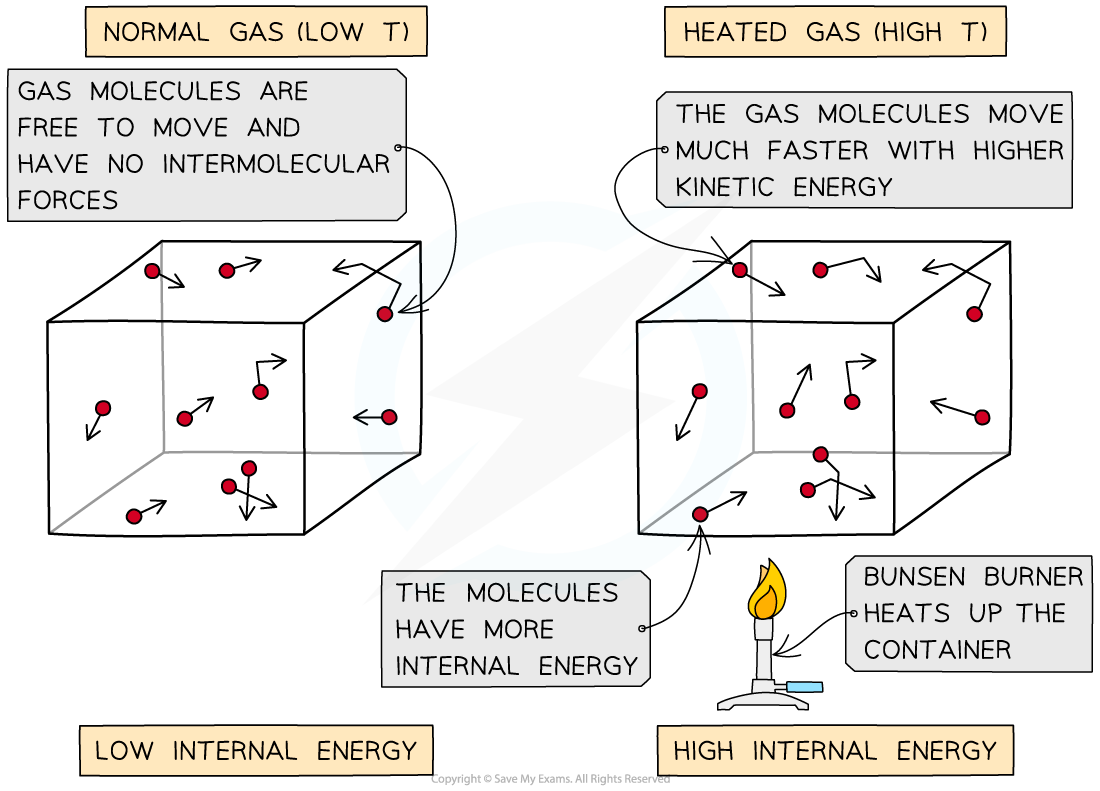
As the container is heated up, the gas molecules move faster with higher kinetic energy. The energy stored within the system - the internal energy - therefore increases
If the temperature of a gas is increased, the particles move faster and gain kinetic energy
They collide more often with each other and the container walls, leading to an increase in pressure
The temperature (in Kelvin) is proportional to the average kinetic energy of the molecules:
Worked Example
When a liquid evaporates, molecules escape from the surface of the liquid.
What happens to the temperature of the liquid and the average kinetic energy of the molecules within it?
| Temperature / K | Average kinetic energy of the molecules |
|---|---|---|
A | Increases | Increases |
B | Decreases | Decreases |
C | Stays the same | Stays the same |
D | Decreases | Increases |
Answer: B
When evaporation takes place, the more energetic molecules leave the surface of the liquid
Since the more energetic molecules have left, the average kinetic energy per molecule must decrease
Therefore, A & D are not correct
Temperature is proportional to the average kinetic energy per molecule, therefore, the temperature also decreases

Unlock more, it's free!
Join the 100,000+ Students that ❤️ Save My Exams
the (exam) results speak for themselves:

Was this revision note helpful?