Statement of Profit or Loss (Cambridge (CIE) A Level Business): Revision Note

Exam code: 9609

Lisa Eades

Written by: Lisa Eades

Reviewed by: Steve Vorster

Updated on

The purpose of the statement of profit or loss

  • The statement of profit or loss shows the income and expenditure of a business over a period of time - usually a year - and identifies the amount of profit made 

Statement of profit or loss: key terminology and calculations

Term

Explanation

Sales revenue

  • Money generated through selling goods and services

  • Calculated using the formula

Price × Quantity

Cost of sales

  • The cost of producing or buying in the goods actually sold by the business during a time period.

  • Also called cost of goods sold

  • Includes raw materials, packaging and direct labour

Gross profit

  • Made when sales revenue is greater than the cost of sales.

  • Calculated using the formula

Sales revenue  Cost of sales

Expenses

  • Non-direct costs a business incurs during normal operations, also called overheads

  • Includes salaries, rent, advertising, utilities and depreciation

Profit from operations

  • Profit made after all direct and indirect costs are deducted from revenue

  • Calculated using the formula

Sales revenue  (Cost of sales + Expenses)

Taxation

  • The amount of money paid to the government based on profit, usually called corporation tax

  • Subtracted after profit from operations to determine final profit

Profit for the year

  • Profit remaining after tax has been deducted

  • This is the amount available to be distributed to shareholders or retained in the business

  • Calculated using the formula

Profit from operations  Taxation

Dividends

  • The portion of profit paid to shareholders as a reward for their investment

Retained earnings

  • Profit kept within the business to be used as a source of finance for future investment or growth

The structure of the statement of profit or loss

  • The statement of profit or loss is divided into three parts

    • The trading account

    • The profit and loss account

    • The appropriation account

An example income statement
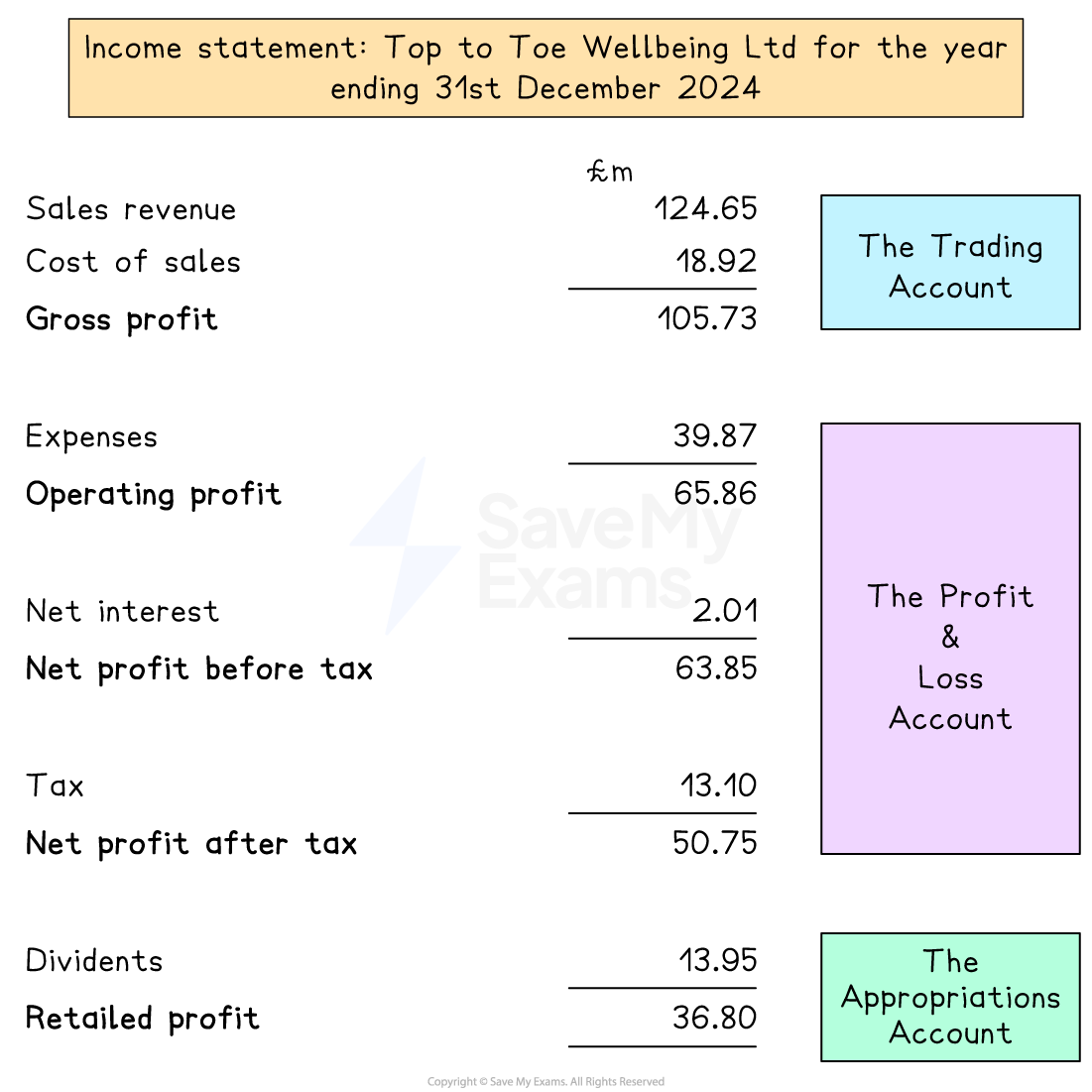
Income statement for Top to Toe Wellbeing Ltd, year ending 31st December 2024, showing revenue, costs, profits, dividends, and retained profit.
An example income statement, showing the trading account, profit and loss account and appropriations account

The trading account

  • The trading account is where the cost of sales is deducted from sales revenue to calculate the gross profit

    • In 2024 Top to Toe Wellbeing Limited's sales revenue was £124.65m and its cost of sales were £18.92m

      • The gross profit for the period was therefore 

= £124.65m  £18.92m = £105.73m

The profit and loss account

  • The profit and loss account deducts a series of expenses to determine the operating profit for the period 

    • In 2024 gross profit was £105.73m and expenses were £39.87m

      • The operating profit was therefore 

    = £105.73m  £39.87m = £65.86m

    • The business also paid £2.01m interest

      • The profit before tax was therefore

    = £65.86m  £2.01m = £63.85m

    • The business also paid £13.10m tax

      • The profit after tax for the period was therefore

= £63.85m  £13.10m = £50.75m

The appropriations account

  • The appropriations account shows how profits are distributed for the period

    • In 2024 Head to Toe Wellbeing Limited distributed £13.95m to shareholders as dividends

      • £36.80m was therefore retained as profit

Amending the statement of profit or loss

  • Making a change to one section of the statement of profit or loss has an impact on other sections

Worked Example

Pershore Plumbers Ltd's accountant has sent the interim statement of profit and loss to Helen, the business owner. She has been asked to check the statement before it is sent to Companies House

Pershore Plumbers Ltd - Statement of profit or loss for the year ending 31st March 2025

Financial statement showing revenue, costs, and profits. Highlights: gross profit £574,450, operating profit £371,820, retained profit £94,390.

Helen identifies three errors

  • Sales revenue for the period was actually £889,540

  • The business received a tax refund of £12,220 during the year

  • The business paid dividends of £220,500 to shareholders

Recalculate the statement of profit or loss to reflect these changes.

(4)

Step 1: Calculate gross profit given the updated revenue figure

Gross profit = Revenue  Cost of sales= £889,540  £310,510= £579,030 (1)

Step 2: Recalculate operating profit

Operating profit =Gross profit  Expenses= £579,030  £202,630= £376,400 (1)

Step 3: Calculate profit for the year given the tax refund

Tax = £66,930  £12,220 = £54,710Profit for the year = Operating profit  Tax= £376,500  £54,710= £321,790 (1)

Step 4: Calculate retained profit given updated dividends

Retained profit = Profit for the year  Dividends= £321,690  £220,500= £101,190 (1)

Pershore Plumbers Ltd - Updated statement of profit or loss for the year ending 31st March 2025

Financial summary showing revenue of £889,540, expenses, taxation, divis at £220,500, and retained profit of £101,190. Copyright Save My Exams.

Unlock more, it's free!

Join the 100,000+ Students that ❤️ Save My Exams

the (exam) results speak for themselves:

Build on this topic

Lisa Eades

Author: Lisa Eades

Expertise: Curriculum Expert

Lisa has taught A Level, GCSE, BTEC and IBDP Business for over 20 years and is a senior Examiner for Edexcel. Lisa has been a successful Head of Department in Kent and has offered private Business tuition to students across the UK. Lisa loves to create imaginative and accessible resources which engage learners and build their passion for the subject.

Steve Vorster

Reviewer: Steve Vorster

Expertise: Content Creator

Steve has taught A Level, GCSE, IGCSE Business and Economics - as well as IBDP Economics and Business Management. He is an IBDP Examiner and IGCSE textbook author. His students regularly achieve 90-100% in their final exams. Steve has been the Assistant Head of Sixth Form for a school in Devon, and Head of Economics at the world's largest International school in Singapore. He loves to create resources which speed up student learning and are easily accessible by all.