14 marks
State whether each of the following mappings is one-one, many-one, one-many or many-many.
(i)
(ii)
(iii)
(iv)
Was this exam question helpful?
Exam code: 9709
State whether each of the following mappings is one-one, many-one, one-many or many-many.
(i)
(ii)
(iii)
(iv)
Was this exam question helpful?
The function is defined by
for .
Sketch the graph of , giving the coordinates of the points where the graph meets the coordinate axes.
Given that the minimum point of the graph has -coordinate , state the range of .
Was this exam question helpful?
The function is defined by
for .
(i) State the range of .
(ii) The domain of is changed to . State the range of for this new domain.
Was this exam question helpful?
The functions and are defined by
for .
Find an expression for
(i) ,
(ii) .
Solve the equation .
Was this exam question helpful?
State whether each of the following mappings is one-one, many-one, one-many or many-many.
(i)
(ii)
(iii)
(iv)
Was this exam question helpful?
The function is defined by
for .
State the range of .
The domain of is changed to . State the range of for this new domain.
Was this exam question helpful?
The function is defined by
for .
Find an expression for .
State the domain and range of .
Was this exam question helpful?
The function is defined by
for .
Sketch the graph of , giving the coordinates of the points where the graph meets the coordinate axes and the coordinates of the turning point.
Write down the range of .
Was this exam question helpful?
The functions and are defined by
for .
Write down the range of .
Find an expression for
(i) ,
(ii) .
Solve the equation .
Was this exam question helpful?
The diagram shows the graph of (solid line) together with a dotted line.
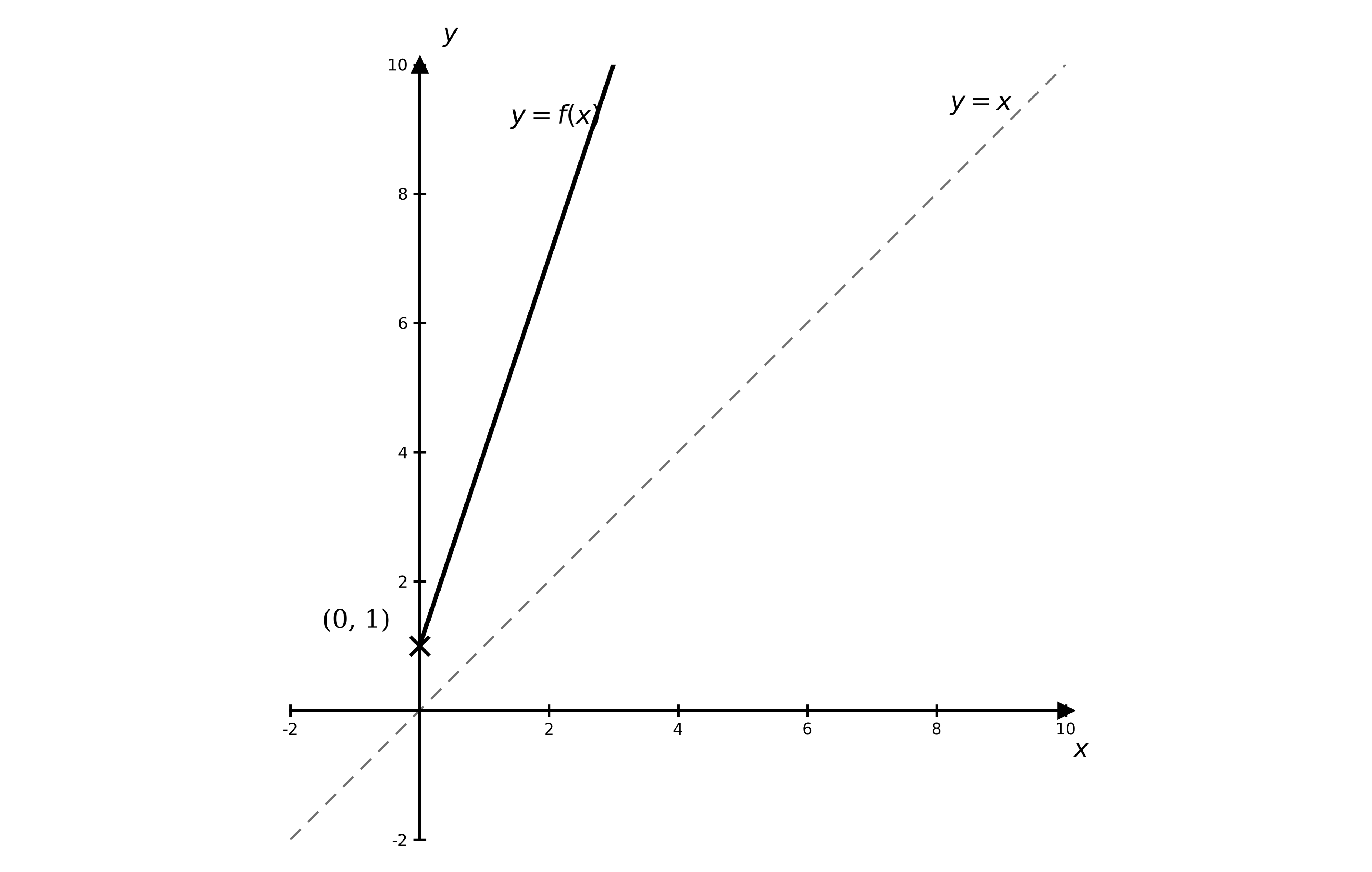
Use the graph to write down the domain and range of .
Given that lies on the dotted line, write down the equation of the dotted line.
On the diagram, sketch the graph of .
Was this exam question helpful?
The function is defined by
for .
Show that can be written as .
Explain why does not have an inverse, and suggest an adaptation to its domain so that the inverse exists.
The domain of is changed to . Find an expression for , and state its domain and range.
Was this exam question helpful?
The functions and are defined by
for .
Find an expression for
(i) ,
(ii) .
Write down and state its domain and range.
Was this exam question helpful?
The function is defined by
Write down the domain of .
Sketch the graph of , stating the coordinates of any intersections with the axes and the equations of any asymptotes.
Write down the range of .
Was this exam question helpful?
The functions and are defined by
for .
Write down the range of .
Find an expression for
(i) ,
(ii) .
Solve the equation .
Was this exam question helpful?
The graph of is shown below.
The diagram shows the graph of (solid curve) together with a dotted line.
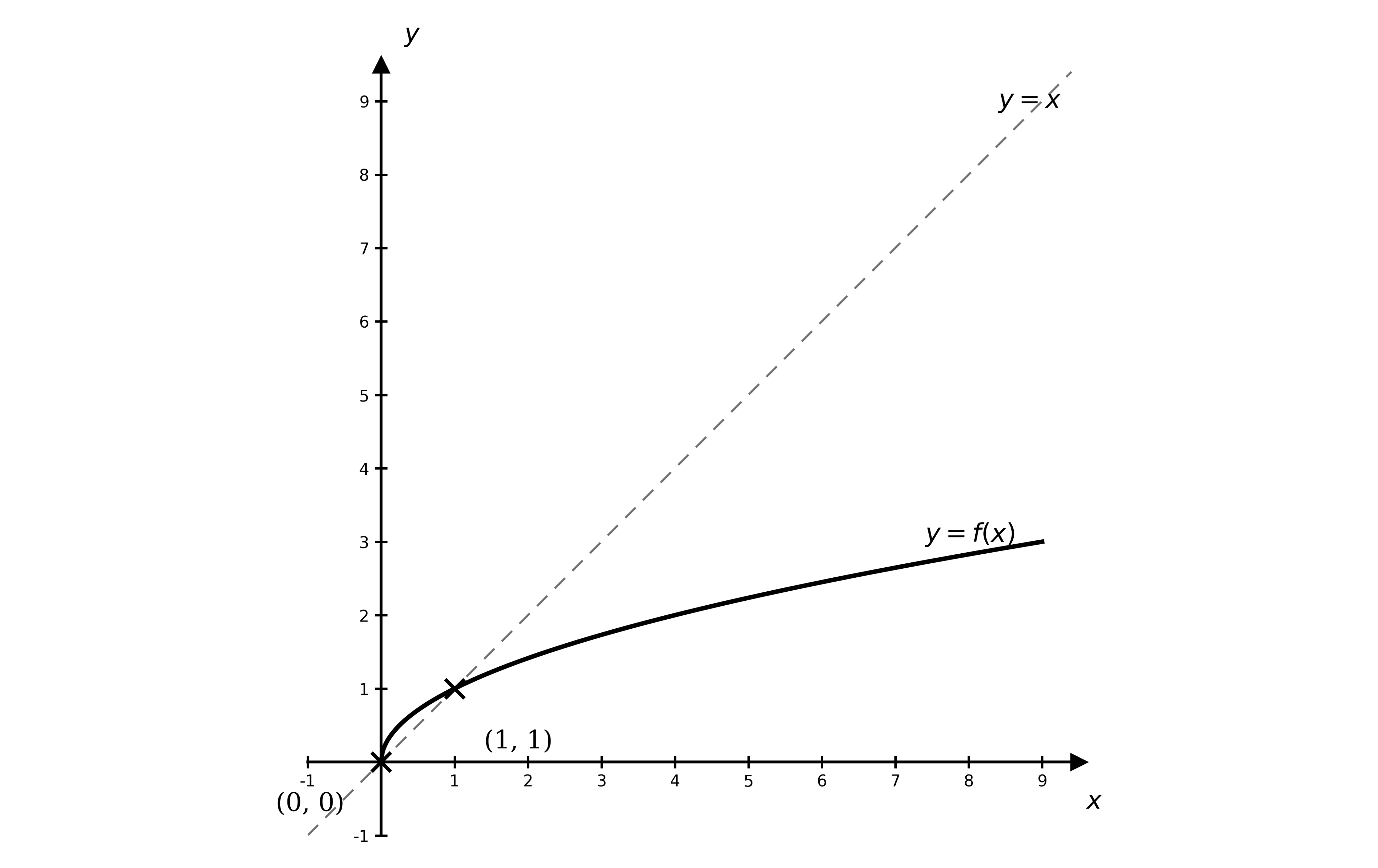
(i) Use the graph to write down the domain and range of .
(ii) Write down the equation of the dotted line.
On the diagram, sketch the graph of .
Was this exam question helpful?
The function is defined by
Write down the domain and range of .
Sketch the graph of , stating the coordinates of any intersections with the axes. (You do not need to give the coordinates of any turning points.)
Was this exam question helpful?
The functions and are defined by
for ,
for .
Write down the range of .
Leaving your answers as single fractions, find an expression for
(i) ,
(ii) .
Given that is a factor of , solve the equation .
Was this exam question helpful?
The function is defined by
for .
Explain why does not have an inverse.
Suggest an adaptation to the domain of so that:
the inverse of exists,
the graph of lies in the first quadrant only, and
the domain of is as large as possible.
State the range of your adapted .
The domain of is changed to . Find an expression for , and state its domain and range.
Was this exam question helpful?
The function is defined by
for .
Work out the range of .
If the domain of is changed to , what is the range of ?
State another domain for that would have the same effect as that in part (b).
Was this exam question helpful?
The diagram shows the graph of together with the line (dotted). The function has rotational symmetry about the origin, and for there is a vertical line of symmetry at .
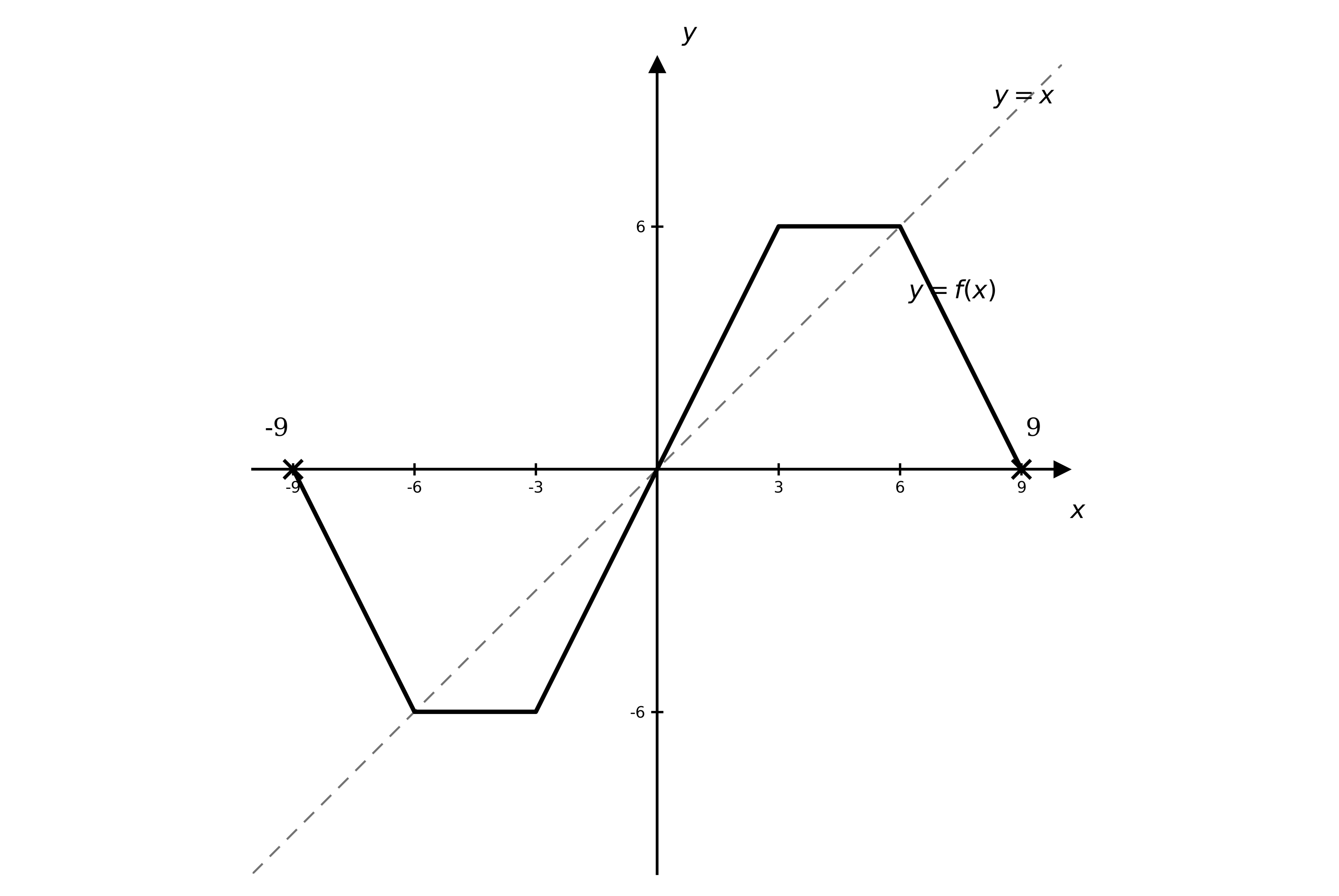
Use the graph to write down the domain and range of .
On the diagram, sketch the reflection of in the line , and explain why this cannot be the graph of .
(i) Given that the maximum solution to is , state the restriction on the domain of such that exists.
(ii) Hence write down the domain and range of .
Was this exam question helpful?
The functions and are defined by
for ,
for .
Find an expression for
(i) ,
(ii) .
Write down and state its domain and range.
The graphs of and are drawn on the same axes. Describe the transformation that maps one graph onto the other.
Find the coordinates of the point where the graphs of and meet.
Was this exam question helpful?