Demographic Trends: Death Rate & Life Expectancy (AQA A Level Sociology): Revision Note
Exam code: 7192

Death rate
The death rate is defined as
the number of deaths per 1,000 of the population per year
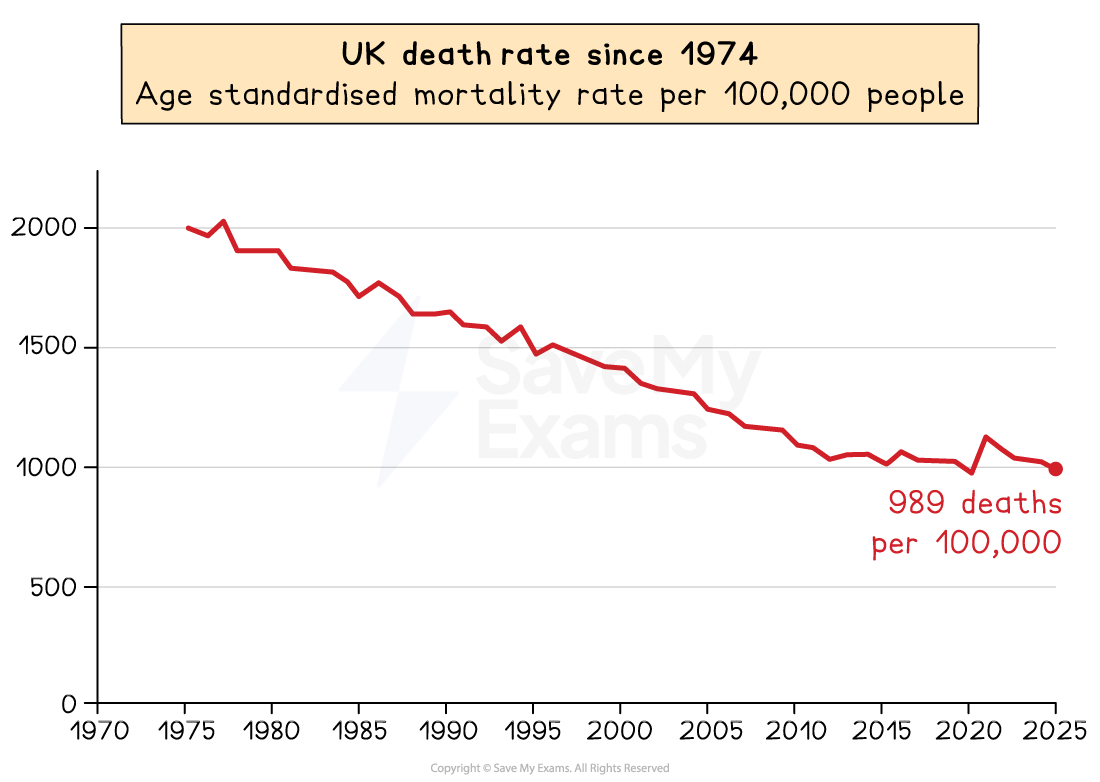
One reason for population growth in the UK is the declining death rate
Trends in the UK since 1900:
The death rate has declined
In 1900, the UK death rate was approximately 19 per 1,000
By 2019, the rate had fallen to 9.1 per 1,000
This decline has contributed significantly to the ageing population in the UK
Life expectancy
Life expectancy is defined as
the average number of years a person born in a given year can expect to live
Trends in the UK since 1900:
Life expectancy has increased
Males born in 1900 could expect to live until around 50 years
Females born in 1900 had an average life expectancy of about 57 years
By 2023, according to the ONS (2025):
Males could expect to live to 78.8 years
Females could live up to 82.8 years
Class, gender, and regional differences
Working-class men are three times more likely to die before the age of 65 than men in professional jobs
People living in the north of England and Scotland have lower life expectancy than those in the south
Women generally live longer than men, but the gender gap is narrowing due to changes in lifestyle, such as women’s increasing involvement in paid work and smoking
Reasons for the decline in death rate and increase in life expectancy
Sociologists have identified several key factors that explain the long-term decline in death rates and the significant rise in life expectancy in the UK since the 19th century
Improved living standards & nutrition
According to McKeown (1976), better nutrition accounts for up to half of the reduction in death rates from 1850 to 1970
Wage rises have lifted people out of poverty so they can afford better housing and more nutritional food
Stronger immune systems made people more resistant to infectious diseases
Although it is difficult to explain why females, who generally receive a smaller share of the family food supply, live longer than males
Medical improvements
From the 1950s onwards, medical advances played an increasing role in reducing death rates
These included:
development of antibiotics, vaccinations, and blood transfusions
expansion of maternity care and specialist treatments
The founding of the NHS in 1948 provided universal access to free healthcare, contributing to a steady improvement in public health
Public health measures
Government-led initiatives in the 20th century significantly improved the physical environment:
Better housing, public sanitation systems, and improved drainage and waste disposal
Clean water supplies reduced waterborne illnesses like cholera
Legislation such as the Clean Air Act reduced pollution and respiratory diseases
Improved education and lifestyle
Greater public awareness of hygiene, health, and disease prevention has led to widespread adoption of healthier lifestyles
People became more aware of the risks of:
poor diet and lack of exercise
smoking and alcohol consumption
Smoking rates have dropped dramatically:
From over 40% in the 1970s to just 11.9% in 2023 (ASH, 2024)
Although obesity rates have increased, medical treatments and drug therapies have helped reduce obesity-related deaths
Other social changes
Introduction of the Welfare State ensured support for vulnerable groups:
Access to free healthcare, disability benefits, and pensions for the elderly and sick
Decline in dangerous manual labour reduced workplace-related deaths
Smaller family sizes improved home hygiene and reduced the spread of infections
Implications of a declining death rate and rising life expectancy
As death rates have fallen and life expectancy has risen since 1900, sociologists have identified several key impacts on family life, population structure, and social policy
These overlap closely with the consequences of an ageing population
Family structure
People are living longer, so more generations of a family are alive at the same time
This has contributed to the rise of the beanpole family
Longer life expectancy also creates a 'sandwich' generation
Grandparents are alive for longer and often provide childcare, supporting dual-earner families and strengthening intergenerational bonds
Family diversity
Rising life expectancy has increased the number of one-person pensioner households, as people live on alone after a partner dies
These households are mainly women, who tend to live longer than men
Chambers (2012) calls this the 'feminisation of later life'
This adds to family diversity but can also lead to social isolation for some older people
The dependency ratio
The dependency ratio refers to the relationship between the working-age population and the non-working dependent population (children and retirees)
As more people survive into old age, the proportion of elderly dependents rises, increasing the burden on the working-age population
Families (often women) may take on the unpaid care of elderly relatives
Public services & policies
An ageing population increases demand for healthcare, social care, and pension provision
Hirsch (2005) argues this presents major policy challenges, such as funding pensions and adapting housing to the needs of older people
In response, the state has raised the pension age
Evaluation
Blaikie (1999) offers a more positive view, arguing that many older people are now healthy, financially independent and active
He describes this as a 'third age' of leisure and consumption, rather than a period of decline and dependency
However, Pilcher (1995) highlights that old age can deepen inequality
Working-class and female pensioners often have lower incomes and life expectancy than middle-class men
Therefore the benefits of a longer life are not shared equally

Unlock more, it's free!
Join the 100,000+ Students that ❤️ Save My Exams
the (exam) results speak for themselves:

Was this revision note helpful?
Build on this topic