Standard Deviation (OCR AS Biology): Revision Note
Exam code: H020

Standard Deviation
Mean
A mean value is what is usually meant when the term “average” is used in biology
Mean = sum of all measurements ÷ number of measurements
Problems with the mean occur when there are one or two unusually high (or low) values in the data (outliers) which can make the mean too high (or too low) to reflect any patterns in the data
The mean is sometimes referred to as X̄ in calculations
Standard Deviation
The mean is a more informative statistic when it is provided alongside the standard deviation
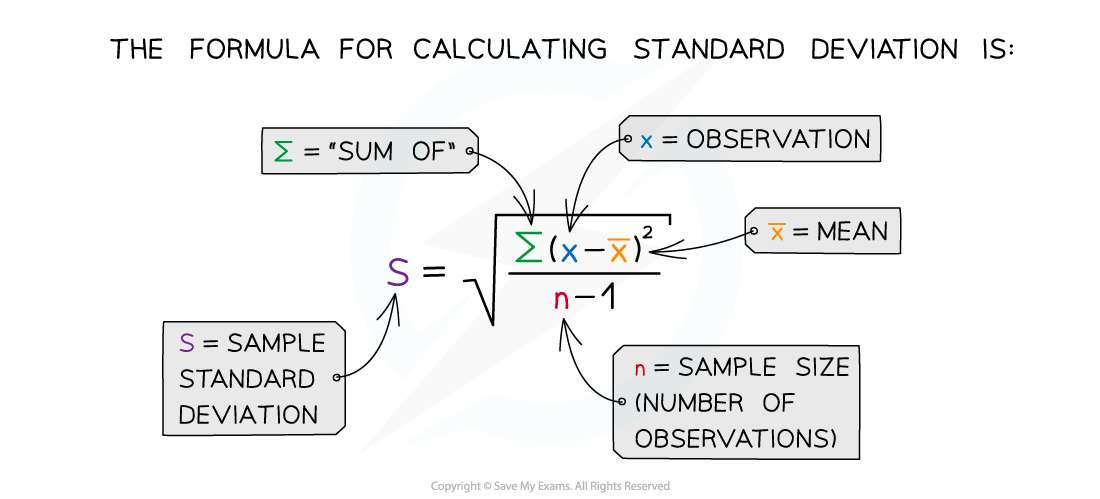
Standard deviation measures the spread of data around the mean value
It is very useful when comparing consistency between different data sets
The mean must be calculated before working out the standard deviation
Worked Example
15 rats were timed how long it took them to reach the end of a maze puzzle. Their times, in seconds, are given below. Find the mean time.
12, 10, 15, 14, 17,
11, 12, 13, 9, 21,
14, 20, 19, 16, 23
Answer:
Step 1: Calculate the mean
12 + 10 + 15 + 14 + 17 + 11 + 12 + 13 + 9 + 21 + 14 + 20 + 19 + 16 + 23 = 226
226 ÷ 15 = 15.067
Step 2: Round to 3 significant figures
Mean (X̄) = 15.1 seconds
Worked Example
The ear lengths of a population of rabbits were measured.Ear lengths (mm): 62, 60, 59, 61, 60, 58, 59, 60, 57, 56, 59, 58, 60, 59, 57Calculate the mean and standard deviation.
Answer:
Step 1: Calculate the mean
Mean = 885 ÷ 15 = 59 mm
Step 2: Find the difference between each value and the mean
Subtract the mean from each value to find the difference
Example: 62 - 59 = 3
Step 3: Square each difference
Square the difference for each value
Example: 32 = 9
Step 4: Total the differences
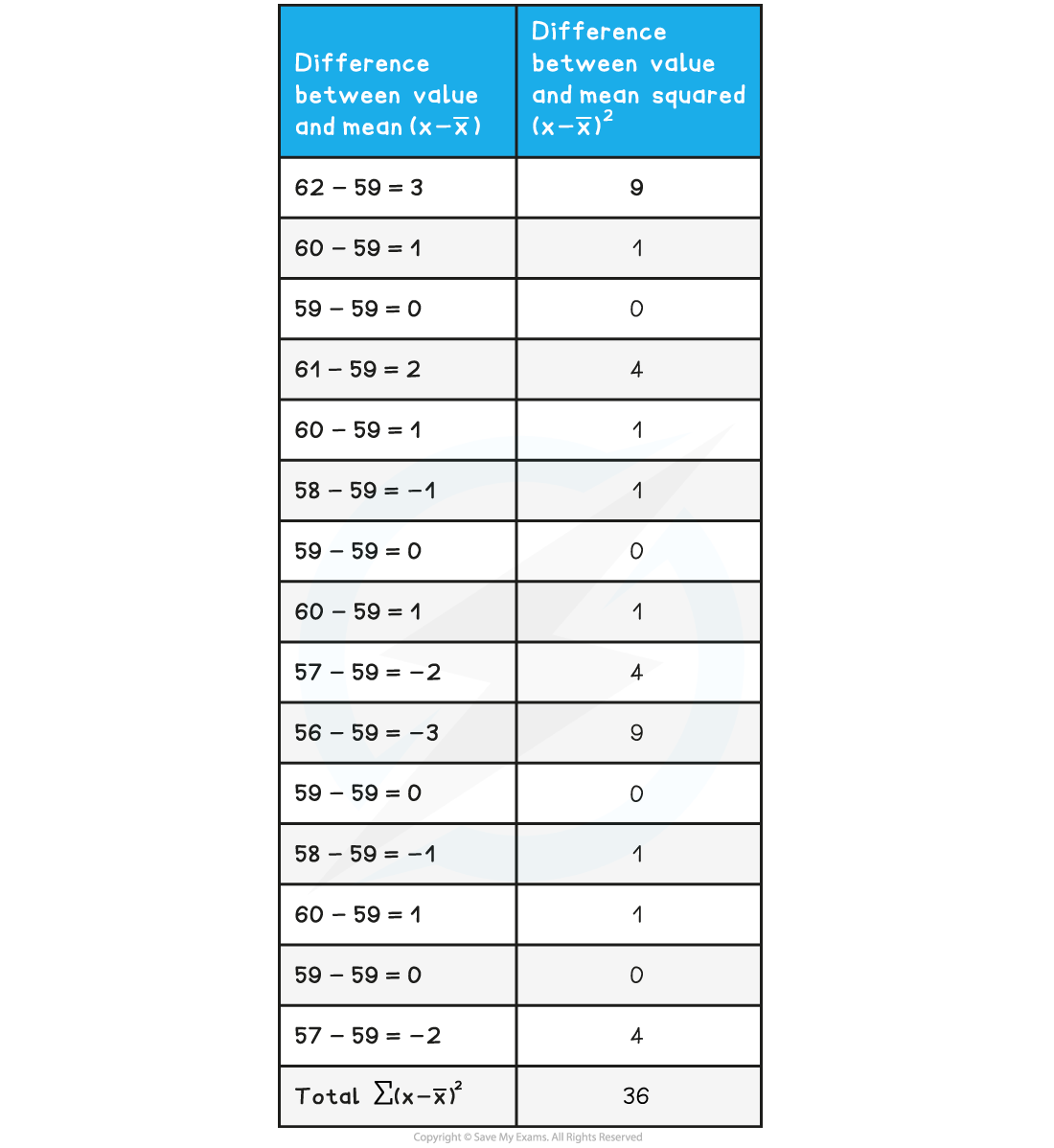
Step 5: Divide the total by (n-1) to get value A
36 ÷ (15 - 1) = 36 ÷ 14 = 2.571
Step 6: Get the square root of value A

Standard Deviation = 1.60
Examiner Tips and Tricks
Constructing a table like the one above can help you to keep track of all your calculations during the exam!

Unlock more, it's free!
Join the 100,000+ Students that ❤️ Save My Exams
the (exam) results speak for themselves:

Was this revision note helpful?
Build on this topic